


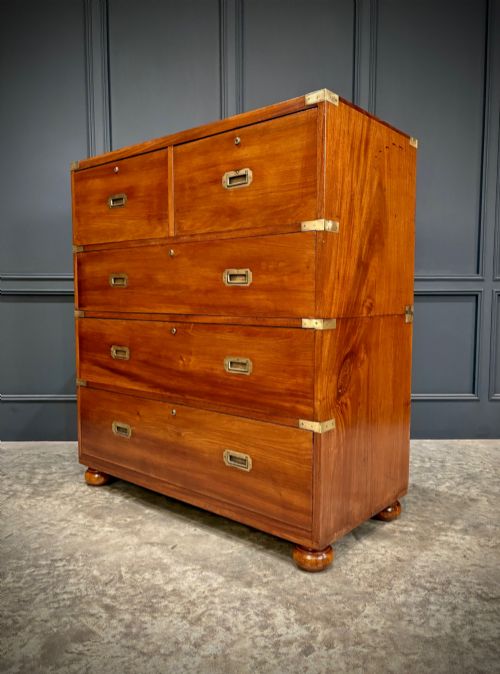


Split Campaign Drawers
Split campaign drawers are two-part modular chests built for travel, prized for their rugged construction and clever configuration.
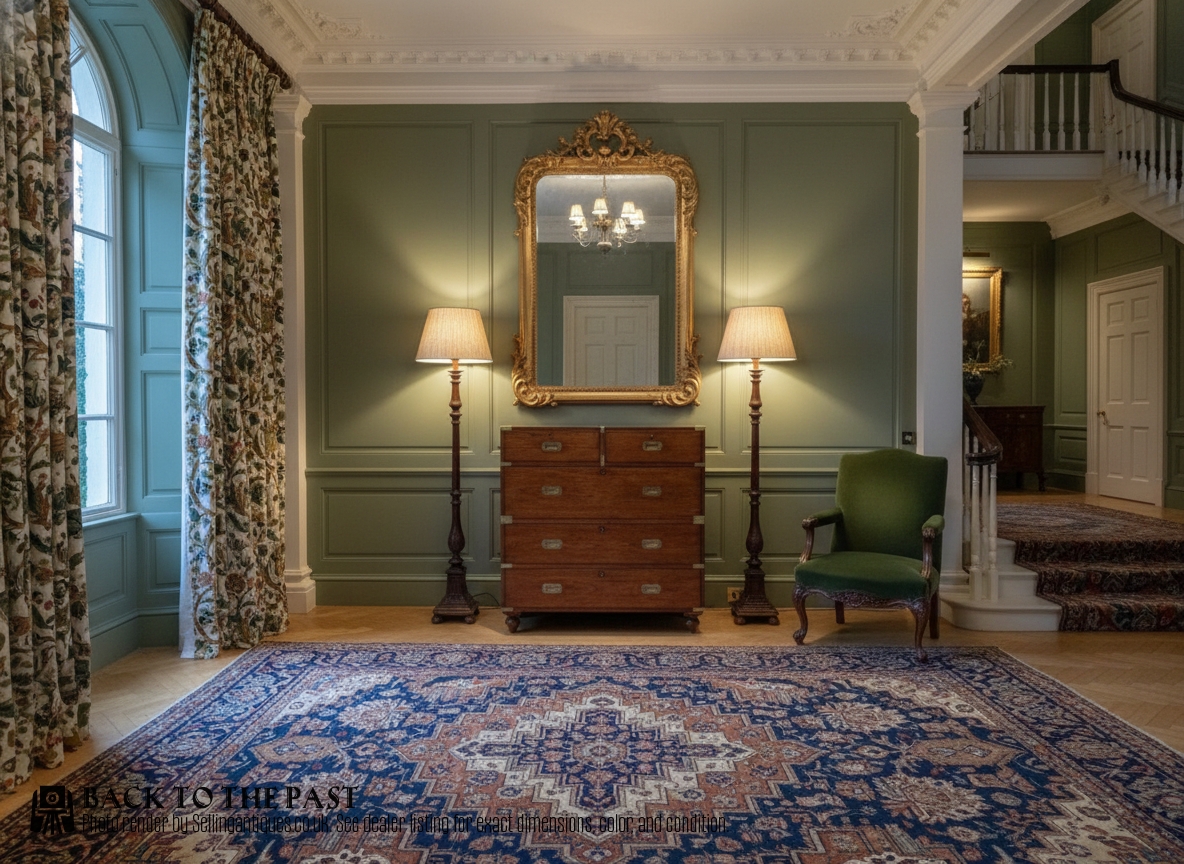
Split Campaign Drawers
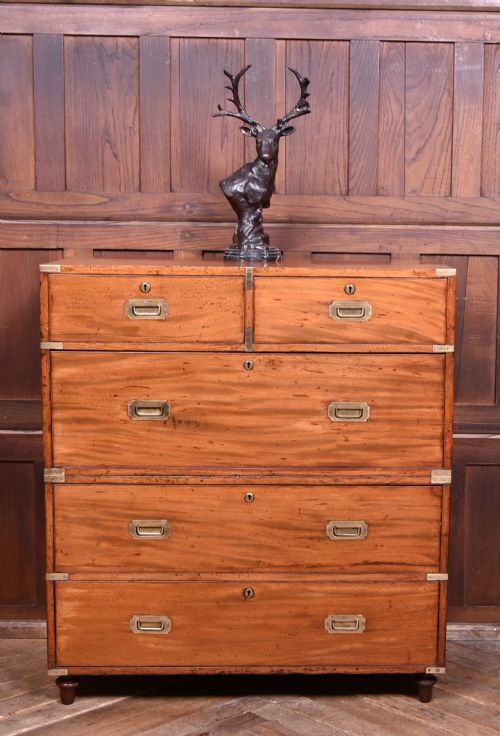
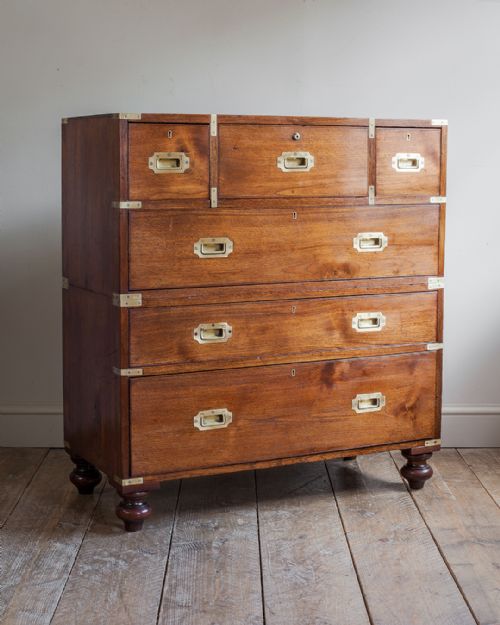
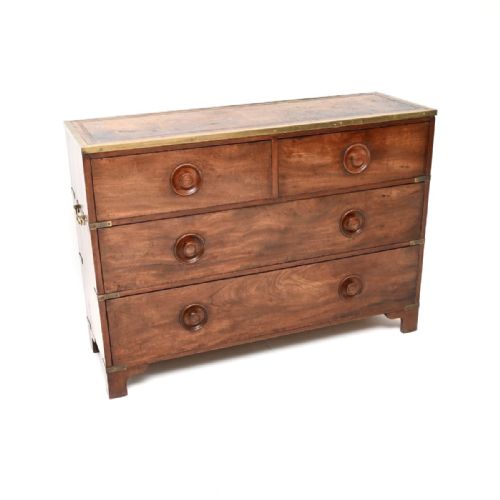
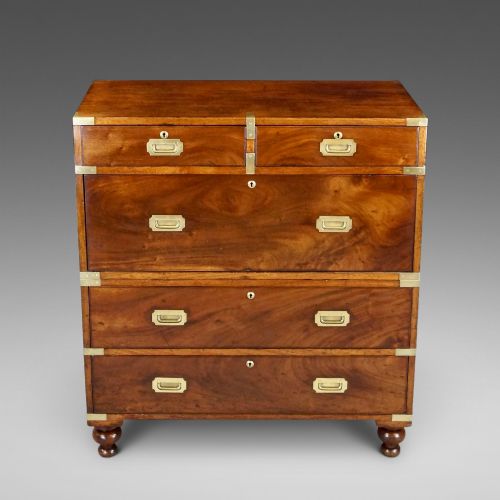
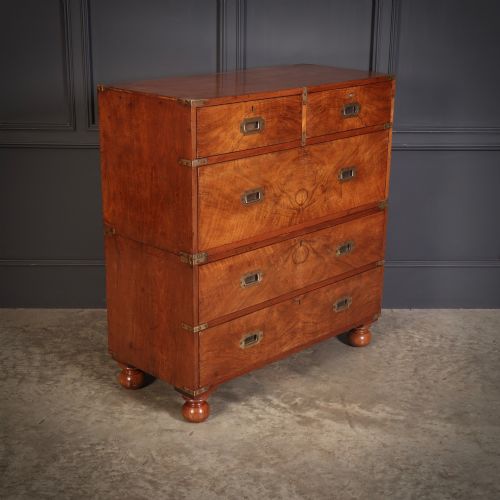
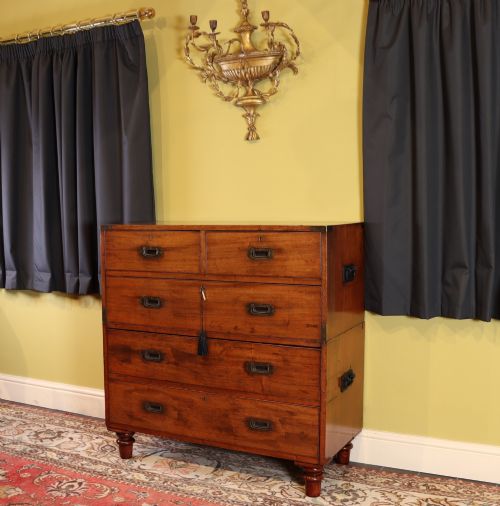
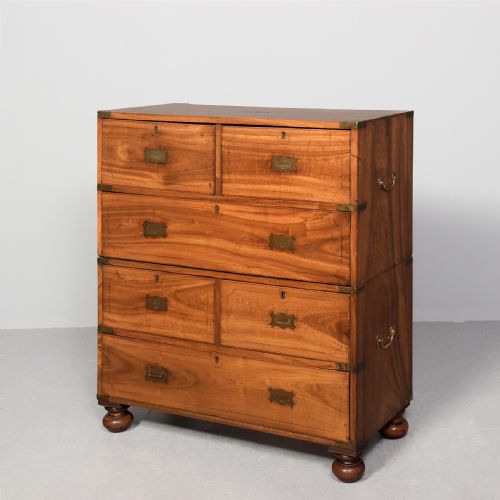
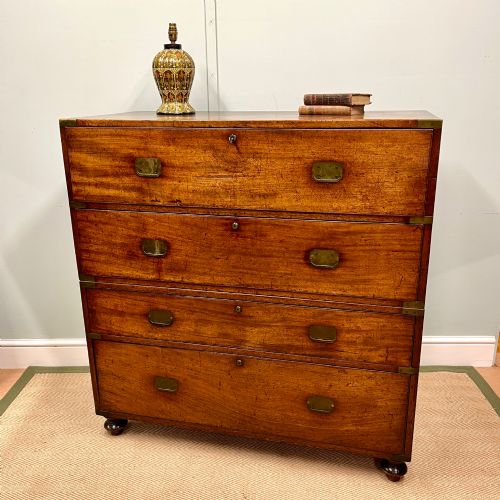
Split campaign drawers comprise modular chests of drawers constructed in two separate sections to facilitate transport during military deployment and colonial travel. The pieces on this page span the Georgian, Victorian, and early twentieth-century eras, reflecting decades of utilitarian design.
Most examples appear as chests of drawers or secretaire chests configured in stacked halves, secured with heavy brass corners and side carrying handles. Mahogany, teak, and camphor wood dominate the forms, originating from British workshops and colonial trade routes alike.
How they were made
Cabinetmakers utilised dense timbers such as mahogany, teak, padouk, and camphor wood to withstand tropical climates and rigorous transit. These woods were joined using tight dovetail joints and reinforced with inset brass straps and flush-fitting pull handles.
The split construction relies on a sturdy frame split horizontally into two matching sections, allowing officers to pack and move their belongings with ease. Secretarial fittings, when present, incorporate internal drawers and writing surfaces integrated seamlessly into the upper carcass.
Listings feature woods including mahogany, teak, camphor wood, walnut, oak, padouk, and cedar wood.
What varies in quality
Quality rests upon the selection of timber and the precision of the brass hardware fittings. Finely figured walnut, solid camphor wood, and rich padouk distinguish the finer pieces from standard utilitarian mahogany and oak.
The integration of the internal secretaire drawer and the crispness of the dovetailing show the hand of a skilled maker. Original recessed brass handles and intact carrying hardware elevate the integrity of the chest.
S. W. Silver & Co. London & Liverpool·Army & Navy
The Split Campaign Drawers Glossary
- Secretaire chest
- A chest of drawers featuring a pull-down writing drawer that conceals smaller pigeonholes and stationary compartments. This fitted desk section usually sits within the upper tier of the two-part carcass.
- Two-part design
- A cabinet structure divided horizontally into distinct upper and lower sections for ease of movement. The separate boxes lock together securely during use.
- Brass-bound
- A technique where flush brass corners and straps are fastened to the exterior edges of the timber to protect against impact during travel. These metal strips anchor the structure firmly.
- Campaign hardware
- Recessed brass handles and flush drawer pulls designed to sit level with the wood surface so nothing catches in transit. These fittings are characteristic of military furniture.
- Chinese Export
- Furniture manufactured in treaty ports such as Canton for Western markets, frequently utilising camphor wood for its insect-repellent properties. These pieces combine British forms with local woodworking traditions.
Split Campaign Drawers: Frequently Asked Questions
Why were these chests made in two parts?
The split construction allowed British military officers and colonial administrators to pack their personal belongings into manageable loads for transport on pack animals, wagons, and ships.
Each half of the chest was fitted with side carrying handles, making it straightforward to lift and stow during active campaigns.
What is a secretaire campaign chest?
A secretaire campaign chest includes a pull-down front on one of the upper drawers, revealing a fitted writing surface and small pigeonholes inside. This gave officers a portable desk while on active service.
The drop-front locks securely just like a standard drawer when not in use.
How do I identify camphor wood chests?
Camphor wood chests have a distinct aromatic scent and a pale grain that darkens gracefully over time. Cabinetmakers favoured this timber in colonial regions to protect uniforms and papers from insects and humidity.
These pieces often feature sturdy brass binding and robust construction typical of Anglo-Chinese trade.
Are these chests suitable for modern homes?
The modular two-part design makes these chests adaptable for placement in bedrooms, hallways, or studies where storage is required. Their shallow depths and flat tops fit well against walls without dominating a room.
The separate sections also simplify moving the furniture between rooms or homes.
How can I tell the period of a campaign chest?
Dating relies on the choice of timber, the style of the brass hardware, and the construction methods used inside the drawers. Georgian and early Victorian examples tend to feature hand-cut dovetails and warm mahogany or walnut.
Later Victorian pieces frequently utilise teak or camphor wood with standardised recessed brass mounts.