
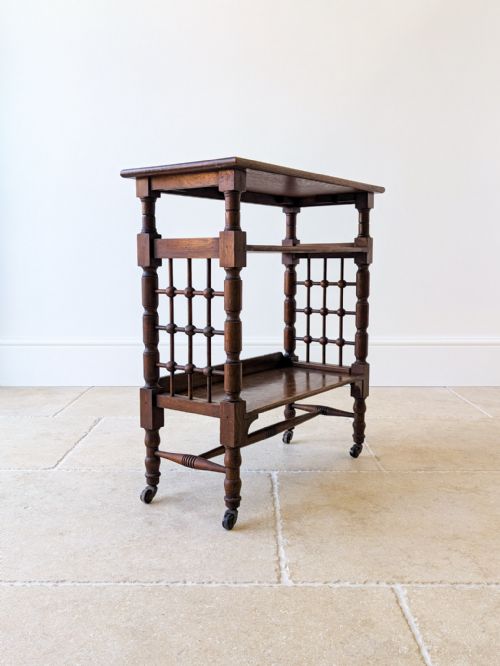
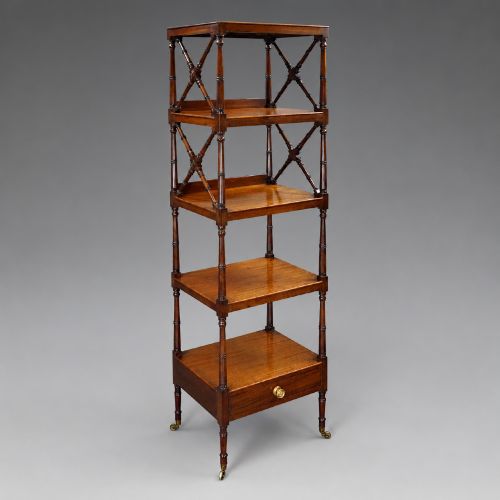
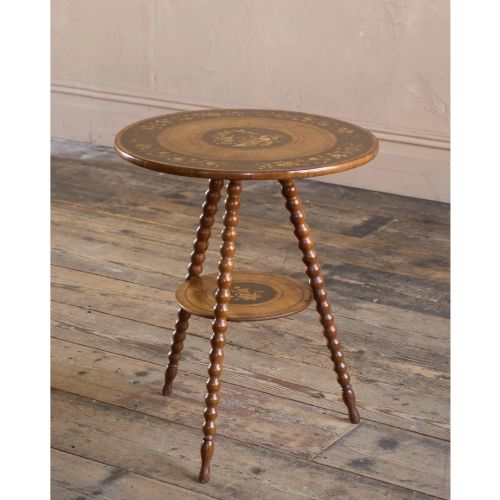
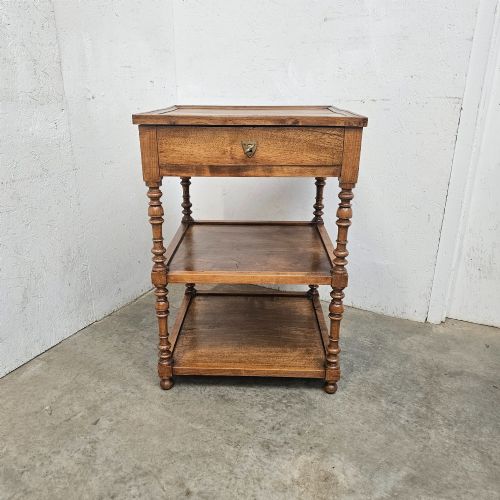


Spindle Tier Side Table
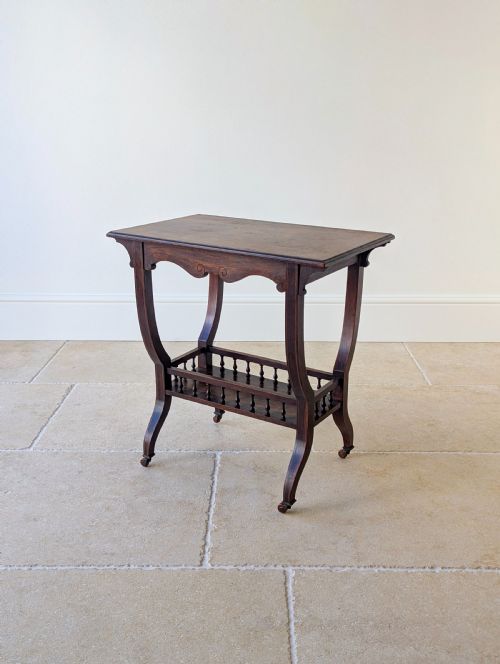
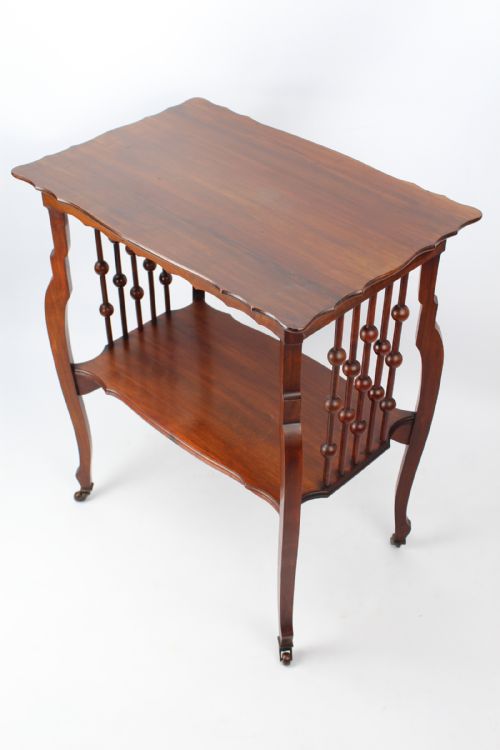
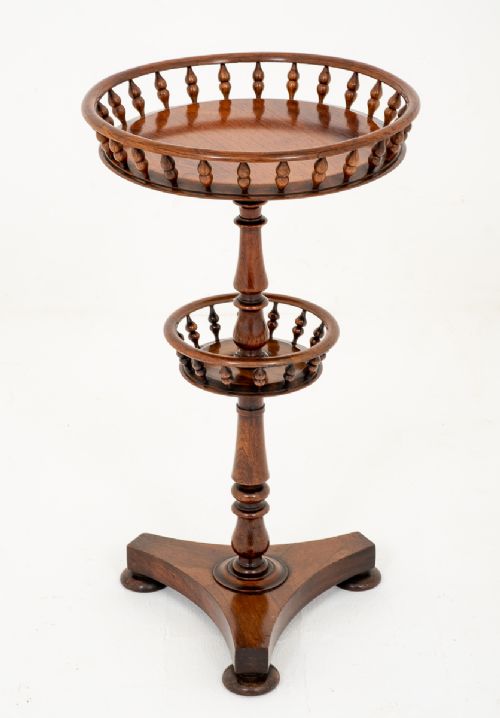
These spindle tier side table examples combine stacked display surfaces with turned uprights, offering versatile multi-level storage for compact spaces.
Spindle Tier Side Table
A spindle tier side table brings together multi-level surfaces and slender turned supports, commonly appearing across the Victorian, Edwardian, and Georgian periods. These pieces function as occasional tables, small whatnots, and etageres for holding books or decorative objects.
The selections available here range from George III designs through to Aesthetic Movement and Arts and Crafts interpretations. Buyers most frequently encounter two-tier and multi-tier formats constructed from walnut, mahogany, and rosewood.
How they were made
Construction relies heavily on dense timbers such as mahogany, walnut, and rosewood, often enhanced with contrasting veneers, boxwood stringing, and marquetry inlay. Turned uprights and bobbin legs require precise lathe work to create the slender spindles characteristic of these tiered forms.
Joinery techniques combine traditional cabinet-making methods for the shelves with secure tenon or dowel connections for the vertical supports. Surface decoration frequently incorporates polished wood finishes that highlight the natural grain patterns of the primary timbers.
Listings feature pieces spanning the Georgian, Victorian, and Edwardian periods, constructed primarily in walnut, mahogany, and rosewood.
What varies in quality
Quality separates pieces through the crispness of the turning on the spindles and the structural integrity of the stacked tiers. Finer examples display meticulous attention to timber selection, particularly in matched veneer panels and precise marquetry or inlay work.
Proportion and balance dictate the overall success of the piece, where lighter framing and tighter joints distinguish superior cabinet-making from heavier or more utilitarian workshop production.
The Spindle Tier Side Table Glossary
- Tier
- A single level within a stacked structure or shelving unit. Multiple surfaces allow for organised display and storage.
- Spindle
- A slender, turned wooden rod used as a vertical support between tiers. These elements provide structural separation while maintaining a light visual profile.
- Whatnot
- An open piece of furniture featuring multiple shelves for displaying ornaments or books. These develop out of the desire for accessible tiered storage.
- Marquetry
- The art of applying decorative veneer pieces to a structure to form intricate patterns. Craftsmen utilise various coloured woods to create pictorial or geometric designs.
- Etagere
- A piece of furniture consisting of a set of open shelves for display. Originating in France, this form emphasises vertical stacking.
- Bobbin leg
- A furniture leg turned on a lathe to resemble a string of beads or bobbins. This decorative turning style appears frequently on late nineteenth-century tables.
Spindle Tier Side Table: Frequently Asked Questions
What is a spindle tier side table used for?
These tables provide compact surface space for lamps, books, and decorative items across multiple levels. Their tiered design maximises display area while occupying a minimal footprint in sitting rooms.
They serve as practical occasional furniture beside seating or in hallways. The raised shelves keep smaller objects organised and accessible.
How do I date a spindle tier side table?
Dating relies on observing the timber species, decorative motifs, and turning styles present in the construction. Georgian and early pieces show different proportions compared to later Victorian and Edwardian examples.
Examine the secondary woods, joining techniques, and inlay patterns for period-specific characteristics. Finer details like bobbin legs or marquetry point directly to late nineteenth-century aesthetic movements.
Are these tables sturdy enough for daily use?
Solid timber construction and properly joined tiers ensure these tables handle everyday placement of lamps and decorative objects. The multiple vertical spindles distribute weight across the lower shelves.
Heavier items belong on the main surface, while upper tiers suit lighter books or ornaments. Careful placement prevents strain on the slender turned supports.
What woods were used to make these tables?
Cabinet-makers predominantly utilised dense hardwoods such as mahogany, walnut, and rosewood for their durability and rich grain. Inlaid sections frequently incorporate lighter materials like boxwood.
Some examples feature decorative veneers applied to stable base timbers. These choices reflect the stylistic preferences of the Victorian and Edwardian eras.