


Solid Mahogany Accent Chairs
Solid mahogany accent chairs bring architectural presence to a room through sculptural timber forms shaped in the Georgian, Regency and Victorian periods.

Solid Mahogany Accent Chairs
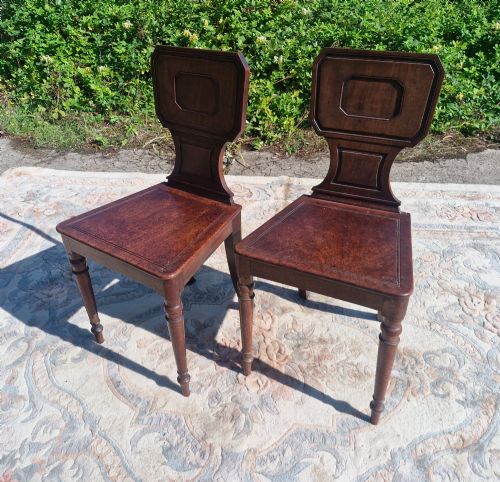
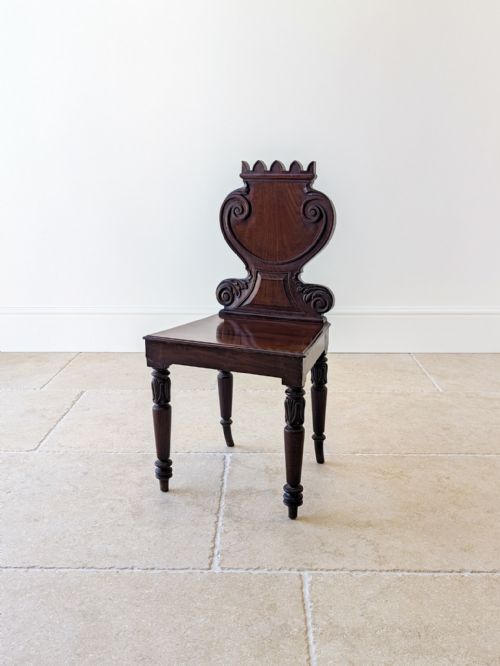
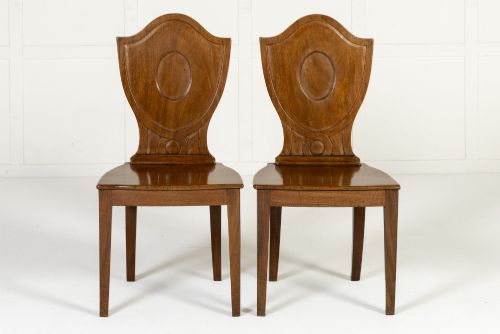
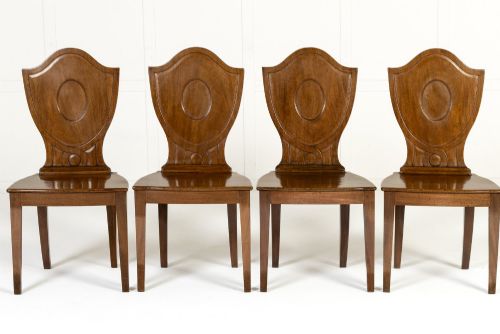
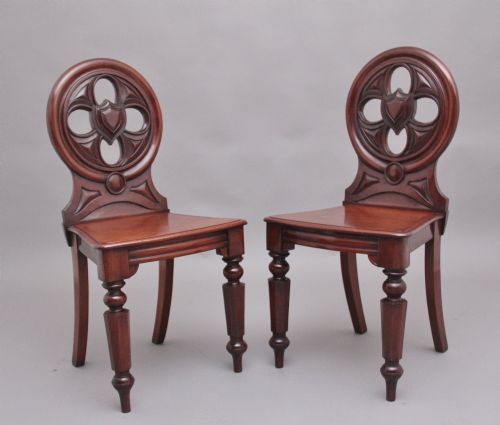
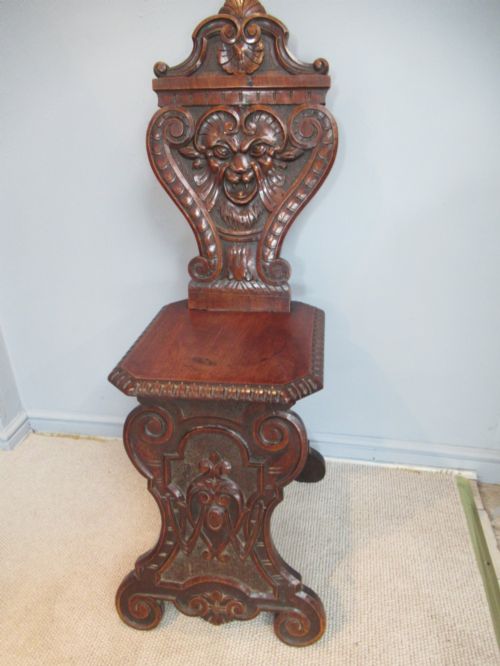
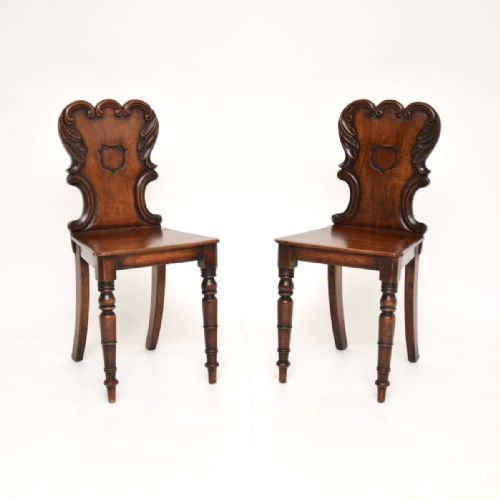
Solid mahogany accent chairs encompass primarily hall chairs and occasional side chairs fashioned from dense hardwood. These seating pieces appear frequently in pairs or sets from the Georgian, Regency and Victorian eras, often displaying carved shield, oval or shell back designs.
The selections found here draw heavily on nineteenth-century British cabinet-making traditions, alongside occasional examples from American and Chinese workshops. Makers such as Gillows and Holland & Sons contribute to the historical lineage of these sturdy timber forms.
Materials and construction
Construction relies upon solid mahogany and dense hardwood timber, selected for its tensile strength and deep grain. Workshops utilised seasoned wood to shape rigid frames capable of sustaining elaborate hand-carved backrests.
Joinery methods integrate traditional pegged and glued joints, occasionally supplemented by applied paint or brass elements. Carving defines the surface detail, particularly on shield backs, pelta backs and shell motifs.
Early nineteenth-century guests sat on solid wood because deep upholstery was deemed unsuitable for waiting in a drafty entrance hall.
Distinctions in craftsmanship
Quality rests upon the crispness of the hand-carving and the thickness of the solid mahogany used in the backplate. Superior examples exhibit deep, clean relief work on shell or pelta backs without softness in the edges.
Structural integrity and timber selection further separate standard pieces from exceptional ones. Denser grain patterns and well-preserved original timber finishes indicate higher-tier workshop output.
Gillows·Holland & Sons
The Solid Mahogany Accent Chairs Glossary
- Hall chair
- A rigid wooden seat traditionally placed in an entrance hall, rarely padded and often featuring a carved solid timber back. These chairs functioned largely for brief waiting or as decorative statements of status.
- Pelta back
- A chair back shaped in the form of a classical shield or crescent, popular during the Regency period. This architectural silhouette draws from ancient Greek and Roman design motifs.
- Shell back
- A carved wooden backrest formed in the likeness of a scallop shell, frequently seen on early nineteenth-century seating. Carvers rendered the fluted ridges directly into the solid mahogany.
- Regency
- An English design period spanning the early nineteenth century, characterised by classical restraint and archaeological revival styles. Furniture from this era often incorporates bold timber grain and sculptural outlines.
Solid Mahogany Accent Chairs: Frequently Asked Questions
Where were these chairs placed originally?
These pieces stood in grand entrance halls and corridors rather than private sitting rooms. Guests and visitors utilised them for brief moments while waiting to be announced.
Their upright wooden construction discouraged lingering, keeping hallways clear while displaying the homeowner's taste through carved mahogany.
How do I distinguish Regency from Victorian examples?
Regency models tend to feature clean classical lines, restrained proportions and sharp neoclassical carving. They reflect an earlier nineteenth-century taste for ancient Greek and Roman forms.
Victorian pieces often display heavier proportions, more exuberant carving, and sometimes gothic or aesthetic movement influences. The timber remains solid mahogany across both periods, but the ornamentation shifts.
Are these seats comfortable for daily use?
Solid mahogany hall chairs were engineered for posture and visual impact rather than long periods of lounging. Their wooden seats and upright backs make them better suited as accent pieces in hallways or corners.
Owners typically place them where sculptural presence matters more than deep cushioning, though they function adequately as occasional side seating.
Why are many of these offered in pairs?
Georgian and Victorian interior design favoured symmetry, leading makers to construct hall chairs in matched pairs or larger sets for flanking doorways and walls.
Displaying matching pieces preserves the architectural balance intended by the original cabinet-makers who placed them symmetrically in grand spaces.