
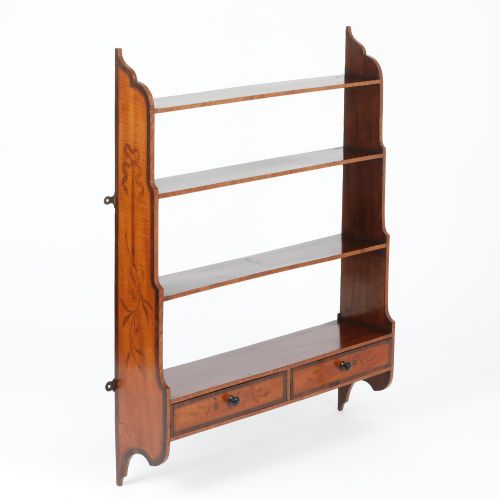


Small Wooden Wall Unit
A small wooden wall unit is a compact storage piece designed to mount directly onto a room partition, saving floor space while displaying books or treasured objects.
Small Wooden Wall Unit
A small wooden wall unit takes the form of hanging bookshelves, wall cabinets, corner cupboards, or plate racks mounted directly onto vertical surfaces. These compact furnishings solve storage needs in rooms where floor space remains at a premium.
The selections on this page span several eras, including the eighteenth century, the Victorian period, and the nineteen-thirties. Pieces range from straightforward oak plate racks to elaborate satinwood and mahogany waterfall shelves.
Buyers frequently encounter variations like Victorian mahogany bookcases, Arts and Crafts wall cupboards, and Cotswold School oak corner cabinets. Each piece brings specific period character to a modern interior.
How they were made
Construction relies heavily on traditional timber selection, employing oak, mahogany, satinwood, limewood, ebonised wood, and pine. Cabinetmakers often incorporated brass hardware and glass panels to complement the primary wooden frames.
Execution varies from the refined joinery seen in eighteenth-century satinwood pieces to the robust construction of nineteenth-century Victorian pine and Edwardian art deco designs. Craftsmen utilised hanging brackets and structural cornices to ensure secure wall mounting.
Listings feature woods including oak, mahogany, satinwood, limewood, ebonised wood, and pine, alongside glass and brass elements.
What varies in quality
Quality rests upon the selection of timber figures, such as the grain in satinwood and mahogany, and the precision of the joinery. Superior examples display thoughtful proportions and harmonious decorative details that elevate standard utilitarian storage into fine furniture.
The distinction between ordinary and exceptional pieces lies in the integrity of the original construction and the subtlety of period stylistic touches, whether executed in a Chippendale Revival mode or a clean Arts and Crafts aesthetic.
The Small Wooden Wall Unit Glossary
- Waterfall bookshelves
- A set of open shelves that steps back progressively from bottom to top, creating a cascading profile often utilised in eighteenth-century and later designs.
- Corner cupboard
- A triangular cabinet specifically constructed to fit neatly into the ninety-degree angle of a room, maximising unused space.
- Plate rack
- A wall-mounted rack featuring horizontal slats or grooves designed to hold dinner plates upright for display and drying.
- Chippendale Revival
- A nineteenth-century style that reinterprets the mid-eighteenth-century designs associated with Thomas Chippendale, featuring characteristic carved details.
- Cotswold School
- An early twentieth-century design movement centred in the Cotswolds that emphasised honest construction and traditional hand-working methods, particularly in oak.
Small Wooden Wall Unit: Frequently Asked Questions
Can I put a corner cupboard in any room?
Corner cupboards adapt well to dining rooms, hallways, and studies where unused corners benefit from enclosed storage. Their triangular footprint allows them to occupy awkward spaces without obstructing walkways.
Measure the exact wall angles of your room beforehand, as older houses often feature irregular corners that require careful placement.
How do I clean wooden wall shelves?
Dust the surfaces regularly with a soft, dry cloth to prevent dirt accumulation on polished oak or mahogany. Avoid harsh chemical sprays that can strip the historic finish or dry out the timber.
Apply a microcrystalline wax periodically to nourish the wood and maintain a gentle sheen appropriate for antique furniture.
How do I tell an 18th-century piece from a Victorian one?
Eighteenth-century pieces often utilise lighter exotic timbers like satinwood alongside mahogany, showing refined proportions and hand-cut joinery details. Victorian iterations tend to be heavier in build, frequently employing dense pine, dark mahogany, or Gothic-inspired carving.
Examining the construction marks, timber shrinkage, and hardware fixings helps determine the manufacturing era of the cabinet.