
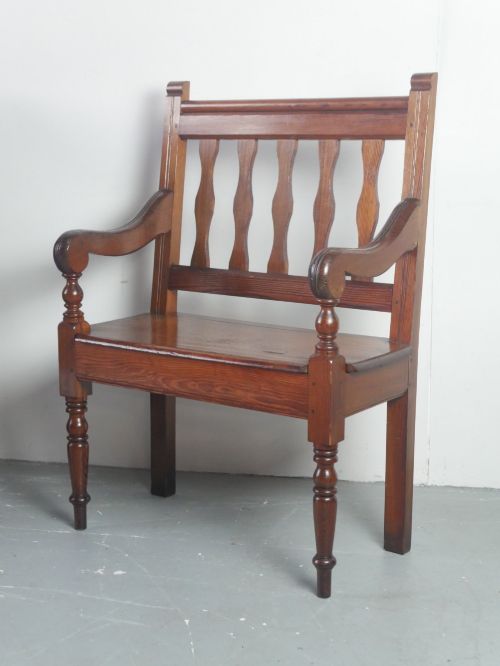
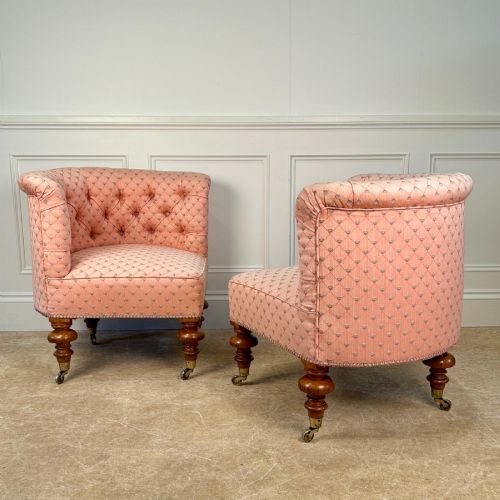


Small Victorian Armchair
A small victorian armchair brings the comfort of the nineteenth century into compact rooms through scaled-down proportions and traditional upholstery.
Small Victorian Armchair
When you search for a small victorian armchair, you encounter compact seating designed across the nineteenth century, ranging from low nursery chairs to button-backed tub chairs and occasional seats.
The pieces listed on this page span the Victorian period alongside earlier Regency influences and later stylistic revivals, taking forms such as bedroom chairs, library chairs, and low rocking chairs.
You are most likely to meet mahogany or walnut frames upholstered in velvet or fabric, alongside country variants constructed in oak, elm, or beech.
How they were made
Cabinetmakers constructed the wooden frames using solid timbers such as mahogany, rosewood, oak, elm, and beech, often incorporating turned or carved cabriole legs and supportive armrests.
Upholsterers built up the seats and backs using traditional stuffing and springs, securing the final layer with fabrics including velvet, corduroy, and patterned textiles.
Details such as brass castors, iron framing, and stamped maker marks reveal the specific workshop origins and functional adaptations of each individual seat.
Some chairs fold for travel, proving that Victorian Victorians took their comfort on the road.
What varies in quality
The distinction between tiers rests upon the choice of timber and the precision of the frame carving, where dense mahogany or rosewood commands greater presence than simpler beech or elm country variants.
Interiors show variation through the integrity of the original upholstery structure, the retention of maker stamps, and whether the frame maintains its rigid joinery without excessive restoration.
Howard and Sons
The Small Victorian Armchair Glossary
- Bergere chair
- An upholstered armchair characterised by a panel of woven cane forming the back or sides. This traditional technique lightens the visual weight of the frame.
- Tub armchair
- A comfortable seat with a curved, enclosing back that flows continuously into the arms. It offers a snug profile suited to smaller spaces.
- Nursing chair
- A low-seated Victorian armchair designed without high arms to facilitate the holding and feeding of infants. These chairs often feature button-backed upholstery.
- Crinoline stretcher
- A curved under-framing brace found on Windsor chairs that resembles a hoop skirt. It provides lateral stability to the legs.
- Wainscot chair
- An early form of wooden armchair constructed with panelled backs and solid timber seats. It reflects seventeenth-century vernacular joinery.
Small Victorian Armchair: Frequently Asked Questions
Where were small Victorian armchairs used?
These compact seats were traditionally placed in bedrooms, dressing rooms, and intimate parlour spaces where full-sized armchairs would overwhelm the room. Their reduced dimensions made them practical for fireside sitting.
Today, they serve the same purpose in modern homes, fitting neatly into reading corners or smaller living rooms without dominating the floor plan.
How do I identify a Victorian armchair?
Look for characteristic timber choices like mahogany and rosewood, alongside button-backed upholstery and turned wooden legs fitted with brass castors. Stylistic details often reflect nineteenth-century revivals.
Proportions are typically more compact than twentieth-century equivalents, reflecting the domestic scaling of the Victorian period.
Are these chairs suitable for daily use?
Many of these pieces remain structurally sound and comfortable for regular seating, particularly examples constructed with sturdy hardwood frames. Much depends on the current condition of the internal webbing and padding.
Pieces requiring attention to the upholstery can be restored by a professional to ensure longevity in a modern household.
What is a nursing chair?
A nursing chair is a low-slung Victorian seat designed with a shorter distance between the floor and the cushion. The absence of high arms allowed women to sit comfortably while wearing voluminous nineteenth-century dresses.
They frequently feature sprung button-backed upholstery and decorative wooden frames.