
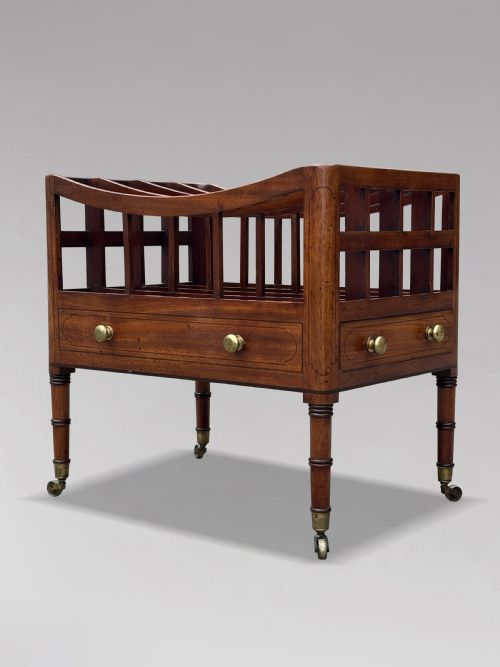


Slatted Wood Music Stand
A slatted wood music stand, known here through surviving canterburys, offers divided storage for sheets and folios in rich mahogany.
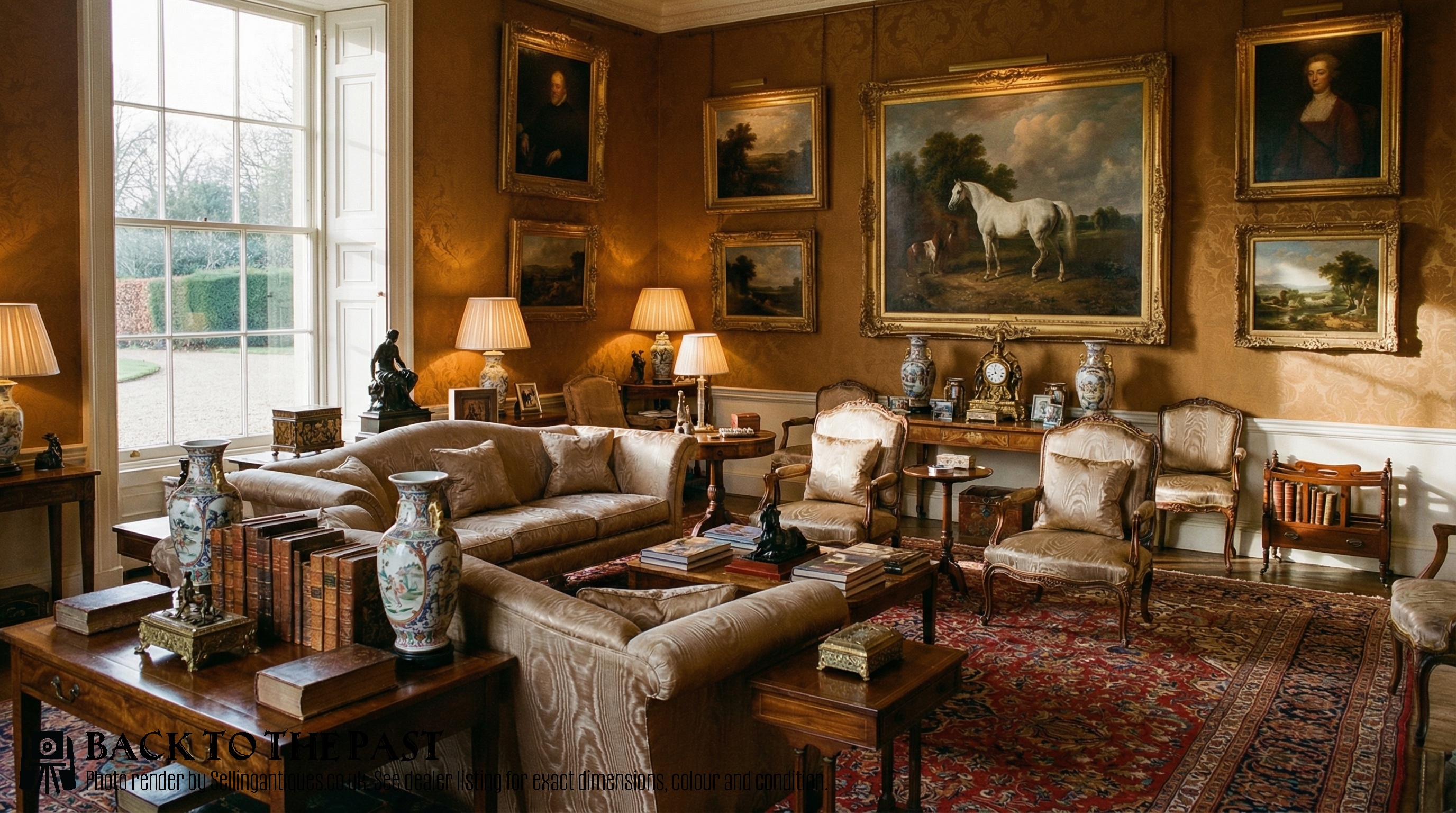
Slatted Wood Music Stand
The slatted wood music stand search leads directly to mahogany canterburys and magazine racks designed to hold folios and scores. These items appear across Georgian, Regency, George III, and George IV periods, alongside one 1930 piece.
Most examples present timber uprights forming distinct compartments above a low base, occasionally incorporating a single drawer or boat-shaped profiles.
Makers from the eighteenth and nineteenth centuries constructed these stands primarily to sit beside a piano or desk in a formal parlour.
How they were made
Cabinetmakers utilised solid mahogany timbers, shaping upright slats to form the open partitions characteristic of the form. Brass castors frequently support the base, allowing the stand to move smoothly across the floor.
Joinery techniques focus on sturdy framing to sustain the weight of heavy paper volumes without warping the delicate wooden divisions.
What varies in quality
Quality rests in the crispness of the timber grain, the elegance of the upright slat profiles, and the integration of functional drawers. Finer examples display refined turning on the supports and careful proportioning across each division.
Later reproductions or simpler twentieth-century interpretations lack the depth of patina and the precise hand-joined construction found in eighteenth-century pieces.
The Slatted Wood Music Stand Glossary
- Canterbury
- A low stand with divisions, designed for holding sheet music or books. It often includes a small drawer at the base.
- Slatted
- Composed of narrow strips of wood arranged vertically or horizontally to form an open barrier. This technique keeps the structure lightweight.
- Mahogany
- A durable tropical hardwood prized for its reddish-brown colour and smooth grain. It forms the primary material for these stands.
- Regency
- An English design style spanning the early nineteenth century, noted for classical restraint and clean architectural lines.
Slatted Wood Music Stand: Frequently Asked Questions
What is a canterbury used for?
A canterbury serves as a tidy storage holder for sheet music, folios, and loose magazines within a music room or study.
The vertical slats keep scores upright and sorted by section for easy selection during practice.
How do I date a mahogany canterbury?
Dating relies on examining the timber colour, drawer construction, and stylistic clues such as George III or Regency turning.
Earlier pieces show hand-cut joinery and dense, aged mahogany surfaces compared to later twentieth-century iterations.
Are these stands strong enough for books?
The sturdy mahogany divisions easily support standard folios and music books without straining the frame.
However, storing heavy volumes of encyclopaedias may exceed the intended capacity of delicate nineteenth-century slats.
Why do some stands have brass castors?
Small brass wheels allowed servants or musicians to reposition the stand easily beside a piano or reading desk.
Original castors remain a useful indicator of period authenticity when inspecting the base.