
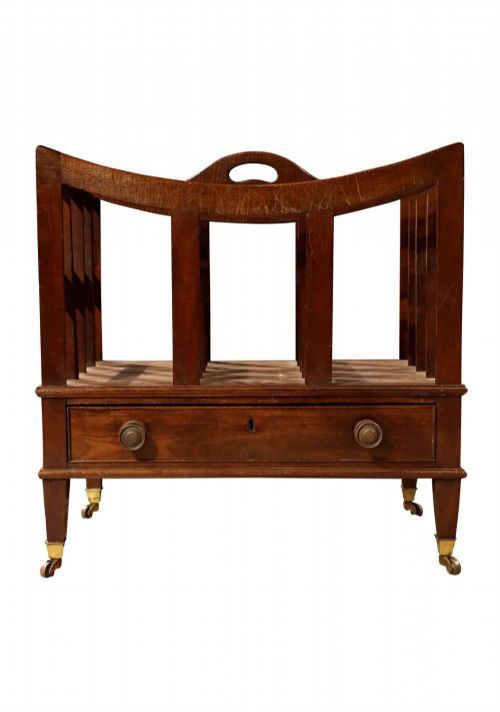


Georgian Wooden Newspaper Rack
A georgian wooden newspaper rack serves as a practical stand for papers and folios, bringing period craftsmanship into daily use.
Georgian Wooden Newspaper Rack
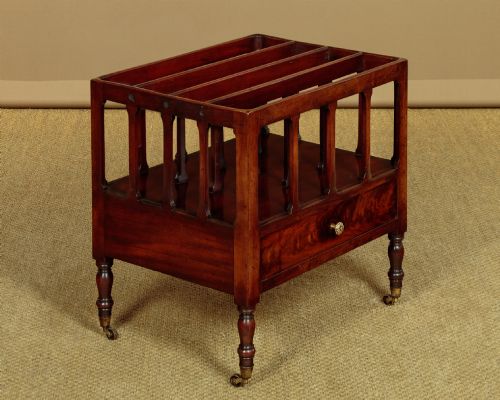
A georgian wooden newspaper rack, more commonly designated as a Canterbury in the trade, functions as a compartmentalised stand designed to hold periodicals, sheets and folios. Buyers seeking a georgian wooden newspaper rack typically encounter pieces spanning the Georgian, Regency and Victorian eras, alongside later revival examples.
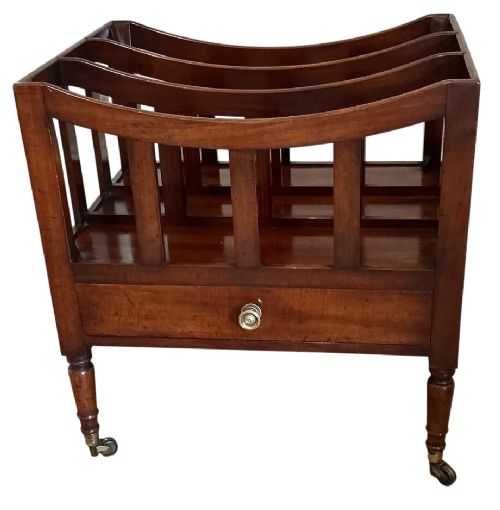
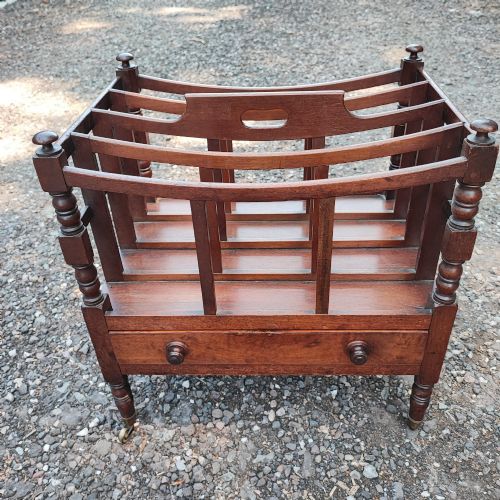
The prevailing form on this page is the Canterbury, featuring slatted or pierced divisions arranged above a low base, frequently fitted with a single drawer or mounted on castors. These items originate predominantly from the nineteenth century, encompassing George III, Regency and George IV periods.
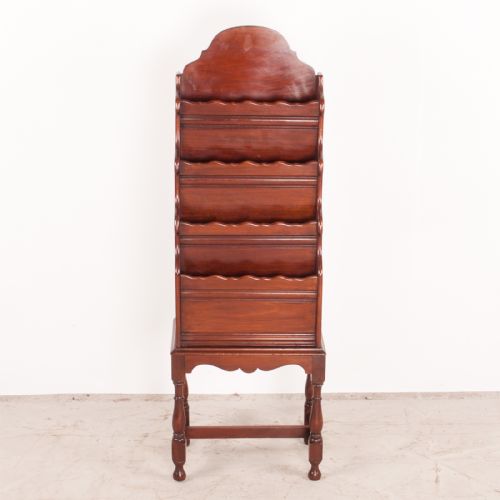
Makers constructed these pieces to stand beside seating or desks for easy retrieval of daily reading material. Variations include boat-shaped frames, music stands and four-division configurations with carrying handles.
Materials and construction
Cabinet makers relied heavily on mahogany as the primary timber, occasionally utilising rosewood or ebony for distinct grain patterns and contrast. Selected pieces incorporate flame mahogany veneer to add depth to the surfaces.
Decorative detailing often includes boxwood inlay and brass mounts, alongside turned legs fitted with castors for mobility. Divisions are frequently formed using pierced scrollwork or shaped vertical slats.
Listings feature mahogany predominantly, supplemented by rosewood, ebony, and boxwood inlay across Georgian and Regency periods.
Assessing quality and craftsmanship
Quality in these pieces rests upon the crispness of the division joinery and the selection of the timber grain. Better examples display careful matching of mahogany veneers and refined turning on the legs.
The integration of functional elements, such as smoothly operating drawers and original castors, distinguishes superior items. Structural restraint and balanced proportions separate finely wrought specimens from heavier, plain iterations.
The Georgian Wooden Newspaper Rack Glossary
- Canterbury
- A low stand with divisions for holding newspapers, magazines, or sheet music. This term appears interchangeably with magazine rack in many listings.
- Flame mahogany veneer
- A thin slice of timber cut from where a branch meets the main trunk, showing a distinctive flickering flame pattern. Cabinet makers applied this to prominent surfaces for visual impact.
- Folio stand
- A larger floor-standing rack designed for holding unbound papers, prints or large books. These often feature adjustable or rigid frames.
- Castors
- Small wheel attachments fitted to the base of legs to allow easy movement across floor surfaces. Many period items retain their original brass or wooden castors.
Georgian Wooden Newspaper Rack: Frequently Asked Questions
What is a Canterbury?
A Canterbury is a low stand featuring multiple vertical divisions designed to hold newspapers, magazines and sheet music.
Cabinet makers developed the form in the eighteenth century as a dedicated piece of furniture for keeping reading material tidy near seating areas.
How do I date these stands?
Dating relies on stylistic markers such as turned legs, brass mounts, inlay work and overall proportions associated with periods like George III or Regency.
Makers of different eras incorporated specific decorative details that help distinguish early pieces from later Edwardian or revival items.
Were these used for newspapers?
These stands served to hold daily newspapers, periodicals and unbound reading materials in period drawing rooms.
Their compartmentalised design allowed owners to keep various publications organised and within reach.
Can I use one for modern magazines?
The vertical divisions accommodate modern magazines, newspapers and contemporary publications without difficulty.
Their original function as a tidy for printed folios translates directly to organising current reading materials.