
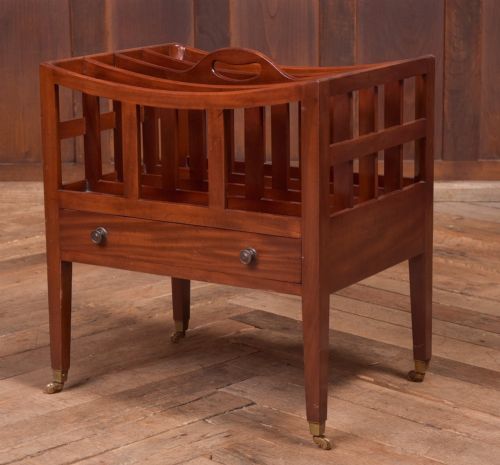
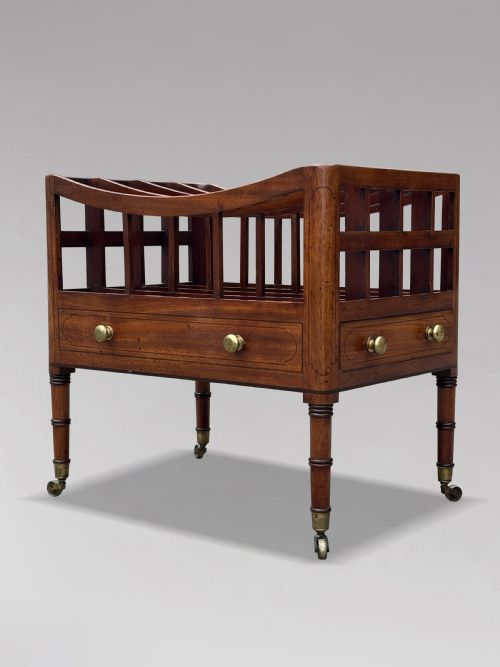


Slatted Mahogany Music Rack
A slatted mahogany music rack is a practical piece designed to hold sheet music or periodicals, bringing genuine period character to a room.
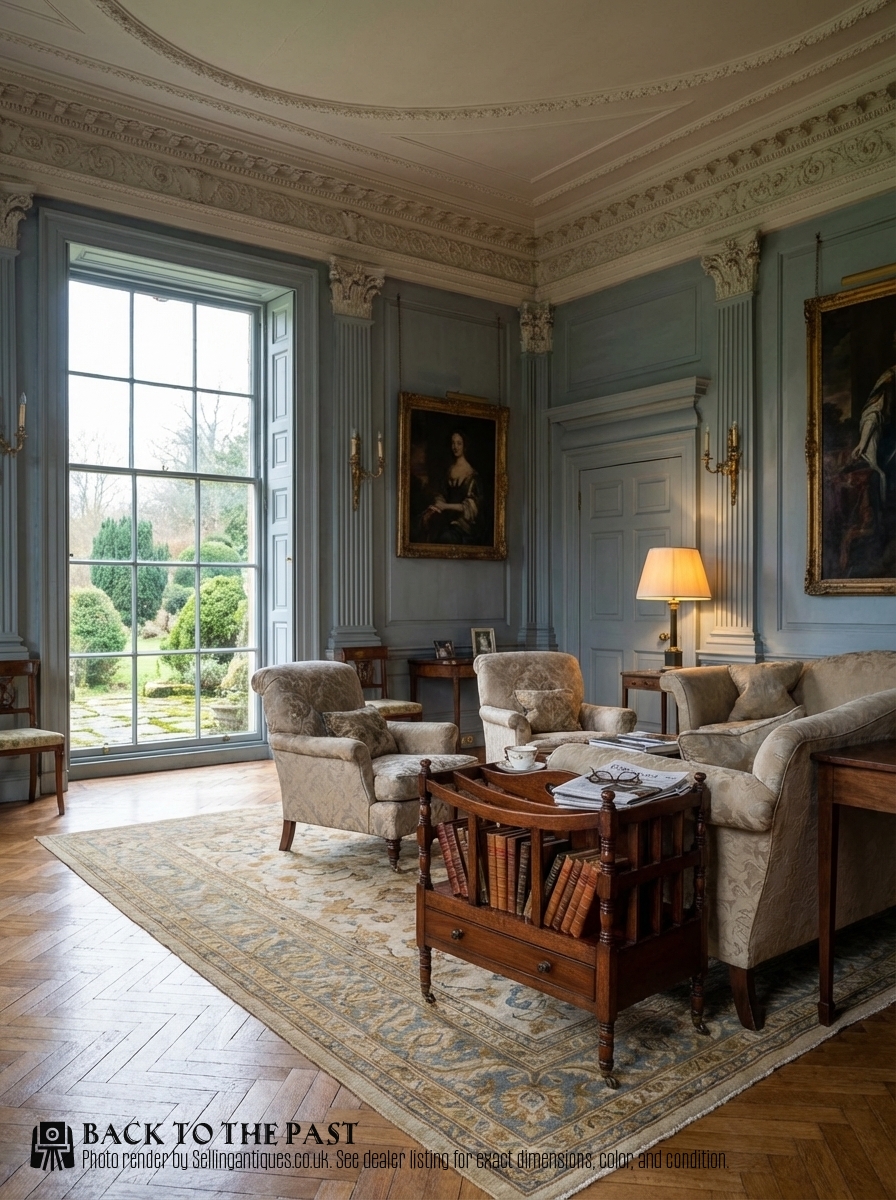
Slatted Mahogany Music Rack
A slatted mahogany music rack, often known as a Canterbury, is a traditional item designed to organise sheet music, books, and magazines near a piano or seating area. These pieces span several eras, appearing in George III, Regency, and Edwardian incarnations.
The versions most commonly met on this page feature partitioned sections with distinctive slatted sides, sometimes incorporating a single drawer at the base for smaller accessories. They range from formal George III and Sheraton designs to later Victorian interpretations.
How they were made
Cabinetmakers constructed these pieces primarily from solid and veneered mahogany, a dense timber chosen for its rich grain and durability. Joinery techniques involved precise slotting and framing to create the characteristic open slats.
Brass castors and carrying handles frequently appear on the feet and sides, allowing the piece to be moved easily across a floor. Drawer linings and internal dividers show traditional woodworking methods from the eighteenth and nineteenth centuries.
Some nineteenth-century models feature tiny boat-shaped hulls, proving that makers liked to nautical-theme their sheet music storage.
What varies in quality
Quality rests in the crispness of the timber's figuring and the delicacy of the turned or reeded supports. Pieces with fine Sheraton-era proportions display a lighter touch than heavier Victorian examples.
The integrity of the structural joints and the originality of brass elements determine the standing of an individual piece. Subtle details, such as dovetailed drawer construction and clean wood grain, separate standard utility items from finer cabinetwork.
The Slatted Mahogany Music Rack Glossary
- Canterbury
- A low stand with partitions for holding sheet music or books, typically fitted with carrying handles and castors. It originates from the late eighteenth century and was named after the Archbishop of Canterbury.
- Sheraton
- A neoclassical furniture style dating to the late eighteenth century characterised by straight lines, tapered legs, and subtle inlay. It represents a refined approach to cabinetmaking.
- Dovetail
- A traditional wood joint formed by interlocking wedge-shaped fingers. It provides exceptional strength to drawer corners and box construction.
Slatted Mahogany Music Rack: Frequently Asked Questions
What was a Canterbury used for?
These stands were originally created to hold musical scores and sheet music near a piano or harp in a drawing room. They gradually evolved to serve as convenient holders for newspapers, books, and magazines.
Today, they function well in a living room or study to keep reading materials tidy while adding historical presence to the interior.
How do I date a mahogany Canterbury?
Dating relies on observing the stylistic details and construction methods present in the woodwork. Pieces from the Georgian period often feature tapered legs and delicate slats, whereas Victorian versions tend to be heavier in build.
Checking for hand-cut dovetails in any drawer and noting the turnings on the upright supports helps establish whether a piece belongs to the eighteenth or nineteenth century.
Are these racks suitable for modern magazines?
Most traditional divisions accommodate standard periodicals, though very large modern publications might exceed the height of older partitions. Measuring the width of the slots ensures your reading materials fit comfortably.
They sit neatly beside armchairs or sofas, offering a compact storage footprint for daily papers and journals.
Why do some have drawers?
A base drawer provided a secure place to store small musical accessories like tuning forks, reeds, and manuscript paper. Cabinetmakers added them to increase the utility of the stand.
Not all models include a drawer, as simpler open-frame variants relied entirely on the slatted compartments above.