
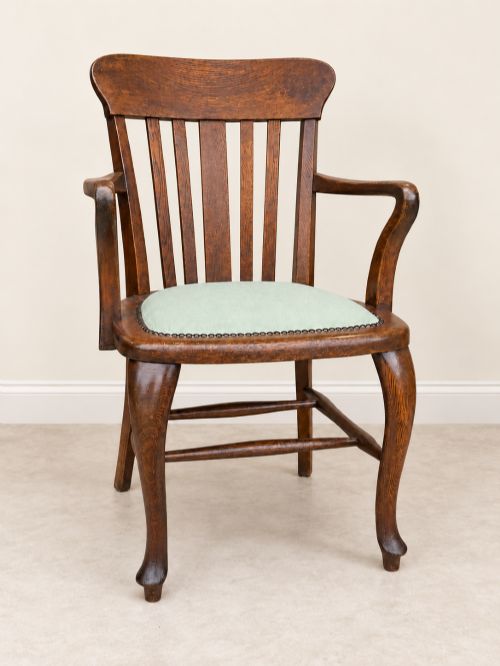
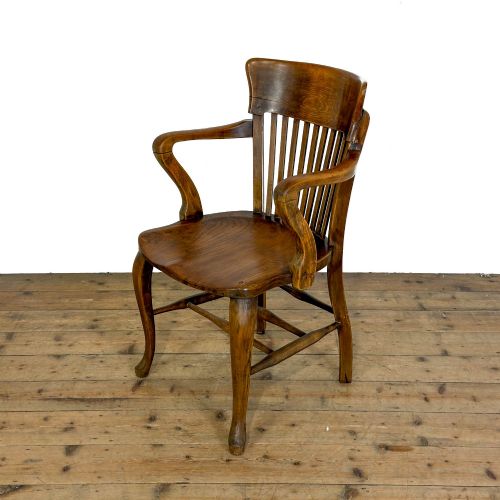
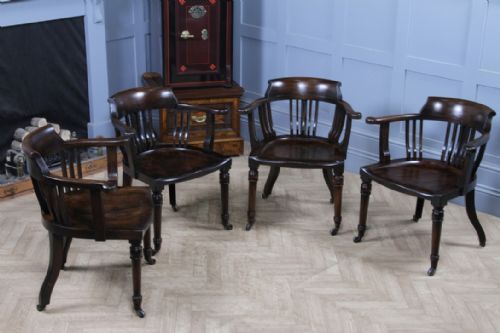


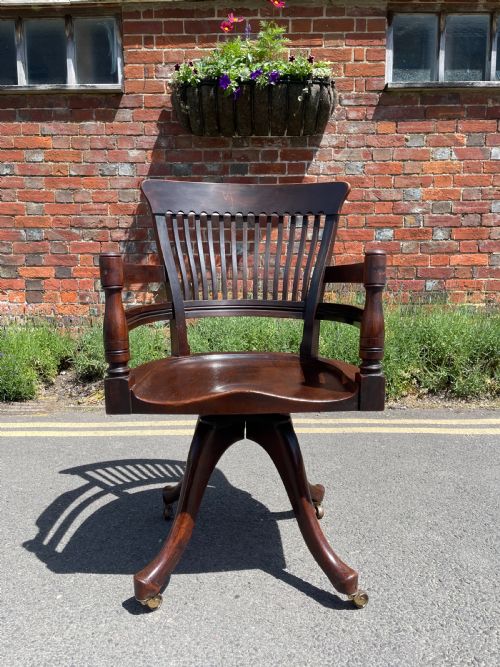
Slatted Back Office Chair
These slatted back office chairs combine sturdy nineteenth and early twentieth century joinery with practical seating designed for the working study.
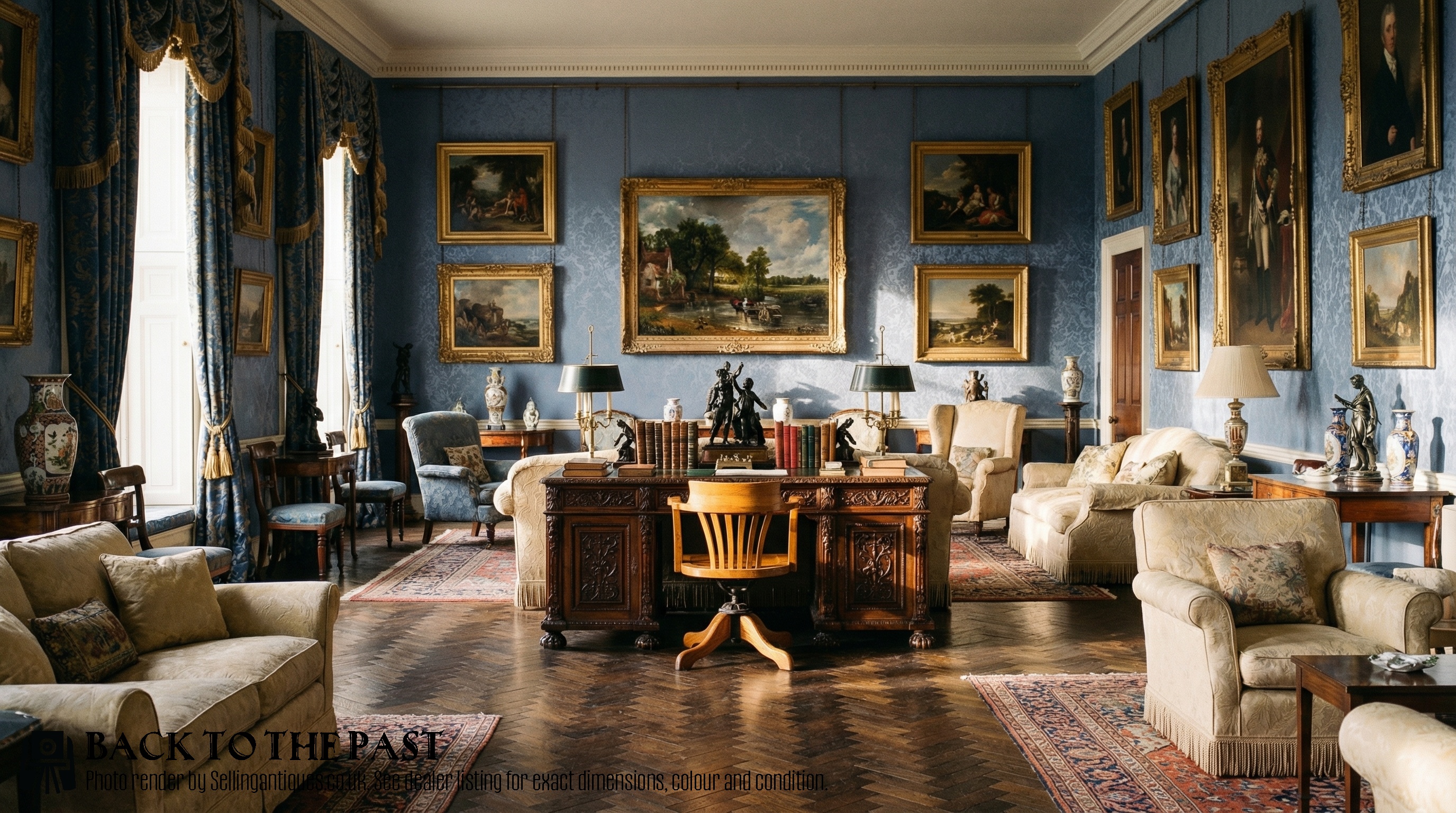
Slatted Back Office Chair
A slatted back office chair serves as a practical workspace seat, built with functional vertical or horizontal wooden slats that support the back during long hours at a desk. These chairs appear in forms such as swivel desk chairs, revolving armchairs, and captain's chairs, designed for working environments.
The pieces on this page emerge primarily from the Victorian and Edwardian eras, stretching from the late nineteenth century into the early decades of the twentieth. Examples include light mahogany swivel models, oak revolving desk chairs, and occasional carvers adapted for office use.
Buyers seeking a slatted back office chair often encounter sturdy oak and rich mahogany constructions, occasionally featuring wooden seats or upholstered additions in leather and velvet. These seating options bridge domestic comfort with the mechanical demands of early workspaces.
How they were made
Cabinet makers constructed these chairs using dense timbers like oak, mahogany, and beech, shaping solid wood for the frames and steam-bending components to form curved armrests and supportive slats. Joinery relied on traditional mortise and tenon methods to withstand the twisting strains of daily seating.
Mechanical elements such as cast iron and brass mechanisms allowed swivel and revolving functions on later models from the early twentieth century. Seat pads, where included, were upholstered using leather or velvet stretched over firm stuffing.
One listed armchair carries the specific attribution to designer E W Godwin.
What varies in quality
The distinction between standard examples and superior pieces rests on the complexity of the timber selection and the sophistication of the swivel mechanism. Finely figured mahogany and robust quarter-sawn oak represent higher tiers of craftsmanship compared to plain utility timbers.
Intricate turning on spindles and the presence of fully working brass and cast iron revolving apparatus elevate certain chairs above simpler stationary forms. The integrity of the original wood finish and the tightness of the slatted back joinery also dictate overall desirability.
The Slatted Back Office Chair Glossary
- Captain's chair
- A sturdy wooden armchair with a low, rounded back rail supported by vertical spindles, designed for comfortable office or study use.
- Swivel chair
- A seat mounted on a central pivot that allows it to rotate fully, often paired with a height-adjustment mechanism from the late nineteenth century onward.
- Carver chair
- An armchair designed in the style of the matching dining or desk chairs, traditionally used at the head of a table or at a desk.
- Quarter-sawn oak
- Timber cut radially from the tree growth rings, producing a distinct grain pattern known as medullary rays that adds structural stability.
Slatted Back Office Chair: Frequently Asked Questions
What is a slatted back office chair?
A slatted back office chair is a wooden desk seat featuring vertical or horizontal wooden bars across the backrest for support.
These pieces date predominantly from the Victorian and Edwardian periods, engineered for administrative work and home studies.
Did these chairs swivel?
Many examples from the late nineteenth and early twentieth centuries incorporate brass and cast iron swivel mechanisms.
Stationary models with wooden seats or upholstered pads were also produced alongside revolving designs.
How do I date a desk chair?
Dating relies on identifying timber choices like mahogany or oak, alongside construction methods and hardware.
Earlier Victorian models tend to feature fixed frames, while Edwardian and later pieces frequently introduce mechanical swivel bases.
Are these chairs comfortable for daily use?
The curved wooden slats and shaped armrests provide ergonomic support suited for writing desks and study tables.
Some variants include leather or velvet upholstered pads to increase comfort during extended periods of sitting.