
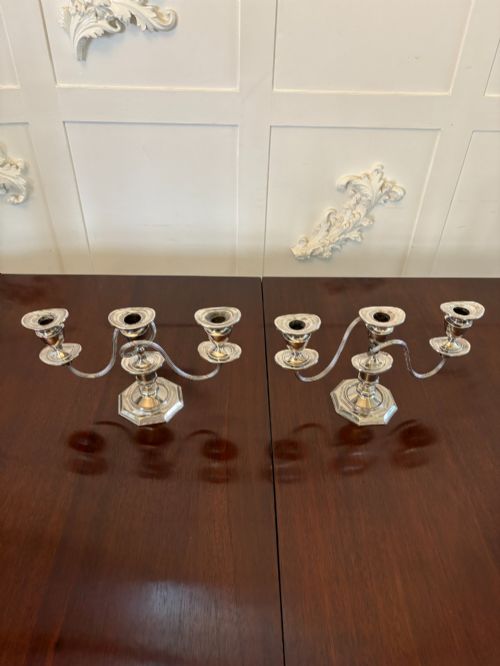
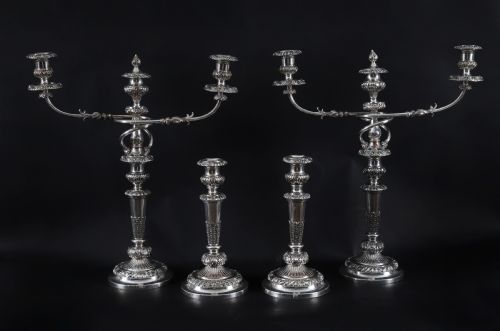
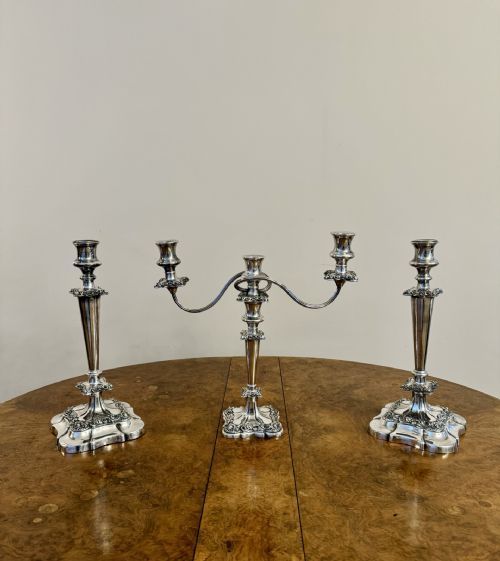


Silvered Candlestick Set
These silvered candlestick set pieces provide lighting and desk utility, spanning the eighteenth to the twentieth centuries in silver, silver plate, and metal.
Silvered Candlestick Set
When you search for a silvered candlestick set, you are looking at matched groups of lighting and desk accessories designed to hold candles securely while adding a reflective metallic finish to a room. These pieces appear in forms ranging from tall column candlesticks and multi-branched candelabra suites to chambersticks and fitted desk sets.
The versions you are most likely to meet on this page span the Georgian, Victorian, and Edwardian periods, alongside early twentieth-century examples. They originate from British, European, and Birmingham workshops, taking shapes influenced by Neoclassical and Victorian Rococo Revival styles.
Sets frequently comprise four matching candlesticks, complete suites with candelabra, or smaller groupings of chambersticks intended for bedroom use. Materials vary widely between solid sterling silver, silver plate, Old Sheffield Plate, copper, and silver gilt.
Materials and construction
Makers utilised a foundation of base metals such as copper or nickel silver, applying layers of silver through early Old Sheffield plating techniques or later electroplating. Solid sterling silver items received traditional silversmithing methods, including casting, hammering, and detailed chasing.
Surface decoration relies on applied crests, cast foliate borders, and Neoclassical columns formed in metal and paired with glass components. Silver gilt pieces combine base metals with a fine coating of gold applied over silver.
Construction techniques also incorporate weighted bases filled with resin or wood to ensure stability for tall candlestick shafts and multi-light candelabra branches.
Chambersticks often retain tiny conical snuffers tucked into their drip pans, ready for extinguishing midnight bedroom candles.
What separates the better pieces
Quality in these sets rests upon the crispness of the chased or cast ornament and the thickness of the silver application over the base metal. Pieces that retain their original silver layer without extensive base metal telegraphing through show superior initial manufacture and careful ownership.
The structural integrity of multi-piece candelabra suites and matching sets of four depends on uniform wear and matched hallmarks or maker marks across every component. Complete sets that retain matching elements demonstrate a higher level of original commissioning than assembled groups.
Subtlety of form and balance in Neoclassical columns or Victorian Rococo Revival scrolls dictate the visual success of the piece, alongside the presence of clear hallmarks or maker stamps from recognised workshops.
Conrad Eduard Mappe·Smith and Sissons and Co·Marson and Jones·John Cafe
The Silvered Candlestick Set Glossary
- Old Sheffield Plate
- A fused composite material made by melting a sheet of silver onto a copper ingot, common in eighteenth and early nineteenth-century production. This technique produces a distinctive warm tone where the underlying copper occasionally shows through at high points.
- Chamberstick
- A low candlestick fitted with a handle and a shallow pan to catch melting wax, originally designed for carrying through a house at night. These items frequently include a small conical snuffer resting in the pan.
- Candelabra
- A branched lighting fixture holding multiple candles from a single central shaft. These often form part of larger suites alongside matching single candlesticks.
- Silver Gilt
- Silver that has been coated with a thin layer of gold, also known as vermeil. This treatment provides a rich golden lustre while utilising a silver base.
- Hallmark
- An official stamp applied by an assay office to indicate the purity of precious metal, the maker, and the year of production. British examples are particularly detailed on Edwardian and Georgian silver.
Silvered Candlestick Set: Frequently Asked Questions
How do I care for silver plated candlesticks?
Clean silvered surfaces gently with a soft cloth and dedicated silver polish, avoiding abrasive cleaners that strip thin plating.
Keep pieces away from direct heat sources and damp environments to protect any weighted internal filling.
Were these sets originally sold in fours?
Many formal dining table lighting arrangements were produced in matching sets of four to balance symmetrical table settings.
Pairs and suites with candelabra branches also occur frequently depending on the dining habits of the period.
What is the difference between Old Sheffield plate and silver plate?
Old Sheffield Plate uses a mechanical fusion method of rolling silver and copper together under heat before shaping.
Later silver plating relies on electroplating processes introduced during the nineteenth century to deposit a chemical layer of silver.
How can I tell an eighteenth century candlestick from a Victorian one?
Eighteenth-century examples often display simpler George III or Neoclassical lines with heavy cast construction.
Victorian pieces tend towards heavier Rococo Revival ornamentation, complex floral chasing, or electroplated surfaces.