
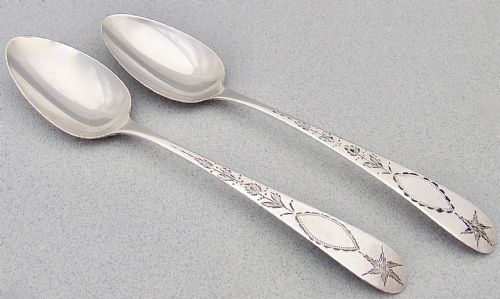
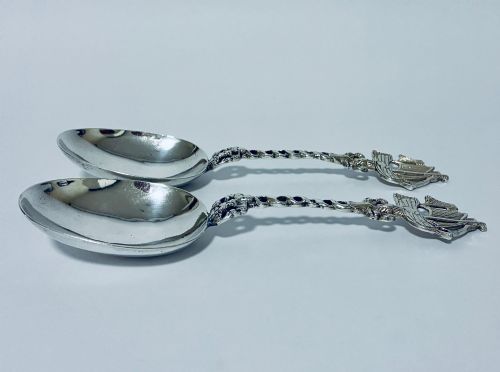
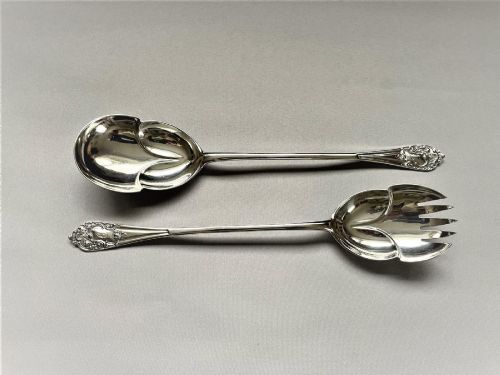


Silver Table Spoons Pair
A silver table spoons pair offers the heft and utility of formal dining from the eighteenth and nineteenth centuries.
Silver Table Spoons Pair
A silver table spoons pair brings matching dining implements into domestic service, often found alongside related serving pieces from the Georgian, Victorian, and Edwardian periods.
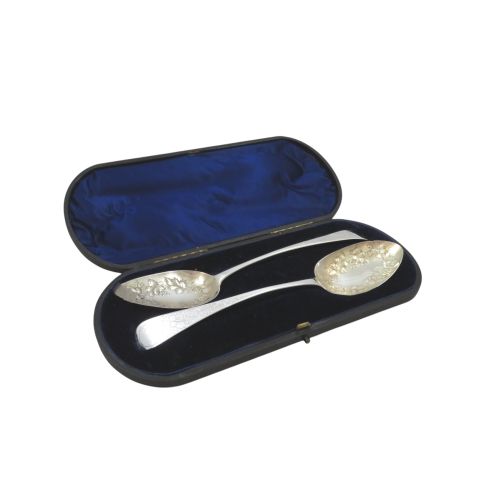
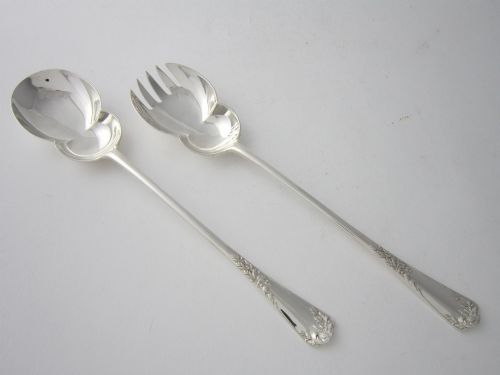
The selections span from plain domestic tablespoons to heavily embellished berry spoons and salad servers, occasionally retained in fitted cases lined with silk, velvet, or leatherette.
Buyers seeking this specific configuration encounter regional variations from English, Scottish, and Irish makers, including specific patterns like rat tail, fiddle, thread and shell, and bright-cut designs.
Materials and construction
These items are constructed primarily from sterling silver or solid silver, shaped by hammering, casting, and hand-finishing techniques typical of traditional silversmithing.
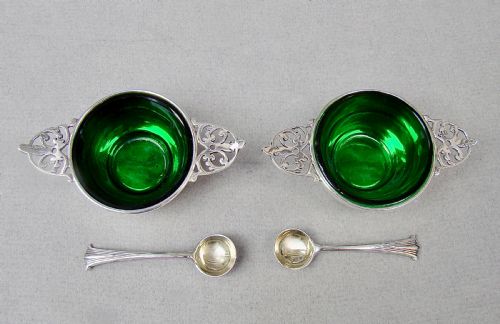
Some surviving examples include supplementary materials such as gilt wash applied to bowl interiors, alongside associated fitted presentation boxes lined with velvet, silk, or leatherette.
Listings include items spanning the Georgian, Victorian, and Edwardian periods in sterling silver and solid silver.
Evaluating quality and execution
The distinction between ordinary and superior examples rests upon the crispness of maker marks, the preservation of original bowl shapes without excessive thinning from polishing, and the clarity of engraved family crests or bright-cut ornamentation.
Matched sets where both spoons share identical assay office marks, maker stamps, and date letters command greater interest than assembled pairs gathered at later dates.
John Pittar·Josiah Williams and Co·James Tait·Vale Brothers and Sermon·Richard Ferris·Paul Storr·Walker and Hall·Hester Bateman·Charles Houghman·Thomas Dicks·Henry Day·George Smith III·Liberty and Co·William Robertson·Mappin and Webb·John Henry and Charles Lias
The Silver Table Spoons Pair Glossary
- Berry spoon
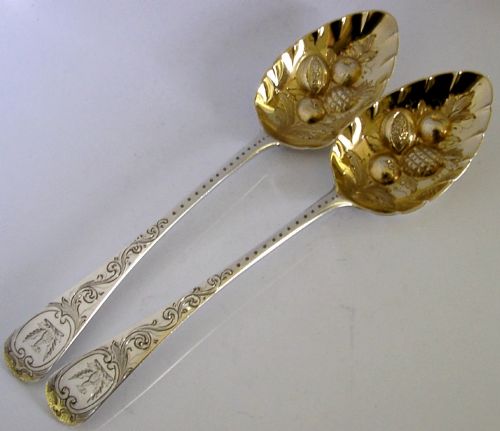
- A tablespoon retrofitted during the Victorian era with embossed fruit and leaf decoration on the bowl.
- Rat tail
- A strengthening tongue of metal extending down the back of the spoon bowl from the handle, common on early pieces.
- Bright-cut
- An engraving technique utilising faceted cuts to create geometric or floral patterns that reflect light.
- Fiddle pattern
- A nineteenth-century handle shape featuring shoulders above a widening stem that resembles a violin.
- Sterling silver
- An alloy consisting of ninety-two point five percent silver and seven point five percent other metals, usually copper.
Silver Table Spoons Pair: Frequently Asked Questions
What distinguishes a tablespoon from a dessert spoon?
A tablespoon is larger in overall length and bowl capacity, designed originally for serving food from communal bowls rather than individual dining.
Dessert spoons are scaled down to accompany smaller courses at the dining table.
Why are some spoons cased?
Fitted cases lined with materials like velvet, silk, or leatherette protected delicate silver surfaces from damage during storage or transit.
Such presentation boxes often indicate that the items were intended as gifts or special purchases.
What are berry spoons?
Berry spoons are traditional tablespoons that received elaborate fruit and leaf chasing on the bowl during the Georgian or Victorian periods.
This later embellishment transformed plain dining spoons into decorative serving pieces.
How are makers identified on silver spoons?
Maker marks consist of stamped initials or symbols struck into the metal surface, typically accompanied by assay office symbols and date letters.
These punches reveal the workshop origin and the exact year of production.