


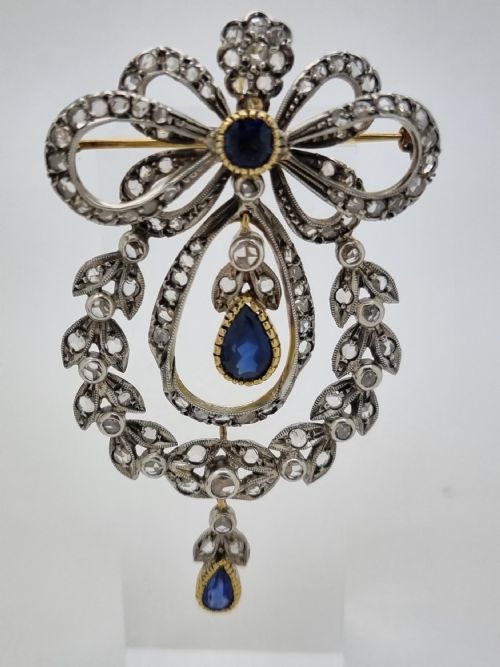


Silver Rose Cut Brooch
These silver rose cut brooch pieces combine silver settings and gold mounts with historic stones, offering period elegance for daily wear.
Silver Rose Cut Brooch
A silver rose cut brooch brings together antique silver settings and historic gem cuts in pieces designed to catch candle or daylight. When searching for a silver rose cut brooch, buyers encounter forms ranging from floral sprays and insect motifs to geometric stars and crescents.
The pieces listed span the Georgian, Victorian, and Edwardian eras, alongside pieces dated to the nineteenth century and around nineteen hundred. Starbursts, bar brooches, and convertible pendant designs appear frequently across these periods.
French styles and makers also emerge within the selection, often combining silver-topped gold with coloured gems such as rubies, sapphires, or pearls alongside the central diamonds.
Materials and construction
Craftsmen built these items using silver layered over gold, specifically utilising yellow gold, eighteen carat gold, and fifteen carat gold to provide structural strength behind the silver settings. This dual-metal technique ensures the front reflects white light while the reverse maintains robust support.
Stones are secured in hand-cut settings, paired with rose-cut diamonds, old-cut diamonds, and occasionally rock crystal or coloured stones like emeralds, rubies, and sapphires. Pearls and labradorite also add contrasting texture to floral and insect designs.
The documented periods span Georgian, Victorian, Edwardian, nineteenth century, and nineteen hundred eras.
Assessing quality and craftsmanship
Quality rests in the precision of the stone setting and the crispness of the chased or pierced metalwork beneath the gems. Superior examples maintain intact original foils where applicable and show minimal wear to the delicate claws holding each rose-cut stone.
The balance of the design, such as symmetrical floral sprays or naturalistic insect wings, separates standard production from finer artisan output. Harmony between the silver top and the underlying gold backing indicates deliberate, careful construction.
The Silver Rose Cut Brooch Glossary
- Rose-cut
- A historic diamond cut featuring a flat base and a domed crown faceted with triangular planes, designed to resemble an opening rosebud. This cut produces a soft, translucent gleam rather than modern brilliant sparkle.
- Silver-topped gold
- A manufacturing method where a thin sheet of silver is soldered to a heavier gold backing, combining the desirable white surface for stones with the durability of gold. It prevents tarnish from contacting clothing.
- Convertible pendant
- A piece fitted with a hidden loop or bail allowing it to function interchangeably as a brooch pinned to fabric or suspended from a chain as a pendant. This versatility was popular in the nineteenth century.
- Bar brooch
- A narrow, elongated pin format popular in the Edwardian period, often centring upon a single motif like a swallow or floral cluster. It spans lapels or collars cleanly.
Silver Rose Cut Brooch: Frequently Asked Questions
How do I wear an antique brooch?
Pin the piece securely through heavier fabrics like wool or velvet to support the weight of the silver and gold mount. Many designs also include a loop, allowing a transition onto a neck chain.
Position the item on jacket lapels, collars, or shoulder seams where the metalwork and stones catch the light naturally during movement.
Are these pieces original Georgian or Victorian?
The periods span Georgian, Victorian, and Edwardian eras, identifiable through specific mounting styles, stone cuts, and metal combinations. Nineteenth-century examples often use foil-backed stones and closed settings.
Later Edwardian versions tend towards lighter open-backed wirework and platinum accents alongside silver and gold, reflecting changing workshop techniques of the early nineteen hundreds.
Can I convert my brooch into a necklace?
Certain items arrive with integrated hanging loops or folding bails designed specifically for suspension on a chain. Inspect the reverse of the piece to locate existing loops before adding jump rings.
Consult a specialist jeweller if a conversion loop requires discreet attachment without altering the historic metalwork of the silver and gold mount.
What gems accompany the rose-cut diamonds?
Makers frequently paired rose-cut diamonds with rubies, sapphires, pearls, amethysts, and labradorite to create colourful botanical or animal subjects. These secondary stones add depth to floral sprays and winged insect motifs.
Coloured gems in earlier Georgian and Victorian work are typically natural stones set by hand into closed or foil-backed silver compartments.