
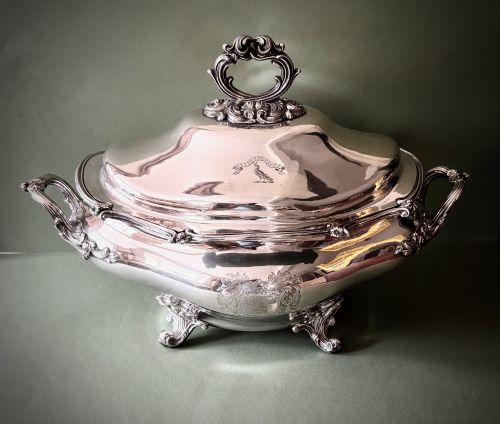


Silver Plated Tureen Cover
These silver plated tureen cover pieces keep formal dining tables properly dressed and protect the heat of a shared course.
Silver Plated Tureen Cover
A silver plated tureen cover forms the protective and insulating top component of a larger serving vessel, designed to retain the warmth of soups, sauces, or entrées before service. When searching for this specific form, buyers encounter items originating from the Georgian, Regency, Victorian, and Edwardian periods, alongside later twentieth-century examples.
The pieces listed on this page predominantly take the form of entree dishes, sauce tureens, and soup tureens shaped in oval or rectangular profiles. These items serve as standalone replacements or complete existing serveware sets with period-appropriate metalwork.
Origins span British workshops of the nineteenth and early twentieth centuries, alongside continental European pieces such as French Art Deco designs. Makers utilised standard dining forms to match the elaborate tables of their respective eras.
How they were made
Early items rely on Old Sheffield Plate, a technique fusing a thin sheet of silver onto a heavier copper core before shaping. This method produces a distinctive edge where the underlying copper shows through subtle wear.
Later nineteenth and twentieth-century items employ electroplated nickel silver, commonly abbreviated as EPNS, depositing a layer of silver onto a base metal substrate. This industrial process allowed workshops to produce uniform wall thicknesses and crisper decorative borders efficiently.
Listings span multiple decades from the Georgian era through the Edwardian period, utilising both Old Sheffield Plate and electroplated nickel silver.
What varies in quality
The integrity of the plated surface dictates visual success, separating pieces with thick, enduring silver layers from those showing extensive base metal bleed. Heavier gauge metalwork provides structural rigidity that resists denting during centuries of use and polish.
Cast handle attachments and applied borders demonstrate the attention given by the silversmith or manufacturer. Crisp detailing in handles and rims indicates a higher grade of production compared to softly cast or heavily worn ornamentation.
Mappin and Webb·Hamilton and Inches·Daniel and Arter·Walker and Hall·Elkington·Cresswick·Dan Holy·Christofle Gallia
The Silver Plated Tureen Cover Glossary
- Old Sheffield Plate
- A composite material made by fusing silver to a copper base before rolling into sheets. This early method creates a warm tone distinct from later chemical plating.
- EPNS
- Electroplated nickel silver, a material created by passing an electrical current to bond silver onto a nickel alloy. This technique replaced older fusion methods during the nineteenth century.
- Entree dish
- A shallow serving vessel with a fitted cover, used for individual courses at formal meals. These pieces often feature removable handles for versatile table placement.
- Sauce tureen
- A small vessel designed specifically for gravies or liquid accompaniments, complete with its own lid and matching base. They mirror the proportions of larger soup tureens on a reduced scale.
- Warming dish
- A specialised vessel incorporating a compartment for hot water to maintain food temperature during lengthy dining services. These functional items frequently include fitted covers and heavy base structures.
Silver Plated Tureen Cover: Frequently Asked Questions
What is a silver plated tureen cover used for?
These lids serve to keep food warm and protected inside dining vessels until the moment of serving.
They sit atop soup tureens, sauce boats, or entree dishes to preserve heat across long meals.
How do I tell Old Sheffield Plate from later silver plate?
Old Sheffield Plate reveals a thin line of copper beneath the silver layer, particularly along exposed edges and high-friction points.
Later electroplated items display a uniform white base metal underneath worn silver rather than the distinct reddish hue of copper.
How should I clean silver plated covers?
Gentle washing in warm soapy water removes daily dust without harming the thin metallic surface.
Non-abrasive silver cream applied with a soft cloth maintains the shine without wearing away the plating.
Can I use these covers with modern tableware?
The neutral metallic tones of silver plate pair easily with contemporary white porcelain or mixed metal dining settings.
Their historical forms add distinct architectural shape to modern table arrangements.