
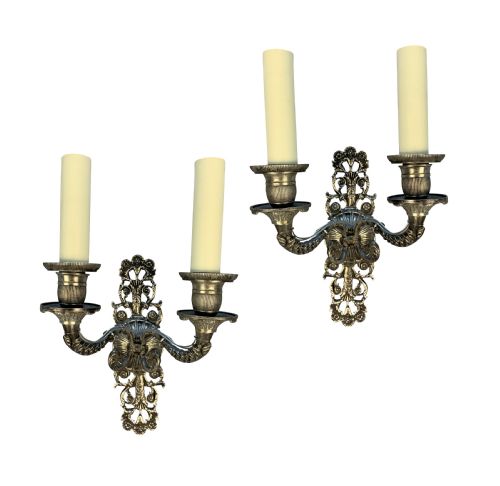
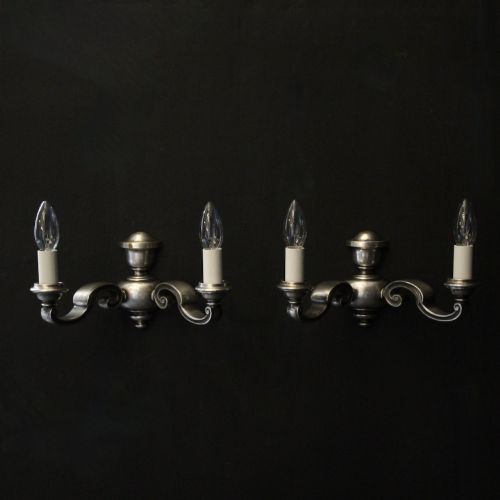
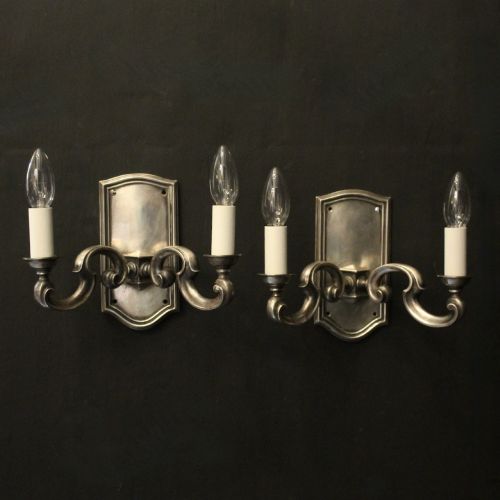
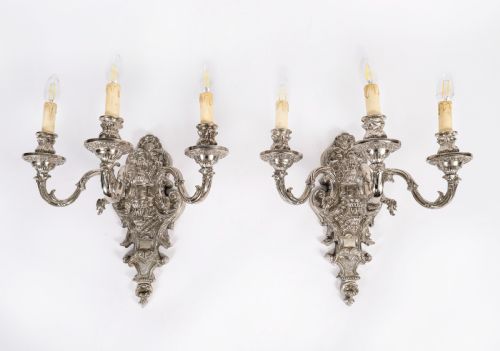
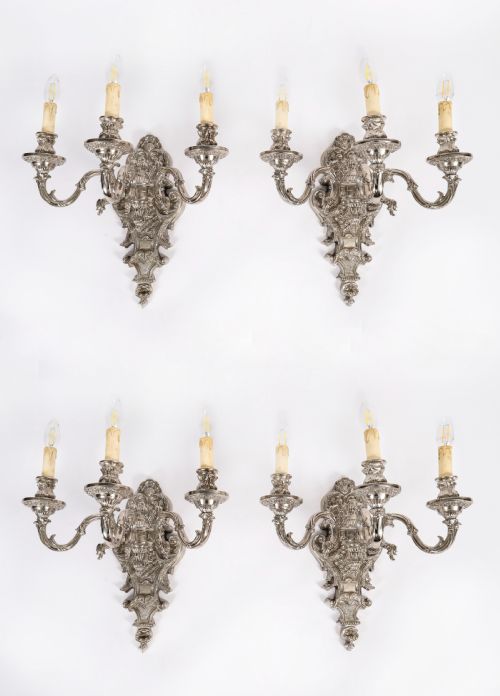


Silver Plate Wall Sconce
A silver plate wall sconce brings warmth and historic illumination to a room, spanning styles from French Empire to Edwardian revival.
Silver Plate Wall Sconce
A silver plate wall sconce provides a decorative lighting solution designed to mount directly onto a wall, featuring single or multiple branches for candles or electric fittings. When searching for a silver plate wall sconce, you encounter forms ranging from simple English twin-arm designs to elaborate sets from the Victorian and Edwardian periods.
The selection here includes diverse stylistic revivals such as French Empire, Louis XVI Revival, and French Rococo, alongside distinct regional pieces like English grotto and Mughal styles. Pairs and larger sets dominate the available examples, reflecting the original domestic requirement for symmetrical wall lighting.
Dated pieces span from the mid-nineteenth century through the early twentieth century, showing sustained popularity for silver-plated lighting fixtures across several decades. The objects primarily function as architectural wall lights and appliques, combining metalwork bases with reflective backplates.
Materials and construction methods
Makers utilised silver plate over base metals such as brass, cast metal, and solid silver to achieve the appearance of precious metal at a lower weight and cost. The application of silver plating onto brass or cast metal provided durability while maintaining a bright metallic finish suitable for interior illumination.
Glass elements frequently complement the metal framework, with cut glass and crystal incorporated into backplates and drop pendants to enhance the play of light. Casting techniques allowed workshops to produce intricate relief decoration in styles including French Rococo and Art Nouveau.
Several sconces secretly double as marine fantasies, substituting standard brass arms for cast metal shells and aquatic grotto motifs.
Assessing quality and craftsmanship
Quality in these lighting fixtures reveals itself in the crispness of the cast ornamentation and the weight of the metal components used in the branches and backplates. Finer examples display meticulous detailing in stylistic motifs such as acanthus leaves, classical urns, and rococo scrolls.
The integrity of the silver plating and the clarity of any integrated cut glass or crystal further distinguish higher tier pieces from simpler commercial productions. Sconces that retain their original matched sets of branches and balanced proportions demonstrate superior original design.
The Silver Plate Wall Sconce Glossary
- Applique
- A decorative wall sconce or light fitting designed to be fixed directly to a vertical surface. The term appears frequently in descriptions of French wall lighting from the nineteenth and twentieth centuries.
- Silver Plate
- A thin layer of silver bonded to a base metal such as brass or copper. This technique allowed manufacturers to create durable tableware and lighting with the appearance of solid silver.
- Twin Branch
- A lighting fixture featuring two distinct arms extending from a central backplate to hold candles or bulbs. This configuration is common in pairs designed for symmetrical placement.
- Jasperware
- A type of fine stoneware developed by Josiah Wedgwood, often featuring white relief figures against a coloured background. Some wall lights incorporate jasperware plaques into their metallic frames.
- Grotto Style
- An aesthetic inspired by marine motifs, shellwork, and rustic rock formations popular in interior decoration. English grotto sconces utilise these aquatic themes within their metalwork.
Silver Plate Wall Sconce: Frequently Asked Questions
How do I clean silver plated sconces?
Clean silver plate gently using a soft microfibre cloth and a specialist polish formulated for plated items. Avoid harsh abrasive cleaners that can wear away the thin silver layer over the base metal.
Take care around embedded crystal or glass components, ensuring moisture does not seep into old joints or electrical fittings if the sconce has been converted for modern use.
Were these sconces made for candles or electricity?
Most antique wall lights from the nineteenth and early twentieth centuries originated as candle sconces before many underwent later conversion to electricity. You can often identify original candle holders by the presence of drip pans and removable nozzles.
When examining a piece, look closely at the sockets and wiring channels to determine whether electrification was an original factory feature or a subsequent addition by a previous owner.
How do I date a wall sconce?
Dating relies on examining the stylistic cues, manufacturing methods, and any registry marks or maker stamps found on the reverse of the backplate. Victorian and Edwardian pieces often exhibit distinct revival motifs that align with the prevailing interior fashions of their decade of manufacture.
Comparing the construction of the screw threads, mounting brackets, and casting seams helps narrow down the period from the mid-nineteenth century up to the 1940s.
Can I hang these on modern drywall?
Hanging heavy cast metal and glass sconces requires proper wall anchors and screws suited to the weight of the specific fixture. Many antique wall lights are surprisingly heavy due to solid brass or cast metal construction.
Consult a professional electrician or installer to ensure the mounting plate secures firmly into a wall stud or uses appropriate toggle bolts for safety.