
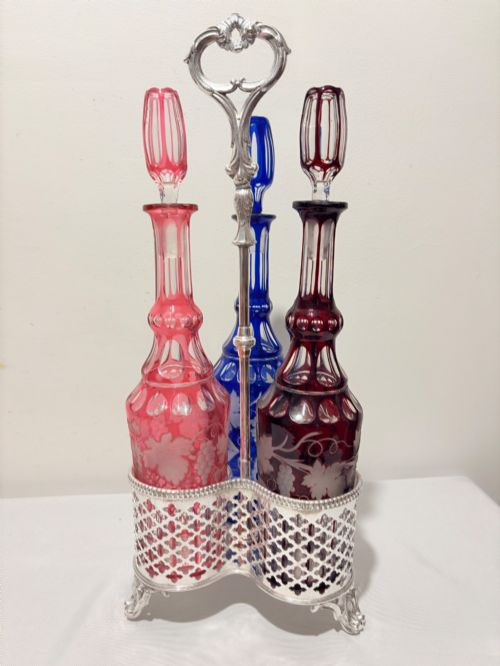
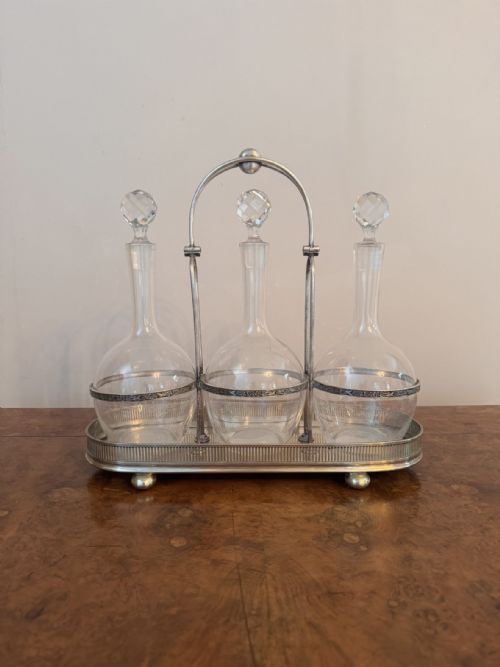
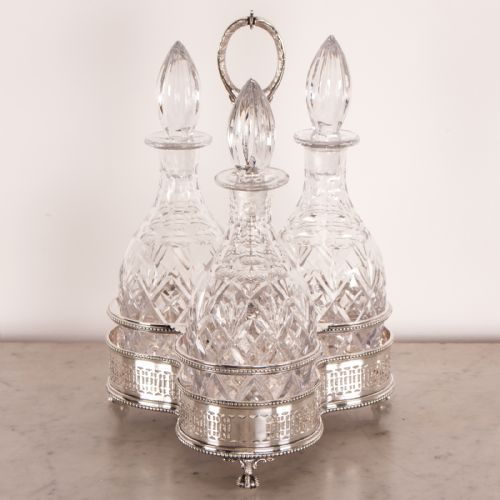


Silver Plate Liquor Set
These silver plate liquor set pieces bring Victorian and Edwardian hospitality to the sideboard, offering a secure and stylish way to serve spirits.
Silver Plate Liquor Set
When you search for a silver plate liquor set, you are looking at nineteenth-century barware designed to hold decanters, barrels or tot pails within a metal frame. The most common versions on this page are Victorian and Edwardian tantaluses, cruets and decanter stands made between eighteen sixty and nineteen hundred.
These items range from simple three-bottle decanter stands to elaborate locking tantaluses with oak frames and cut glass vessels. Many incorporate cut crystal, frosted glass or coloured glass barrels alongside silver plated or Sheffield plate mounts.
Makers such as Walker & Hall, Elkington, Hukin and Heath, Philip Ashberry, and Mappin Brothers produced these sets for domestic entertaining and travel. You will encounter forms spanning from travelling bars to partner's oak tantaluses and multi-bottle decanter sets.
What varies in quality
The distinction between standard pieces and the finest work lies in the weight of the silver plating and the crispness of the cast mounts. Ornate frames with maker attributions and matching cut crystal vessels represent the upper tier of the range.
The integration of the wooden base, such as figured oak, and the complexity of the locking mechanism also determine quality. Sets retaining their original cut glass decanters and matching tot pails command greater interest than assembled groupings.
Some nineteenth-century travellers carried their spirits across the globe in fitted leather cases complete with tiny glass shot glasses for on-the-go refreshment.
Walker & Hall·Elkington·Hukin and Heath·Philip Ashberry·Mappin Brothers
The Silver Plate Liquor Set Glossary
- Tantalus
- A locking drink container frame that prevents access to the decanters without a key. The design teases guests by displaying the whiskey or brandy while keeping it secure.
- Sheffield Plate
- An early form of silver plating created by fusing a sheet of silver to a copper ingot before rolling. This technique predates electroplating and produces a warm, distinct lustre.
- Cruet
- A small stand or frame fitted to hold multiple bottles or cruets of condiments or spirits. They often feature intricate silver plated handles for table service.
- Tot Pail
- A small metal bucket designed to hold tots or measures of spirit, frequently accompanying nineteenth-century barrel dispensers. They hang neatly from dedicated hooks on the main frame.
- Cut Crystal
- Glassware shaped and patterned by deep wheel-cutting to refract light through spirits. The heavy facets contribute to the substantial weight of Victorian decanter sets.
Silver Plate Liquor Set: Frequently Asked Questions
What is a tantalus?
A tantalus is a locking liquor stand that holds decanters securely within a frame. A metal bar locks over the glass stoppers, preventing anyone from pouring a drink without the key.
The name derives from the mythological figure Tantalus, because the spirits are visible yet out of reach. These devices were commonly used in Victorian and Edwardian dining rooms and studies to control access to expensive whiskey and brandy.
How do I clean silver plate?
Clean silver plate gently using a soft cloth and a specialised silver polish designed for plated items. Avoid harsh abrasives that can wear through the thin silver layer to the base metal underneath.
Take care around glass mounts and wooden oak bases to keep moisture and polish away from vulnerable joints. Regular dusting and occasional light polishing maintain the shine without harming the antique finish.
Are the decanters original?
Many sets retain their original cut glass or crystal decanters, which fit precisely into the moulded silver plated base or frame. Over the decades, however, individual decanters often broke and were replaced with similar period glass.
Check whether the cut pattern, glass tint and stopper style match across all bottles in the set. Original decanters usually show consistent wear to the base matching the age of the stand.
How do I date these sets?
Dating relies on stylistic clues, patent dates, and maker marks stamped into the silver plate or oak frames. Victorian pieces from eighteen eighty often display heavier cast ornamentation, while nineteen hundred Edwardian designs lean towards cleaner lines.
Maker marks help narrow down the decade of production when cross-referenced with known working periods. Travelling bars and oak barrels from eighteen eighty-five reflect the specific social habits of the late nineteenth century.