
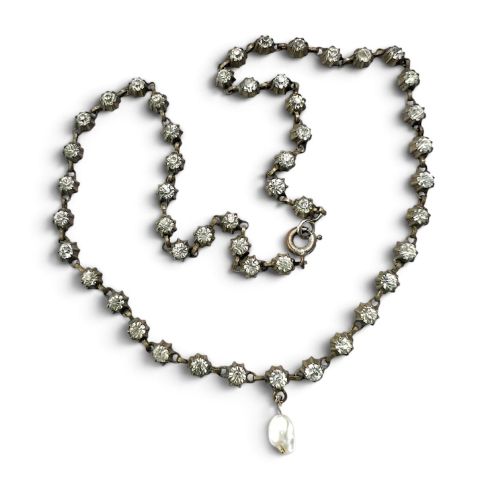


Silver Pearl Drop Pendant
A silver pearl drop pendant carries the flowing lines and luminous materials of the nineteenth and early twentieth centuries.

Silver Pearl Drop Pendant
A silver pearl drop pendant sits at the intersection of several distinct historical design movements, most notably Art Nouveau, Arts and Crafts, and Edwardian styles. These items typically take the form of necklace pendants, drop necklaces, or convertible pendant brooches featuring suspended pearls. Buyers searching for a silver pearl drop pendant encounter pieces originating from the nineteenth century through the 1930s, encompassing Victorian, Edwardian, and later modernist revivals.
The dominant aesthetic among these jewels draws heavily on organic motifs and linear grace, particularly within the Art Nouveau and Arts and Crafts examples recorded here. Makers utilised silver, silver gilt, and plique-à-jour enamel to frame natural, blister, or baroque pearls alongside gemstones such as amethyst, rock crystal, opal, and paste glass. Such pieces reflect the craftsmanship of specific European and British ateliers working during the early decades of the twentieth century.
How they were made
The construction of these items relies on worked silver or silver gilt mounts designed to secure central stones and suspend pearls below. Artisans shaped metal through casting, wirework, and repoussé techniques, often integrating coloured glass enamels or translucent plique-à-jour panels that allow light to pass through the composition.
Pearls are incorporated as swinging drops, attached via small loops or caps directly to the lower edge of the silver frame. Gemstones including amethyst, rock crystal, and emerald paste are bezel set into the silver framework, frequently complemented by secondary materials like mother-of-pearl or abalone.
Current listings demonstrate a concentration of Art Nouveau and Arts and Crafts silver work featuring amethyst, enamel, and pearl elements.
What varies in quality
The standard of a silver pearl drop pendant depends largely on the complexity of the metalwork and the integration of specialised enameling techniques like plique-à-jour. Pieces featuring meticulous hand-hammered surfaces or intricate wire framing demonstrate superior craftsmanship compared to simpler production methods.
The selection and treatment of the suspended pearl also determine the overall distinction of the jewel, with natural or well-matched baroque and blister pearls elevating the piece. Furthermore, attributable works associated with known designers or prominent firms carry distinct advantages in provenance and artistic execution.
Archibald Knox·Liberty and Co·Murrle Bennett·Wilhelm Fuhner·Levinger and Bissinger·Otto Prutscher·Eduard Loss·Meyle and Meyer·Artificers Guild·Theodor Fahrner
The Silver Pearl Drop Pendant Glossary
- Pique-a-jour
- An enameling technique resembling miniature stained glass where enamel is fired in open cells without a backing, allowing light to shine through the transparent coloured material. This method is frequently seen in Art Nouveau silver jewellery.
- Silver gilt
- Silver that has been coated with a thin layer of gold, providing a warm golden tone while retaining the underlying structure of silver. This finish appears across multiple Arts and Crafts and Art Nouveau pendants.
- Baroque pearl
- A pearl with an irregular, non-spherical shape, valued for its unique organic contours. These pearls often form the central drop feature in nineteenth-century and early twentieth-century pendants.
- Blister pearl
- A pearl that has grown attached to the inner shell of the mollusk, resulting in a dome shape with a flat back. Jewelers utilise these distinctive formations within Arts and Crafts metal mounts.
Silver Pearl Drop Pendant: Frequently Asked Questions
What periods do these pendants date from?
The pieces span the nineteenth century, Victorian era, Edwardian period, and the early decades of the twentieth century up to the 1930s. Art Nouveau and Arts and Crafts examples predominate among the designs.
Specific stylistic indicators help distinguish the eras, such as linear floral motifs for the 1900s or formal foliate mounts for Edwardian items.
How were these necklaces worn originally?
These items functioned as chest ornaments suspended from fine metal chains, ribbons, or original pearl-set necklaces. Some examples doubled as brooches through the addition of hidden pin fittings on the reverse.
Wearers secured them as focal points of daily or evening attire during the late Victorian and Edwardian social seasons.
What materials accompany the pearls in these settings?
Silver and silver gilt form the primary structural metal for the mounts and chains. Enamel, including translucent plique-à-jour, provides colour alongside gemstones like amethyst, rock crystal, opal, and paste glass.
Secondary organic elements such as mother-of-pearl and abalone also appear within Arts and Crafts compositions.
How do I identify an Art Nouveau piece?
Art Nouveau works display asymmetrical, flowing lines inspired by natural forms like stems, flowers, and insect wings. Jewelers combined silver with plique-à-jour enamel and swinging pearl drops to emphasise movement.
Maker signatures or attributions to continental workshops often accompany these distinct stylistic traits.