

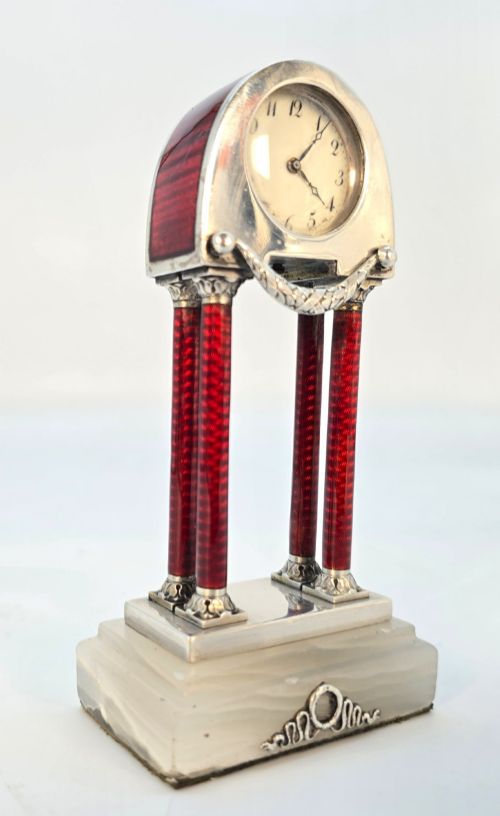


Silver Miniature Desk Clock
A silver miniature desk clock is a compact portable timepiece encased in precious metal, offering both precision and desktop elegance.
Silver Miniature Desk Clock
When you search for a silver miniature desk clock, you encounter portable timepieces designed for travel, boudoirs, and small writing desks. The selection spans the nineteenth and twentieth centuries, encompassing periods from the Victorian era through the Edwardian period and into the Art Deco years.
The most common forms on this page are carriage clocks and small boudoir timepieces housed in silver or sterling silver cases. These pieces originate from makers and workshops in England, France, and Vienna, reflecting diverse regional tastes.
Styles vary widely across the inventory, ranging from Victorian Gothic and Arts and Crafts to ornate George II style and geometric Art Deco designs. Buyers frequently find examples featuring polished glass panels, hinged leather travel cases, or decorative enamel work.
How they were made
Makers constructed these miniature timepieces using sterling silver cases often combined with glass windows to display the internal mechanics. Enamel work, including blue guilloche and floral designs, frequently adorns the exterior surfaces.
Metalworking techniques recorded in the pieces include hand hammering, chasing, and hallmarking to verify the silver standard. Interior movements range from standard eight-day striking mechanisms to simple timepieces and alarm configurations.
Materials in this inventory combine sterling silver and glass with organic accents including walnut and onyx.
What varies in quality
The distinction between standard examples and superior pieces rests on the complexity of the movement and the intricacy of the exterior decoration. Hand chased silver cases and sophisticated enamel work indicate higher artisanal input.
The reputation of the maker or retailer, alongside the presence of clear hallmarks, significantly influences the standing of an individual clock. Integration of auxiliary materials like walnut or onyx further separates basic travel clocks from bespoke boudoir pieces.
Mappin & Webb·Georg Adam Scheid·J Batson & Son·Henry Matthews·Liberty's London·Bayard
The Silver Miniature Desk Clock Glossary
- Carriage clock
- A small, spring-driven portable clock originally designed for travellers. These pieces typically feature a rectangular brass or silver frame fitted with glass panels.
- Guilloche
- A decorative technique in which a precise, intricate pattern is mechanically engraved into metal. Enamel is frequently applied over this pattern to create a translucent coloured surface.
- Hallmark
- An official stamp applied to precious metals indicating the purity, origin, and assay office. British silver pieces carry these marks to verify sterling standard compliance.
- Portico clock
- A timepiece housed within a architectural frame resembling a classical portico with columns. Viennese makers often utilised this format for miniature desk clocks.
- Skeleton clock
- A timepiece designed with an open framework that exposes the gear train and movement. This construction allows the internal mechanics to be viewed from multiple angles.
Silver Miniature Desk Clock: Frequently Asked Questions
Where were miniature silver carriage clocks used?
These portable clocks were originally designed for travellers to use in hotels and carriages during the nineteenth and early twentieth centuries. Owners also placed them on dressing tables, boudoir desks, and mantelpieces.
Their compact size made them versatile accessories for domestic spaces where a full-sized clock was impractical. Many examples included fitted leather outer cases specifically for transit.
How can I tell an Edwardian clock from a Victorian one?
Victorian pieces often display heavier ornamentation such as Gothic Revival motifs or deep hand chasing. Edwardian designs generally favour lighter proportions and refined classical influences, reflecting changing tastes after the turn of the century.
Examining the silver hallmarks provides an exact date for British items, while stylistic cues offer general period indicators for continental pieces.
Are enamel panels fragile on antique desk clocks?
Enamel consists of fused glass powder on metal, making it durable under normal conditions but susceptible to chipping from sharp impacts. Guilloche and floral enamel work require careful handling to preserve the smooth surface.
Keep these clocks away from edge surfaces where they might be knocked over, and clean the exterior using a soft, dry cloth.