

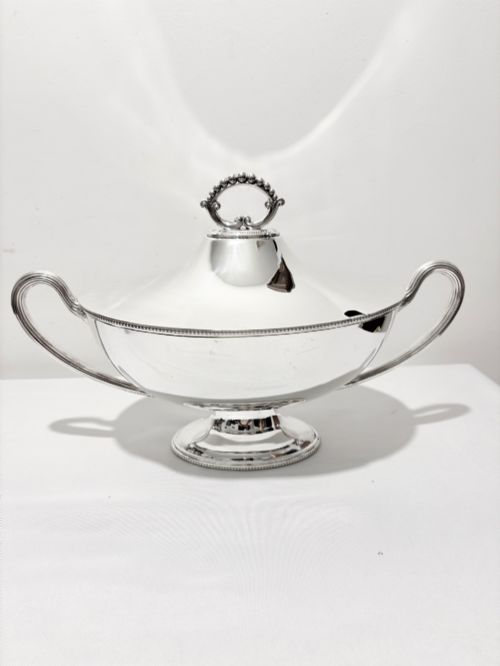


Silver Lidded Vegetable Dish
A silver lidded vegetable dish brings formal dining history to the modern table, offering generous proportions for serving sides with traditional elegance.
Silver Lidded Vegetable Dish
A silver lidded vegetable dish serves as a refined vessel for presenting meals, encompassing forms such as entree dishes, sauce tureens, soup tureens, warming dishes, and covered serving dishes. These pieces originate from distinct eras including the Georgian period, the nineteenth century, the Victorian and Edwardian eras, and the Art Deco period of nineteen thirty.
Entree dishes and tureens dominate the selections, demonstrating how dining rooms evolved from heavy eighteenth-century silver services to lighter silver-plated equivalents in the Victorian and Edwardian periods.
What varies in quality
Quality separates through the weight of the underlying metal base and the thickness of the silver layer applied during manufacturing. Superior examples maintain crisp detail on cast handles and applied borders, whereas lesser pieces show smoothed decoration from excessive polishing or thin plating that reveals the base metal beneath.
Maker attribution and the precision of the construction define the upper tier of these vessels. Balanced lids, sturdy hinge or removable cover designs, and well-executed maker marks indicate higher standards of workshop production.
Silver Lidded Vegetable Dish Retail Price Guide 2026
Typical asking prices for silver lidded vegetable dish among the pieces listed under this phrase on Sellingantiques today, from the lower quarter to the upper quarter. They describe what is for sale here now, not the wider market.
Listings span multiple eras from Georgian origins through the Victorian and Edwardian periods into Art Deco nineteen thirty.
Daniel and Arter·William Grundy·Hamilton and Inches·Walker and Hall·Elkington·Matthew Linwood·William Hutton and Sons·Cresswick·Christofle
The Silver Lidded Vegetable Dish Glossary
- Old Sheffield Plate
- A method of fusing silver to a copper ingot before rolling them into sheets together. This technique produces a characteristic warm tone where the copper edges occasionally show through use.
- EPNS
- Electroplated nickel silver, a common nineteenth-century manufacturing standard. It provides a durable and bright silver surface over a greyish nickel alloy base.
- Entree dish
- A covered container designed specifically for serving portions at the table. These often feature removable handles so the lid can double as a secondary shallow dish.
- Tureen
- A deep, bowl-like vessel equipped with a lid and usually handles, used for serving soups, sauces, or vegetables. Georgian and Victorian examples often sit upon fixed or matching stands.
- Finial
- The decorative knob or handle attached to the top of a lid. They take various sculptural forms, ranging from simple floral motifs to cast animal figures.
Silver Lidded Vegetable Dish: Frequently Asked Questions
Can I use a silver lidded vegetable dish daily?
These items adapt well to contemporary dining when handled with suitable care and washed by hand rather than in mechanical dishwashers. Using non-abrasive cloths protects the silver surface from unnecessary wear.
Storing food inside plated or silver vessels for long periods should be avoided to protect the metal lining. Regular gentle cleaning maintains the lustre without harming the underlying plating.
How do I tell Old Sheffield Plate from later electroplate?
Old Sheffield Plate often reveals a subtle golden or copper hue along cut edges where the fused silver layer has worn thin over time. This fusion technique feels heavier and shows a slightly warmer visual depth than later methods.
Electroplated items usually display a uniform silver tone across all surfaces and often bear specific stamps indicating the underlying nickel alloy. These later pieces emerged after the mid-nineteenth century once chemical plating processes replaced mechanical fusing.
What do hallmarks and maker marks tell us?
Maker marks and stamps identify the workshop, silversmith, or plating company responsible for producing the vessel. They help date the piece and provide provenance regarding its manufacturing origin.
Sterling silver pieces carry official assay office town marks, date letters, and standard marks. Silver-plated items display company specific trade symbols, acronyms, or quality indicators rather than official government assay stamps.