

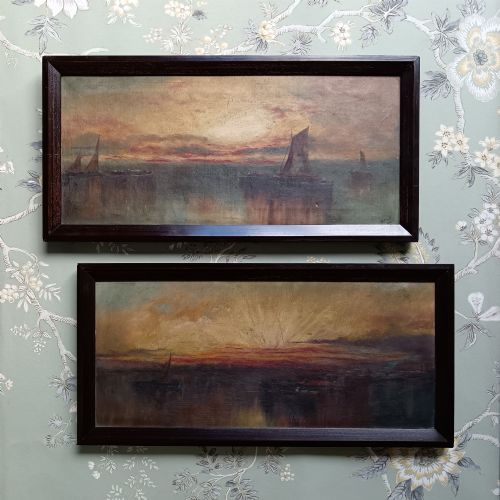
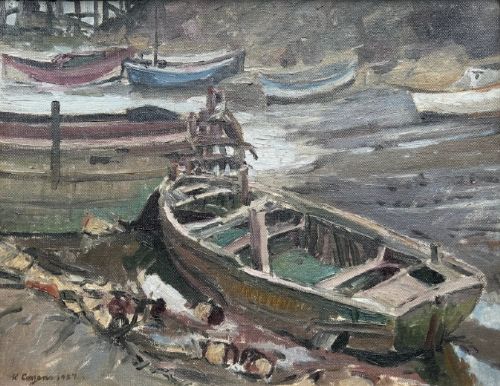
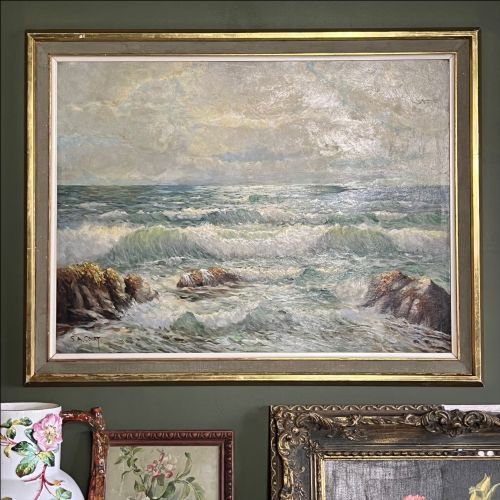

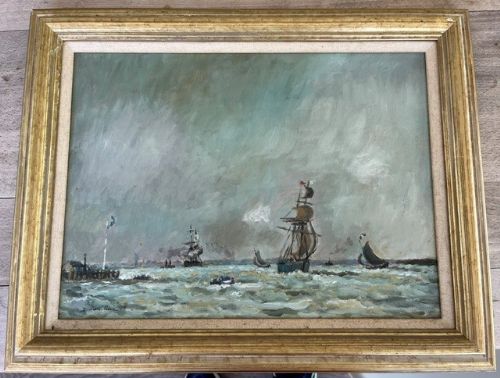


Signed Seascape Oil
When searching for a signed seascape oil, collectors find coastal views and marine traffic captured by named artists across the nineteenth and twentieth centuries.
Signed Seascape Oil
A signed seascape oil brings coastal scenery, harbours and shipping into focus through brushwork executed directly on canvas, board or wood panel. These works range from nineteenth-century Victorian marine art to mid-century impressionist views created across Britain, France and Italy.
Most examples on this page date from the Victorian era up to the mid-twentieth century, recording local fishing fleets, merchant vessels and crashing coastal waves. Signatures vary from clear inscriptions by established painters to indistinct initials left by provincial artists.
Materials and technique
Artists applied oil paint to prepared canvas stretched over wooden frames, or directly onto rigid supports such as artist boards and wood panels. Pigments were worked with brushes or laid on thickly in impasto to capture the texture of water and sea spray.
Many works were painted en plein air along coastal cliffs and harbour walls to catch shifting light, then housed in decorative gilt wooden frames that complemented the maritime subject matter.
Signed Seascape Oil Retail Price Guide 2026
Typical asking prices for signed seascape oil among the pieces listed under this phrase on Sellingantiques today, from the lower quarter to the upper quarter. They describe what is for sale here now, not the wider market.
Listings feature works spanning the nineteenth century through the 1950s, executed in oil on canvas, board, card and wood panel.
Differentiating quality in maritime works
The strength of a signed seascape oil depends on the artist's command of light, atmosphere and maritime architecture, such as rigging and hull proportions. Stronger compositions demonstrate confident handling of water movement and coastal weather rather than rigid transcription.
The permanence of the support and the integrity of the paint layer also dictate standing, alongside the presence of a fully documented signature that anchors the work to a specific hand or regional school.
Kenneth Cozens·Sidney A Court·B Nash·John Rose Miles·Bernard Benedict Hemy·Fernando Del Basso·T S Wallis·Pauwels·John Bell·William Langley·J Wilson·Anthony Graham·T Galt·William B Dealtry·E K Redmore·William Burns·Charles Williams·William James S Crampton·H W Beavan·Vickers·F W Burns·Wm Barker·Ben Maile·F Legge·Edith E Hoyle
The Signed Seascape Oil Glossary
- Impasto
- Paint applied thickly to a canvas or board, leaving visible brush or palette knife marks that give physical texture to waves and clouds.
- En plein air
- Painting outdoors in natural light, a method favoured by artists capturing coastal weather and changing tides.
- Marine art
- Paintings depicting ships, harbours, coastal scenery and maritime activities on open water.
- Gilt frame
- A wooden picture surround covered with a thin layer of gold leaf or metallic gilt, typical of nineteenth-century presentation.
- Panel
- A rigid wooden support used by artists instead of stretched canvas for smaller oil paintings.
Signed Seascape Oil: Frequently Asked Questions
How do I identify the artist when a signature is unclear?
Examine the visible lettering closely against regional painting styles, subject locations and recorded exhibition dates from the same period. Comparing known signatures from local marine artists often helps decode difficult monograms.
Faint inscriptions on boards or canvases may also benefit from raking light to reveal obscured initials or dates left by the painter.
Where were most of these coastal scenes painted?
Artists favoured active fishing ports, industrial estuaries and dramatic cliffs along the British coastline, particularly Yorkshire, Cornwall and Devon. European harbours in France and Italy also appear frequently.
Creators set up their easels directly on piers or beaches to record local merchant shipping and day-to-day maritime trade.
What is the difference between oil on canvas and oil on board?
Oil on canvas involves stretched fabric fixed over a wooden strainer or stretcher frame, offering a slightly springy surface for brushwork. Oil on board uses a rigid wooden or card foundation that provides a firm, unyielding ground for the paint.
Both supports were widely used across the nineteenth and twentieth centuries depending on whether the artist worked in a studio or outdoors.
How should I frame an antique maritime oil painting?
Traditional gilt wooden frames suit nineteenth and early twentieth-century marine works, echoing the original display conventions of the period. Simple mouldings often complement mid-century impressionist pieces without overwhelming the composition.
Ensure any replacement frame allows the canvas or board to breathe and avoids trapping moisture against the painted surface.