

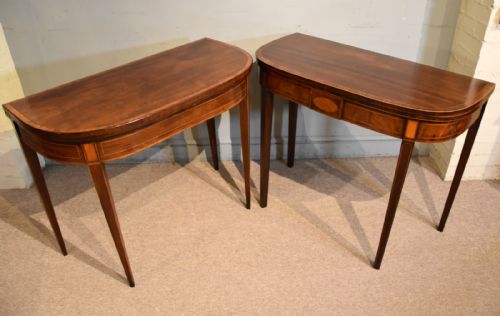
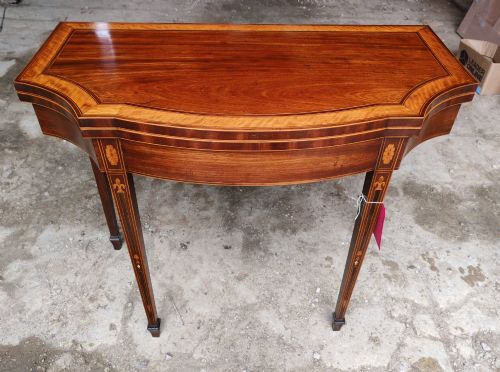


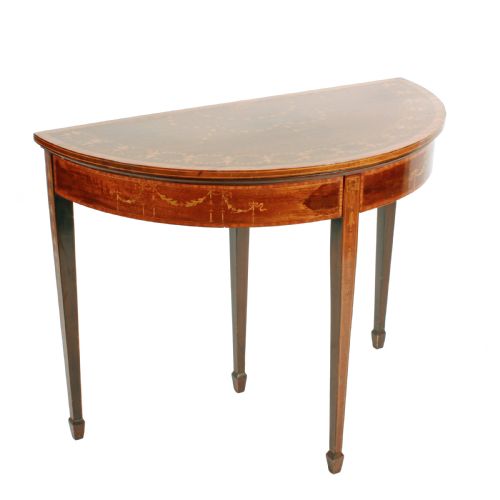

Sheraton Style Foldover Table
These Sheraton style foldover table pieces are versatile folding furniture designed for cards, games, or tea.
Sheraton Style Foldover Table
A sheraton style foldover table is primarily designed for cards, games, or tea, appearing across periods from the 18th century through to the 1930s. The selection on this page centres on card tables, games tables, and tea tables, alongside occasional console forms.
Most examples you meet are either genuine Georgian pieces or later revivals from the 19th and early 20th centuries, including Edwardian interpretations and Sheraton Revival pieces. These tables frequently adopt a demi-lune shape or rectangular folding tops that reveal a baize-lined surface when opened.
The assortment reflects both original 18th-century craftsmanship and later revivals from 1890, 1900, 1920, and 1930. Buyers find both single tables and matched pairs, particularly within the Sheraton Revival and Georgian categories.
How they were made
Construction relies heavily on mahogany and satinwood, often enhanced with boxwood and rosewood veneers or decorative painted timber. Brass components frequently appear on hinges and swing legs supporting the folding tops.
Inlay work defines the aesthetic, with satinwood inlay and contrasting stringing providing the delicate geometric or classical motifs associated with the style. Joinery combines traditional cabinet-making techniques with turning and tapered leg construction suited to folding frames.
Sheraton Style Foldover Table Retail Price Guide 2026
Typical asking prices for sheraton style foldover table among the pieces listed under this phrase on Sellingantiques today, from the lower quarter to the upper quarter. They describe what is for sale here now, not the wider market.
Many a Victorian card player relied on these clever folding tops to quickly clear the room for supper.
What varies in quality
Quality rests on the crispness of the satinwood inlay and the selection of timber veneers, where finely figured mahogany or rich satinwood distinguishes superior examples from plain construction. The precision of the joinery in the folding mechanism and the stability of the swing legs also mark the standard of the piece.
Original 18th-century pieces carry the authority of age, whereas later revivals from the Edwardian era or the 1920s and 1930s depend entirely on the fidelity of their proportions and the skill of the marquetry or inlay work.
The Sheraton Style Foldover Table Glossary
- Demi-lune
- A half-moon shape commonly used for the tops and frames of card tables designed to sit flat against a wall. This profile became a hallmark of late 18th-century design.
- Foldover table
- A table with a hinged top that doubles its surface area when unfolded, supported by a swing leg or pivoting frame. These were essential items for entertaining.
- Satinwood inlay
- A contrasting light-coloured wood inserted into darker timber surfaces to create decorative borders and classical motifs. It forms a primary decorative element in Sheraton Revival furniture.
- Card table
- A specialised folding table equipped with a baize or leather playing surface and sometimes corner wells for counters or candlesticks. They emerged in various geometric forms during the Georgian period.
- Sheraton Revival
- A late 19th and early 20th-century movement that reinterpreted the light, neoclassical furniture designs of Thomas Sheraton. Pieces from this era often feature elaborate satinwood inlay and painted timber.
Sheraton Style Foldover Table: Frequently Asked Questions
What is a foldover table used for?
These tables served primarily for social gatherings, functioning as card tables for games like whist, or as tea tables. When folded closed, they stood compactly against a drawing room wall as console or side tables.
Opening the hinged top revealed a baize-lined surface ready for evening entertainment, making them exceptionally adaptable pieces of domestic furniture.
How do I tell an original Georgian piece from a revival?
Distinguishing original 18th-century tables from 19th or 20th-century revivals requires examining the timber ageing, construction methods, and secondary woods used in the frame. Revivals often bear the hallmarks of Edwardian or 1920s and 1930s manufacturing techniques.
Design terminology in listings also guides identification, separating authentic George III pieces from later Sheraton Revival interpretations.
What woods were used to make these tables?
Mahogany and satinwood form the primary structural and surface timbers for these tables, complemented by boxwood and rosewood for contrasting details. Painted timber also appears in certain decorative revival examples.
Brass hardware is standard for the hinges and pivoting mechanisms that allow the top leaf to fold and unfold securely.