





Sheraton Revival Dining Table
These Sheraton revival dining table selections bring neoclassical grace to the modern room, offering elegant surfaces shaped by late nineteenth and early twentieth century cabinet-makers.
Sheraton Revival Dining Table
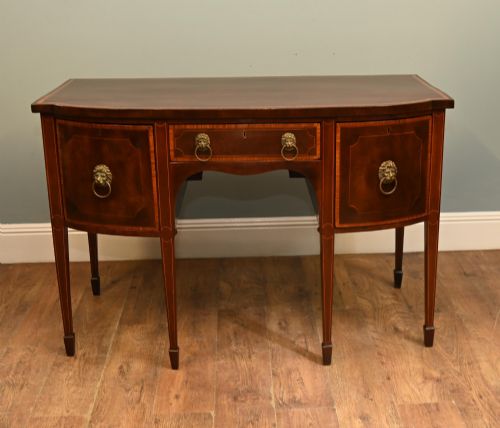
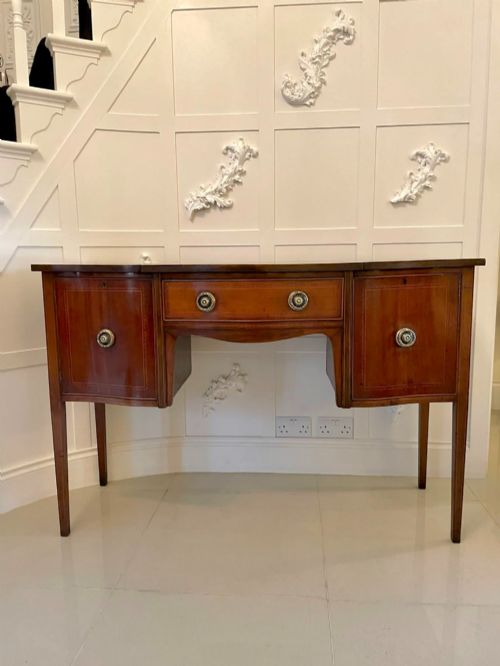
When you search for a sheraton revival dining table, you are looking at fine furniture pieces inspired by late eighteenth-century neoclassical designs, typically produced during the Victorian and Edwardian eras. The listings here predominantly feature extending dining tables alongside related dining room pieces such as sideboards, serving tables, and side chairs from the 1880s to 1910.
The objects combine historical design motifs with the solid construction methods of the late nineteenth century. You will encounter forms styled in the manner of Sheraton and Hepplewhite revivals, showcasing the enduring popularity of classical English furniture types during the Edwardian period.
How they were made
The construction relies heavily on mahogany as a primary timber, often enhanced by satinwood and boxwood inlay to create striking surface contrasts. Cabinet-makers utilised wood inlay and satinwood cross-banding to decorate the tops and borders of these tables and sideboards.
Brass fixtures frequently appear on these pieces for handles and mechanical extensions. Marquetry and delicate stringing demonstrate the precise hand-working techniques applied by makers during the Edwardian era and late nineteenth century.
Sheraton Revival Dining Table Retail Price Guide 2026
Typical asking prices for sheraton revival dining table among the pieces listed under this phrase on Sellingantiques today, from the lower quarter to the upper quarter. They describe what is for sale here now, not the wider market.
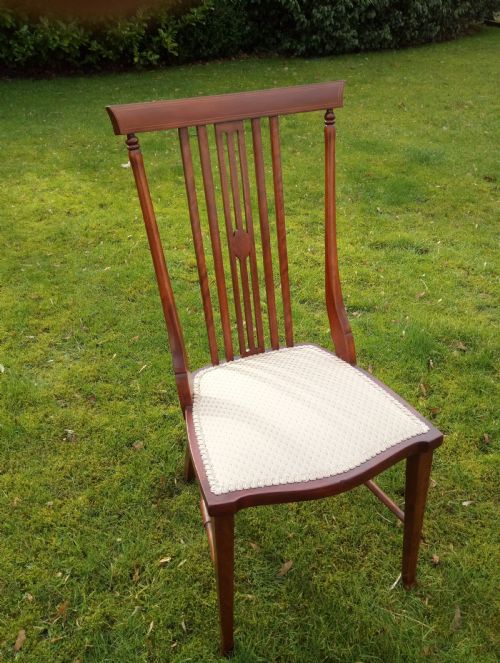
A solitary bedroom chair from the early 1900s sits quietly among the heavy sideboards and dining tables.
What varies in quality
Quality in a sheraton revival dining table rests on the crispness of the inlay and the selection of the mahogany timber. Pieces with fine satinwood cross-banding and intricate boxwood stringing demonstrate superior craftsmanship compared to plainer examples.
The depth and clarity of the marquetry work distinguish the finer pieces on the market. Furthermore, the overall proportion and the fidelity to classical revival lines dictate the aesthetic standing of each piece.
Howard And Sons
The Sheraton Revival Dining Table Glossary
- Sheraton Revival
- A late nineteenth and early twentieth century design movement that reinterpreted the light, neoclassical forms popularised by Thomas Sheraton in the eighteenth century. It is characterised by straight tapered legs and refined inlay work.
- Satinwood
- A durable, lustrous yellowish timber native to Ceylon and India, highly prized for its use in contrasting veneers and banding on Edwardian furniture. It brings a bright golden contrast to darker mahogany fields.
- Cross-banding
- A border veneer applied around the edges of a table top or drawer front so that the grain runs at right angles to the central panel. This technique frames the primary wood and showcases the maker's skill.
- Marquetry
- Decorative patterns formed by the insertion of various coloured woods and other materials into a veneer surface. It differs from inlay by assembling the pattern before fixing it to the solid substrate.
Sheraton Revival Dining Table: Frequently Asked Questions
What is a sheraton revival dining table?
A sheraton revival dining table is a piece of furniture made during the late nineteenth or early twentieth century that imitates the neoclassical style of the 1700s. These pieces often feature mahogany construction with contrasting wood inlay.
They reflect the Victorian and Edwardian appreciation for lighter, more graceful furniture forms than those of the mid-nineteenth century. The design idiom draws directly upon the pattern books of Thomas Sheraton.
How do I date these tables?
Dating relies on examining the construction materials, secondary timbers, and the specific style of the revival movement. Pieces seen on this page span from the 1880s through the Edwardian period up to 1910.
Techniques in veneering and the specific shade of mahogany can also provide clues to whether a piece originates from the late Victorian or Edwardian era.
How were these tables used?
These tables served as the centrepiece for formal dining in late nineteenth and early twentieth century homes. They were designed to accommodate multiple guests during family meals and social gatherings.
Many featured extending mechanisms to expand the surface area when hosting larger dinner parties.
How do I care for inlaid wood?
Inlaid surfaces require consistent indoor humidity and protection from direct sunlight to prevent the delicate boxwood and satinwood from drying out. Regular dusting with a soft, dry cloth preserves the polished finish.
Avoid placing hot items or liquids directly onto the mahogany surface to protect the historic polish and underlying veneers.