
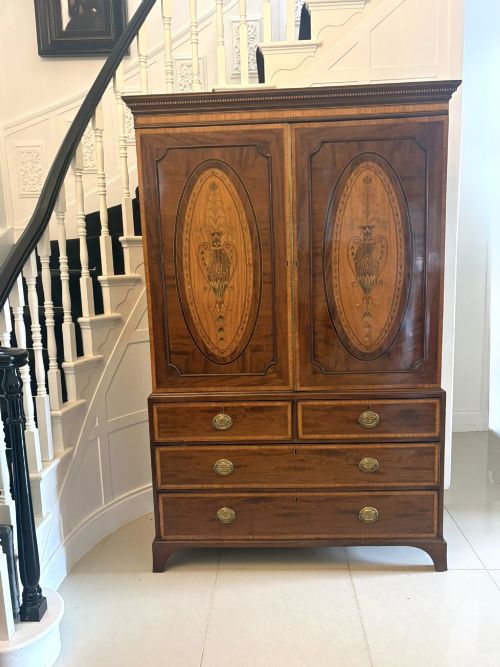
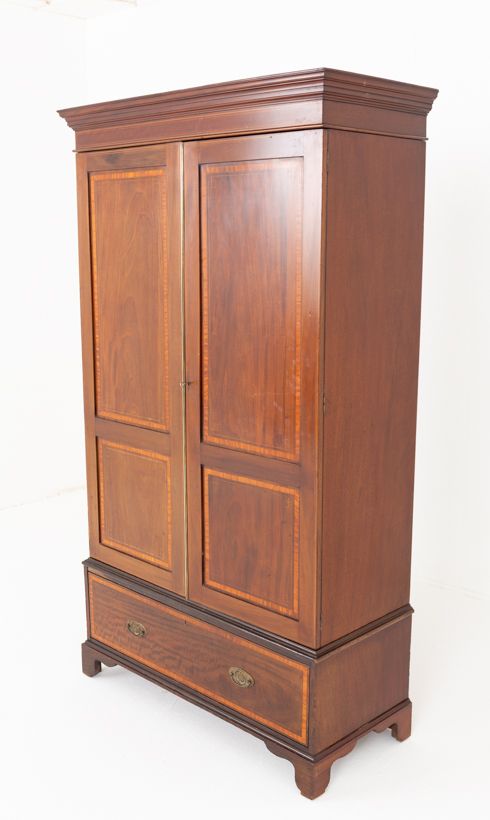
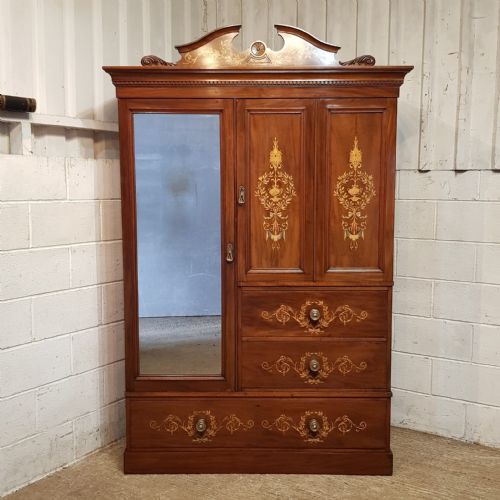
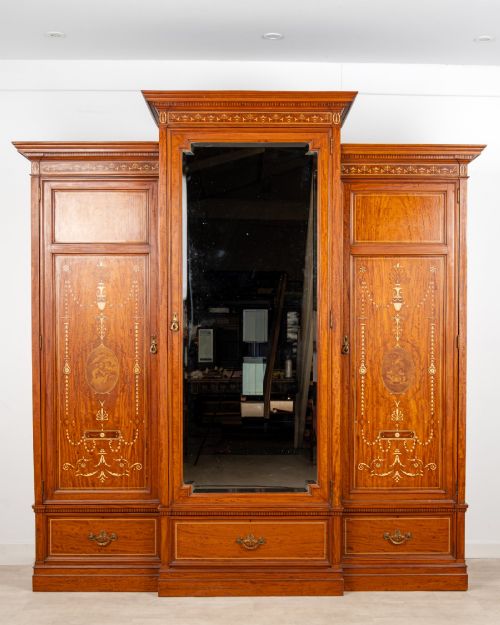
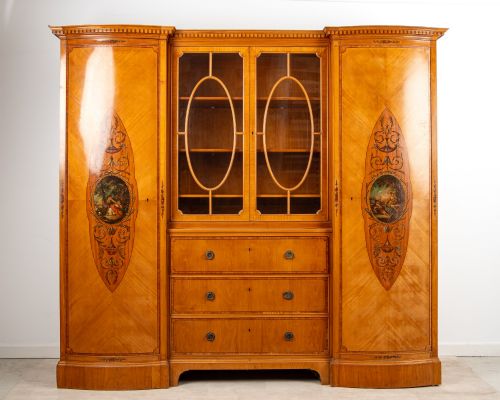
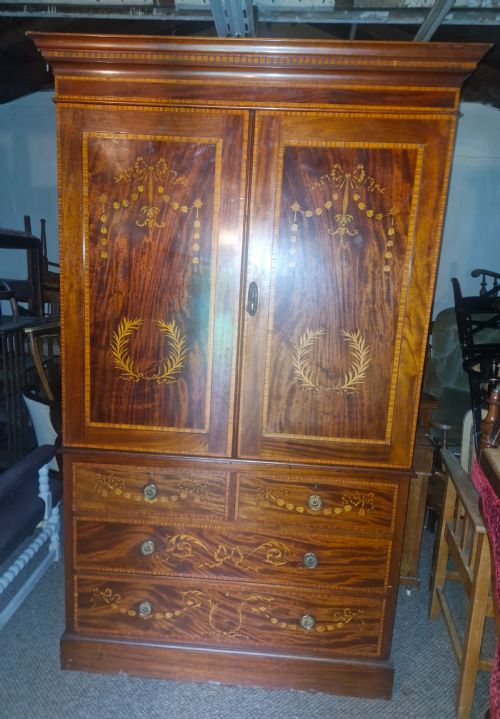


Sheraton Inlaid Armoire
These sheraton inlaid armoire pieces bring graceful classical lines and fine cabinet-making into modern bedrooms.
Sheraton Inlaid Armoire
A sheraton inlaid armoire combines the architectural proportions of late eighteenth-century design with the practical storage needs of large wardrobes and linen presses. Pieces span from the Georgian period through the Victorian era and into the Edwardian decades, capturing shifting tastes in domestic furniture.
Buyers frequently encounter Edwardian interpretations and Sheraton Revival pieces alongside older Georgian examples, reflecting the enduring popularity of this refined style. Forms vary from single wardrobes and compactums to large triple cabinets and fitted linen presses.
The construction serves as a practical storage solution, often incorporating hanging space, sliding trays, and drawers within a single architectural facade. These tall cabinets anchor a bedroom with balanced proportions and restrained decorative motifs.
Materials and construction
Cabinet-makers relied on mahogany, walnut, and satinwood as primary timbers, often enhanced by flame mahogany veneer to create striking grain patterns on large doors and panels. These sturdy carcases provide the structural integrity required for tall wardrobes and presses.
Decoration is achieved through delicate stringing and inlay work utilising boxwood and brass, alongside painted panels and marquetry details in specific revival pieces. These contrasting woods define panels and borders with geometric precision.
Some Edwardian wardrobes hide a secret sliding tray system originally designed to keep starched collars pristine.
Distinctions in quality
The refinement of the timber selection and the precision of the boxwood stringing dictate the visual success of the piece, separating standard production from exceptional cabinet-making. Grain matching across large wardrobe doors demands high technical skill.
Structural integrity depends on the quality of internal fittings, such as sliding linen trays and original brass hardware, which retain their smooth function over centuries of domestic use. The handling of cornices and plinths reveals the original maker's commitment to classical proportions.
Druce & Co.·Maples & Co
The Sheraton Inlaid Armoire Glossary
- Armoire
- A large wardrobe or cupboard for storing clothes, typically featuring two or more doors. These tall pieces dominate bedroom interiors and offer substantial storage capacity.
- Linen Press
- A tall cabinet traditionally used for storing folded linen and bedding, combining upper shelving with lower drawer storage. Georgian and Victorian examples often feature sliding trays behind panelled doors.
- Compactum
- A multi-functional wardrobe that integrates hanging space, drawers, and shelving into a single unified cabinet. Edwardian makers utilised this form to maximise storage efficiency in large bedrooms.
- Stringing
- Narrow strips of contrasting wood inlaid into shallow channels on the furniture surface to create decorative borders. This subtle technique defines drawer fronts and panel edges.
- Marquetry
- The art of applying pieces of veneer to a structure to form decorative patterns and pictorial designs. This technique adds colour and intricate detail to cabinet doors.
Sheraton Inlaid Armoire: Frequently Asked Questions
How do I date a sheraton inlaid armoire?
Dating relies on examining the primary timber, secondary woods used in internal construction, and the style of the inlay work. Georgian pieces display crisp hand-cut dovetails and native timbers, while Edwardian revivals often incorporate softer secondary woods and machine-cut elements.
The overall proportion and decorative motifs also shift between periods. Late eighteenth-century originals favour strict neoclassical symmetry, whereas Edwardian interpretations often present lighter satinwood finishes and painted panels.
What is the difference between a wardrobe and a linen press?
A traditional wardrobe is designed primarily for hanging garments vertically on rails or hooks within tall doors. A linen press is characterised by internal sliding trays or shelves behind the upper doors, historically intended for folded textiles, paired with lower drawers.
Over time, many linen presses have been converted to hanging wardrobes by removing internal trays to suit modern clothing needs. Examining the interior configuration helps reveal the original function of the cabinet.
How do I care for satinwood and mahogany surfaces?
Regular dusting with a soft, dry cloth prevents the accumulation of abrasive particles on polished veneer surfaces. Avoid placing antique cabinets in direct sunlight or near heat sources to prevent the timber from drying and splitting.
Application of traditional microcrystalline wax feeds the wood and maintains a gentle lustre without building up heavy residues. Professional advice should be sought before attempting any chemical cleaning on painted panels or delicate stringing.
Will a large armoire fit in a modern bedroom?
These large cabinets require careful measurement of ceiling height and doorway clearance prior to purchase, as many do not dismantle fully. Edwardian and Victorian triple wardrobes and compactums are particularly substantial pieces that demand adequate wall space.
Consider the swing of large doors and the depth of internal hanging space when planning room placement. Many pieces feature removable cornices that assist with installation in rooms with standard ceiling heights.