
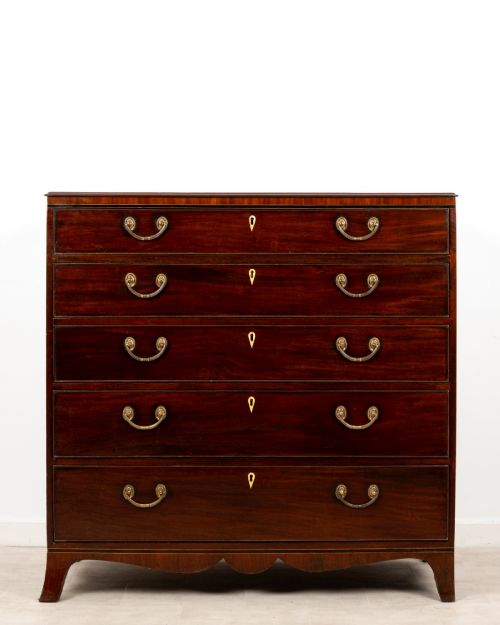

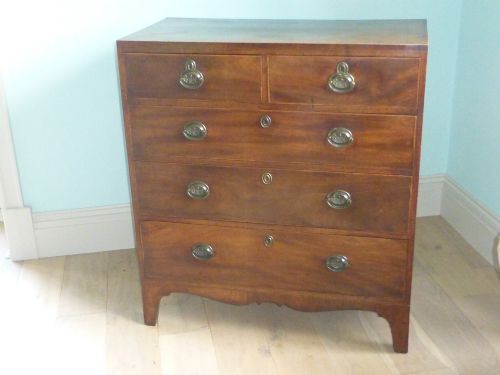

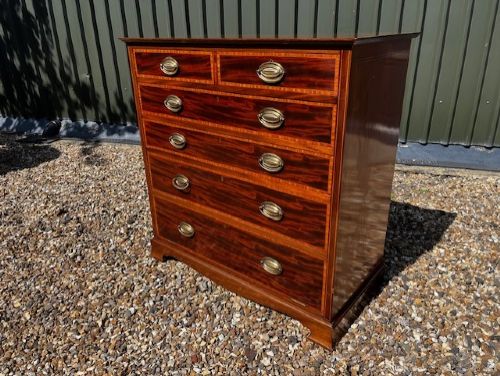


Sheraton Chest of Drawers
A sheraton chest of drawers brings disciplined geometry and fine cabinet-making into a room through precise lines and restrained marquetry.
Sheraton Chest of Drawers
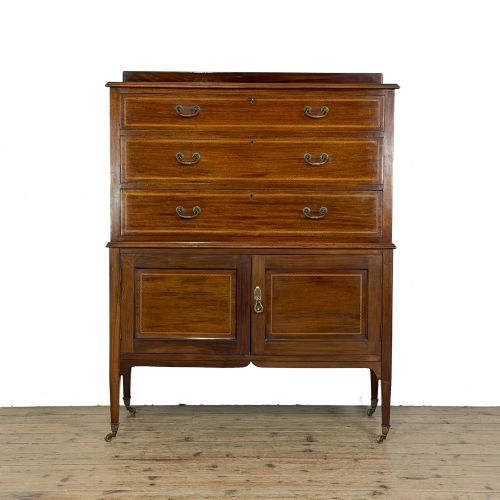
A sheraton chest of drawers embodies the refined classical taste of the late eighteenth century, defined by rectangular or bow-fronted carcass work and tapered supports. Pieces encountered range from genuine late Georgian examples to Edwardian revivals that imitate the lighter proportions of the original era.
Makers produced standard drawer chests alongside complex secretaire variants, linen presses, and tallboys designed to maximise storage without heavy visual bulk.
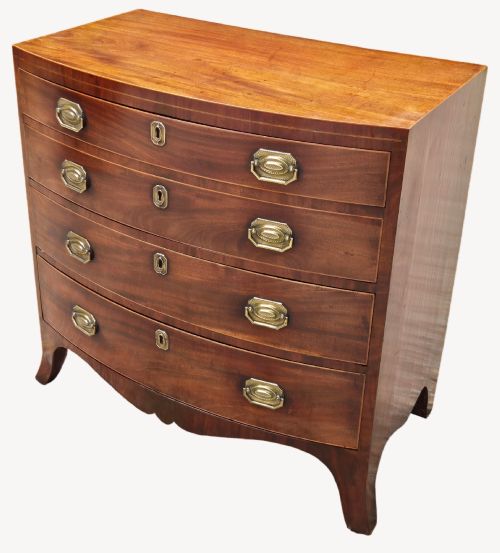
Surviving formats span flat fronts, bow-fronts, and serpentine shapes executed in mahogany or satinwood.
Materials and construction
Workshops relied heavily on solid mahogany and figured flame mahogany timbers, frequently contrasted with pale satinwood banding and delicate boxwood stringing.
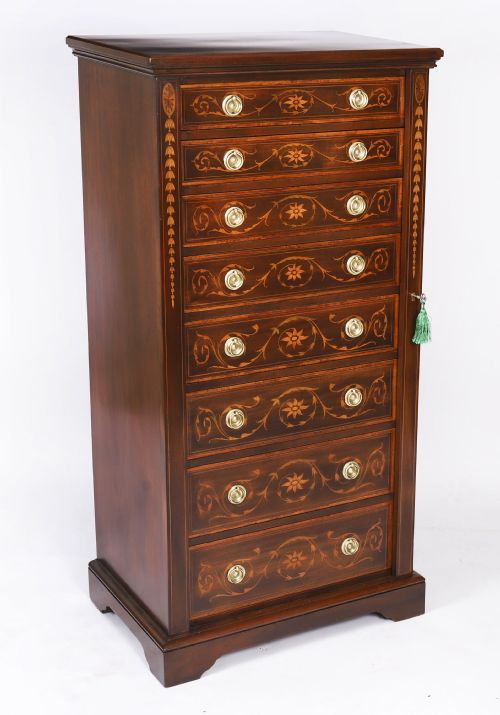
Inlays incorporated contrasting woods and bone details, set flush into the primary surfaces around drawer edges and panel borders.
Internal framing utilised secondary timbers such as oak, while brass hardware secured the drawer fronts and doors.
Secret compartments inside secretaire drawers kept confidential correspondence away from prying eyes.
Craftsmanship and proportion
Superior execution shows in the tightness of the dovetail joints and the continuous alignment of grain across adjacent drawer fronts.
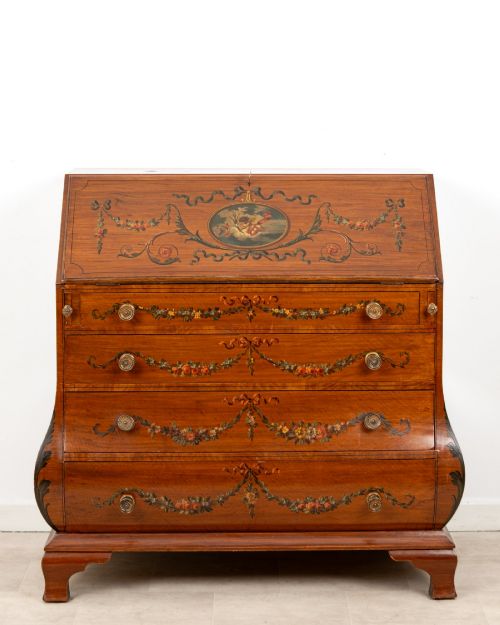
The finesse of the painted decoration or the precision of the boxwood inlay dictates the visual success of satinwood revivals.
Original brasses and well-figured secondary timbers separate standard utility pieces from exceptional cabinet work.
J Shoolbred·Edwards and Roberts
The Sheraton Chest of Drawers Glossary
- Bow-front
- A convex curved cabinet front that softens the corners of a room. This shape required advanced joinery to bend veneers and timbers accurately.
- Satinwood
- A lustrous tropical hardwood prized for its pale golden yellow colour. It provided a contrasting surface for painted motifs and darker banding.
- Secretaire chest
- A case piece featuring a fitted top drawer that drops down to reveal a writing surface and small pigeonholes. It combined desk and storage functions in one footprint.
- Tallboy
- A tall chest of drawers constructed in two stacked sections to increase storage capacity. These towering units raised storage capacity while maintaining a compact floor footprint.
- Stringing
- Thin strips of contrasting wood inlaid into grooves on drawer fronts or legs. This technique outlined the structural geometry of the piece.
Sheraton Chest of Drawers: Frequently Asked Questions
How do I spot a revival piece?
Edwardian revival examples often display machine-sawn internal timbers and uniform modern brass fittings that differ from eighteenth-century hand-cut construction methods.
Closer inspection of the secondary woods inside the drawers usually reveals the later manufacturing date.
Were these used in bedrooms?
Georgian versions served primarily in principal bedchambers for linens and daily apparel, whilst specialised gentleman's variants included built-in dressing drawers.
Later Edwardian iterations continued this domestic function across both bedrooms and dressing rooms.
What is a brushing slide?
A pull-out shelf integrated just beneath the top surface, designed for folding clothes or temporarily resting small items during dressing.
This practical feature sat concealed behind the upper moulding when not in active use.
How should I care for satinwood?
Satinwood benefits from minimal direct sunlight to prevent the pale golden tones from darkening or fading unevenly over decades.
Regular dusting with a dry cloth protects the polished surface without requiring heavy wax applications.