



Shell Relief Carving
Shell relief carving brings miniature classical sculpture and architectural ornament to life through the patient removal of natural layers.
Shell Relief Carving
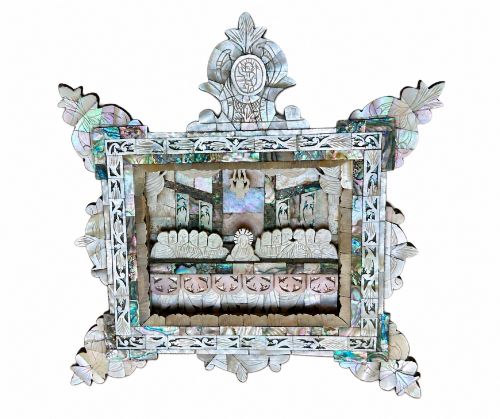
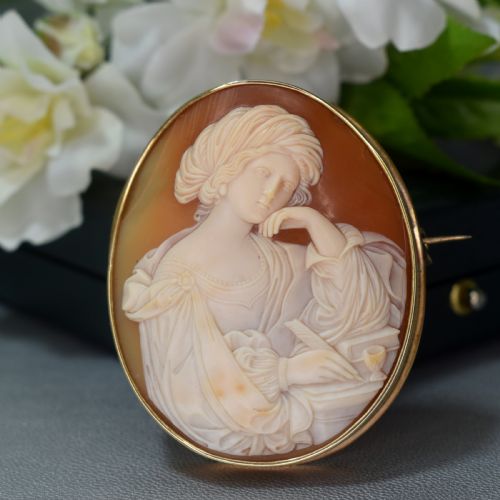
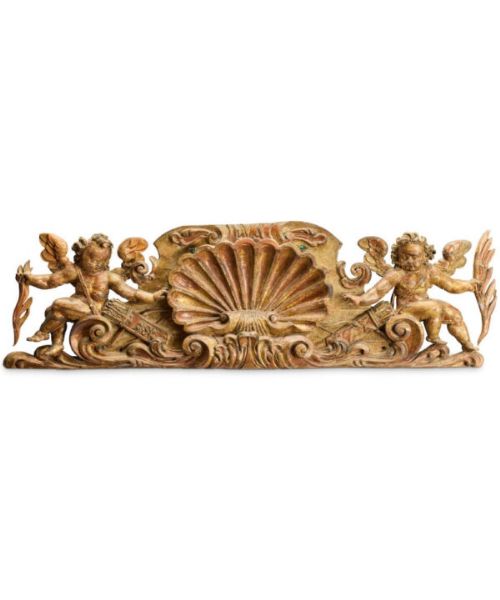
Shell relief carving encompasses both personal adornment such as cameo brooches and earrings, and architectural elements like carved wood pediments finished in gesso and gold leaf. The personal ornaments utilise natural shell, Queen conch shell, and mother of pearl set in yellow gold, 9ct gold, 18ct gold, pinchbeck, or silver.
The pieces appearing on this page span the 18th century, the Victorian era, and the mid-20th century. Visitors will regularly encounter portrait cameos, mythological subjects like the goddess Flora or the Persian Sibyl, and decorative plaques originating from Italy, Jerusalem, and England.
Forms range from intimate earrings and mounted tabletop ornaments to monumental framed cameos and architectural fragments. Each object demonstrates the transformation of organic shell or timber into detailed sculptural relief.
How they were made
Makers carve shell relief pieces by exploiting the natural colour banding found in mollusc layers, cutting away the darker outer stratum to leave a white figure raised against a contrasting background. This demands precise hand tools and a steady eye to preserve the delicate depth without puncturing the thinner shell strata.
Precious metals such as 9ct gold, 18ct gold, and silver are shaped into bezels and frames to house the carved shells, while pieces like architectural pediments rely on carved wood finished with gesso and gold leaf for their substantial decorative presence.
Listings feature items spanning the 18th century, Victorian period, and 1940, utilising shell, 9ct gold, yellow gold, Queen conch shell, silver, carved wood, gesso, and gold leaf.
What varies in quality
Quality rests upon the depth of the carving, the crispness of the undercutting, and the natural uniformity of the shell layers. Superior examples display facial expression and anatomical proportion with great clarity, whereas lesser pieces show softer, shallower lines with less anatomical definition.
R. Pernice
The Shell Relief Carving Glossary
- Cameo
- A method of carving an object such as an engraved gem or shell in relief. This technique creates a raised design that stands out from a background of a different colour.
- Conch shell
- The material derived from large marine snails, frequently utilised for Victorian cameo brooches and earrings. Its natural pink and white layers provide strong contrast for portrait carvers.
- Pinchbeck
- An alloy of copper and zinc invented in the 18th century to imitate gold. It frequently appears as the mounting metal on period costume jewellery and Victorian pieces.
- Gesso
- A plaster-like mixture applied to wood surfaces as a base for gilding. It permits crisp moulding and carving on architectural fragments and decorative plaques.
- Mother of pearl
- The iridescent inner layer of mollusc shells. Artisans carve this material into flat plaques and decorative inlays with shimmering tonal variations.
Shell Relief Carving: Frequently Asked Questions
How do I wear a shell cameo brooch?
Pin shell cameo brooches securely to heavy fabrics like wool coats, velvet lapels, or thick linen collars where the weight of the metal frame is properly supported. Ensure the safety chain, if fitted, is secured alongside the main pin to prevent accidental loss during wear.
Keep these items away from perfumes, hairsprays, and direct cosmetics, as the organic calcium carbonate of the shell reacts poorly to harsh chemicals and alcohol.
How should I clean my carved shell?
Clean carved shell gently using a soft, dry cloth to remove dust from the intricate recesses of the relief. Avoid soaking shell pieces in water or using ultrasonic jewellery cleaners, which can cause permanent surface damage.
Apply a tiny touch of mineral oil with a soft brush only if the shell appears excessively dry, buffing away any excess gently after a few minutes.
What is the difference between Victorian and later cameos?
Victorian cameos often depict classical mythology, religious figures, or historical sibyls in finely chased gold or pinchbeck mounts. These 19th-century works reflect the grand tour era's fascination with Italian antiquity and sculpture.
Later 20th-century examples tend toward simplified portraits or stylised floral motifs, occasionally utilising larger Queen conch shells within sterling silver settings.
How are architectural shell carvings used today?
Architectural shell carvings, such as carved wood pediments with gesso and gold leaf, are displayed as wall-mounted focal points above doorways or fireplaces. They bring historic texture and classical proportion into modern interior spaces.
Position these larger wooden elements away from direct heat sources and damp walls to preserve the underlying gesso and gilt finishes.