








Serpentine Top Breakfast Table
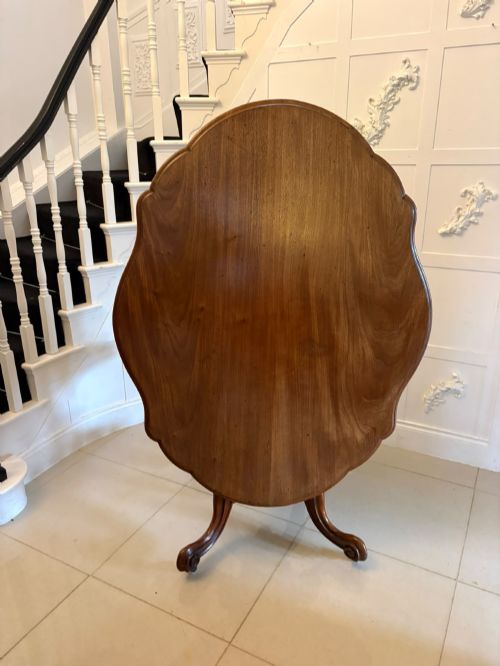
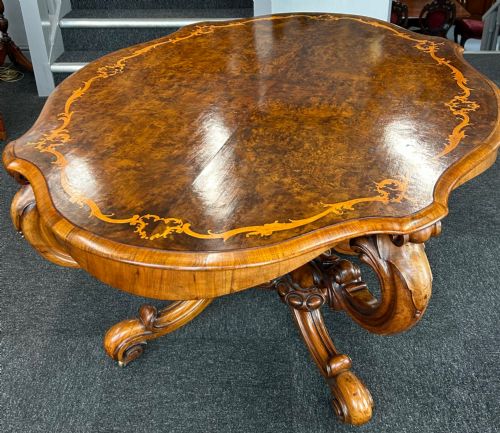
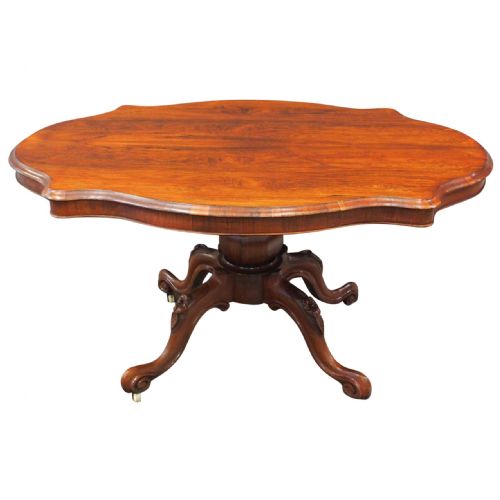
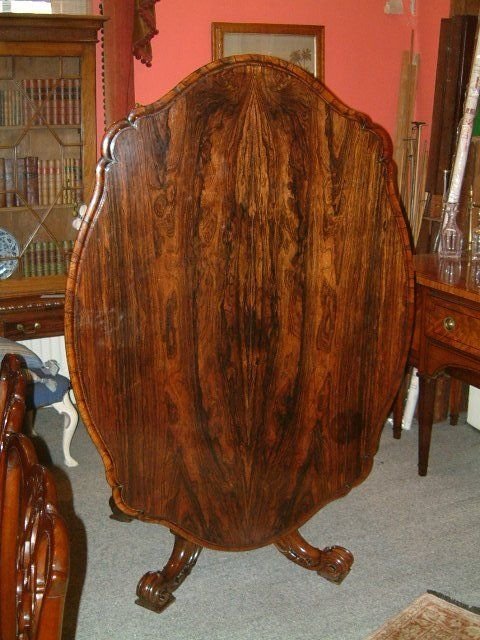
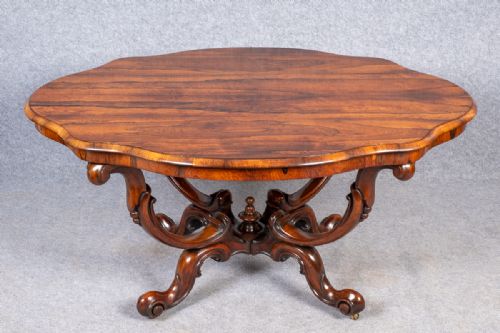
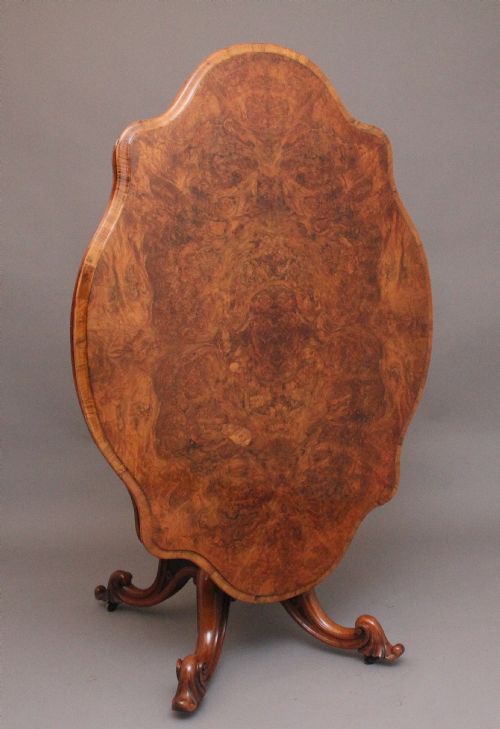
A serpentine top breakfast table brings fluid Victorian curves and rich timber grain to the centre of a room.
Serpentine Top Breakfast Table
A serpentine top breakfast table is a distinct Victorian form, appearing primarily across the middle decades of the nineteenth century. These pieces combine a shaped, undulating edge with a tilt-top mechanism and a substantial central pedestal, functioning as both dining and centre tables.
The examples gathered here span from eighteen fifty to eighteen seventy, capturing the height of Victorian cabinet-making. Most pieces rely on burr walnut, rosewood, or figured mahogany to create a striking visual impact in a principal room.
Materials and construction
Cabinet-makers of the period employed choice veneers such as burr walnut and rosewood laid over stable secondary woods, sometimes complemented by delicate fruitwood inlay. This technique allowed workshops to display rich, figured grain patterns across the generous surfaces of the tops.
The heavy timber tops rest on turned or carved pedestals supported by robust bases, frequently fitted with brass castors. The tilt-top mechanism relied on sturdy timber blocks and metal catches to allow the table to stand upright when not in use.
Serpentine Top Breakfast Table Retail Price Guide 2026
Typical asking prices for serpentine top breakfast table among the pieces listed under this phrase on Sellingantiques today, from the lower quarter to the upper quarter. They describe what is for sale here now, not the wider market.
Many a Victorian breakfast table spent its quiet mornings folded upright and hiding modestly against the parlour wall.
Judging quality
Quality in these tables rests on the selection of the timber veneer and the crispness of the serpentine moulding. Superior examples display symmetrical, highly figured grain across the entire top without disruption.
Constructional depth also distinguishes the better pieces, seen in substantial pillar supports and finely carved bases rather than plain turnings. The smoothness of the tilt mechanism and the integration of the pedestal add to the standing of a piece.
Edwards & Roberts
The Serpentine Top Breakfast Table Glossary
- Serpentine top
- A table surface with an undulating edge featuring alternating concave and convex curves. This shape requires careful hand-moulding along the perimeter of the timber.
- Tilt-top
- A hinged mechanism allowing the table surface to rotate and lock into a vertical position. This design enabled the table to be stored against a wall when floor space was needed.
- Burr walnut
- A highly prized timber veneer sourced from the wart-like growths on walnut trees. It yields complex, swirling grain patterns favoured by nineteenth-century cabinet-makers.
- Centre table
- A freestanding table designed to be viewed from all sides in the middle of a room rather than pushed against a wall. These pieces often feature finished decoration around the entire base.
Serpentine Top Breakfast Table: Frequently Asked Questions
What is a serpentine top breakfast table?
A serpentine top breakfast table is a nineteenth-century Victorian form featuring a curved, undulating edge and a central pedestal base. These versatile tables were designed for dining and general use.
Most examples include a tilt mechanism so the top can be folded away when space is required. They showcase rich timbers like burr walnut and rosewood.
How do I use a tilt-top table?
The tilt-top mechanism relies on a brass or wooden catch beneath the surface that releases the top from its horizontal position. This allows the table to pivot upright for storage or movement.
When returning the table to horizontal, ensure the catch engages fully to lock the surface securely in place before placing items on it.
How do I care for Victorian walnut and rosewood?
Keep these tables away from direct sunlight and heat sources to prevent the timber veneers from drying out or splitting. Gentle dusting with a soft cloth maintains the polished finish.
Avoid using modern silicone sprays, relying instead on traditional beeswax applied sparingly to nourish the wood grain.
How do I date a Victorian breakfast table?
Dating relies on the combination of timber choices, decorative carving styles, and construction methods recorded across the mid-nineteenth century. Pieces from this era frequently employ burr walnut veneers and rosewood.
Makers' marks or stamps, when present on the underside or mechanism, provide a direct link to specific workshops active during the period.