
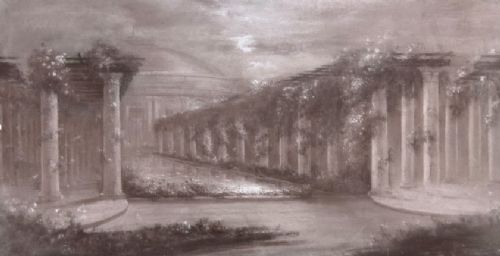


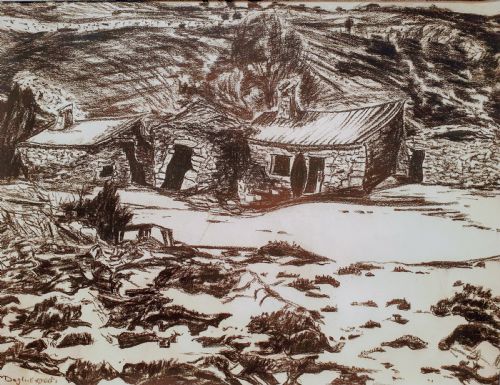

Sepia Paper Architectural Drawing
These sepia paper architectural drawing works capture monumental facades and historic structures through monochrome washes and precise lines, offering a direct view into past design rooms.
Sepia Paper Architectural Drawing
A sepia paper architectural drawing presents historical buildings, institutional designs, and urban structures rendered in monochrome brown tones. The selection spans the nineteenth and twentieth centuries, including academic study pieces alongside finished townscapes.
Many examples emerge from nineteenth-century contexts, such as school training projects and detailed studies of notable landmarks like cathedrals and botanical glasshouses. These works function as both technical records and accomplished graphic art.
Buyers encounter both signed individual sheets by named artists and anonymous academic exercises. The forms range from small pencil sketches to large framed watercolours on paper attached to canvas stretchers.
Materials and techniques
Artists and students utilised paper as the primary support, frequently mounting larger sheets onto canvas stretchers to maintain stability. The monochrome palette relies on sepia ink, charcoal, and watercolour washes.
Draftsmen combined graphite pencil and ink lines to establish precise geometric perspectives of facades and interiors. Watercolour and wash applications then provided tonal depth and shadow across the architectural surfaces.
The current selection spans works created across the nineteenth and twentieth centuries, utilising paper, watercolour, ink, and charcoal.
Qualities that set pieces apart
The precision of the draughtsmanship and the confidence of the ink or pencil line distinguish accomplished academic works from routine student exercises. A skilled hand captures both structural accuracy and atmospheric lighting within a restricted tonal range.
Condition and presentation also define the upper tier, where intact paper surfaces, minimal foxing, and appropriate historic framing preserve the integrity of the original medium. Provenance, such as identifiable school origins or named makers, further anchors the historical value.
Charles James Lauder·H. H Wyatt·Sir Francis Leggatt Chantrey·Fred Lawson·George De Paris·Joseph Hansom
The Sepia Paper Architectural Drawing Glossary
- Sepia
- A dark brown pigment derived from the ink sac of the cuttlefish, widely used for monochrome drawings and washes.
- Academic study
- A rigorous drawing or painting executed by an art student or pupil to master technique, perspective, and proportion.
- Canvas stretcher
- A wooden frame upon which paper or fabric is stretched tight before drawing or painting.
- Wash
- A thin, transparent layer of diluted watercolour or ink applied to paper to create smooth areas of tone.
- Provenance
- The documented history and ownership trail of an artwork that helps verify its authenticity and origins.
Sepia Paper Architectural Drawing: Frequently Asked Questions
How do I date an architectural drawing?
Dating relies on stylistic clues, historic dress in associated townscapes, and any inscribed dates or signatures left by the draftsman.
Paper stock, watermark evidence, and framing methods also provide reliable indicators of the period of execution.
Where were these drawings displayed?
Original architectural drawings were produced for design competitions, school exhibitions, and architectural offices.
Many remained bound in folios or stored in institutional archives before entering the art market as framed wall pieces.
How should I frame a drawing on paper?
Framing historic paper requires acid-free mount boards and conservation-grade materials to prevent discolouration and degradation over time.
Glazing with UV-filtering glass protects the delicate sepia inks and watercolours from fading under ambient light.
Are student drawings collectible?
Nineteenth-century academic and school drawings are increasingly appreciated for their exceptional technical skill and graphic purity.
They offer a direct glimpse into historical training methods and the rigorous standards demanded of young draftsmen.