

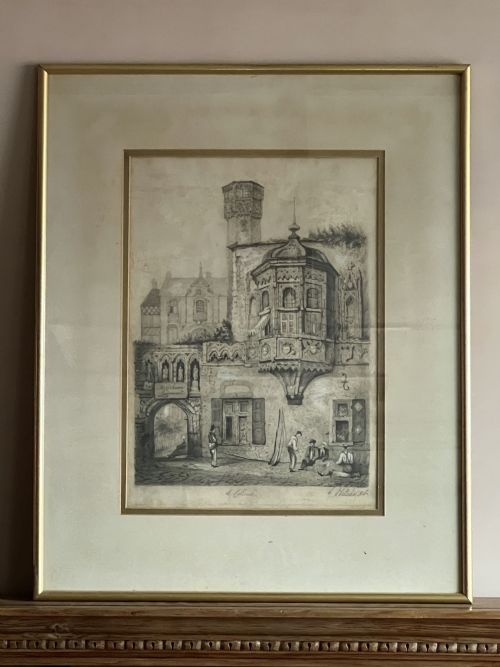


Sepia Ink Landscape Drawing
These sepia ink landscape drawing pieces offer monochrome views of rural and urban scenes, prized by collectors for their tonal subtlety and historical draughtsmanship.
Sepia Ink Landscape Drawing
A sepia ink landscape drawing captures scenery using brown monochrome pigments, often combining ink line work with tonal washes on paper. When searching for a sepia ink landscape drawing, buyers encounter works ranging from Georgian studies to mid twentieth century British townscapes.
The selections available span multiple eras, including Georgian, nineteenth century, and early twentieth century periods. Examples include works attributed to notable figures like Thomas Rowlandson and regional artists associated with the Norwich School.
The subjects vary from French southern scenes and German townscapes to rural English mills, churches, and timber loading yards. These pieces are typically presented as framed original works on paper, frequently incorporating pencil and watercolour elements.
How they were made
These works rely on paper as the primary support, combined with ink, wash, and graphite or pencil. Artists built up their compositions using fine ink lines for structural detail alongside fluid washes to create depth and shadow.
Watercolour and tinted washes were frequently introduced to supplement the sepia ink, adding subtle colour variations or reinforcing tonal contrasts across the landscape. The finished drawings are typically housed behind glass within wooden frames.
What varies in quality
The quality of a drawing rests on the confidence and economy of the line work, alongside the control shown in the application of the wash. Superior examples demonstrate a secure grasp of perspective and atmospheric light through minimal means.
Condition and provenance further distinguish the range, with well preserved sheets retaining their original paper integrity and distinct tonal depth without excessive fading. Works bearing clear attributions to established draughtsmen or identifiable regional schools generally command greater attention.
Fred Lawson·Thomas Rowlandson·John Thistle·Thomas Monro·Thomas Lound
The Sepia Ink Landscape Drawing Glossary
- Wash
- A thin, transparent layer of diluted ink or watercolour applied to paper. It provides tonal variation and shadow in monochrome or coloured drawings.
- Norwich School
- A regional group of artists active in the nineteenth century inspired by the Norfolk landscape. They produced significant works in watercolour and drawing.
- Georgian
- Pertaining to the period spanning the reigns of the first four Georges, noted for distinct developments in British watercolours and graphic art.
- Framed Artwork
- A piece presented within a protective enclosure of wood and glass. This secures the paper substrate and aids preservation.
Sepia Ink Landscape Drawing: Frequently Asked Questions
What is a sepia ink landscape drawing?
A sepia ink landscape drawing is a work on paper executed primarily in brown monochrome ink, often enhanced with wash or pencil.
These pieces depict natural scenery or townscapes and range from Georgian studies to twentieth century works.
How should I frame these drawings?
These works on paper require conservation framing behind glass to protect them from light damage and atmospheric moisture.
Using acid free mounts prevents direct contact between the paper and the glazing.
How do I identify the period?
Dating relies on stylistic conventions, paper characteristics, and any recorded signatures or historical attributions.
Georgian and nineteenth century examples often display distinct handwriting, framing styles, and subject matter typical of those eras.
Where were these artists active?
The artists represented worked across various British regions, including Norfolk, Yorkshire, and Devon, as well as continental locations.
Regional movements like the Norwich School contributed significantly to the tradition of British landscape drawing.