
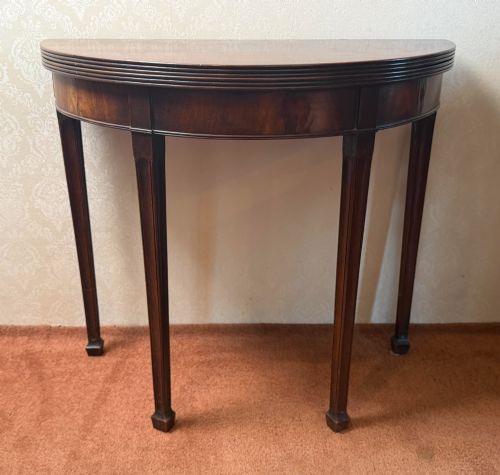
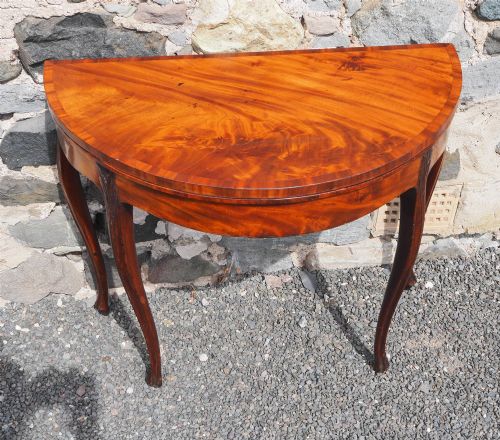
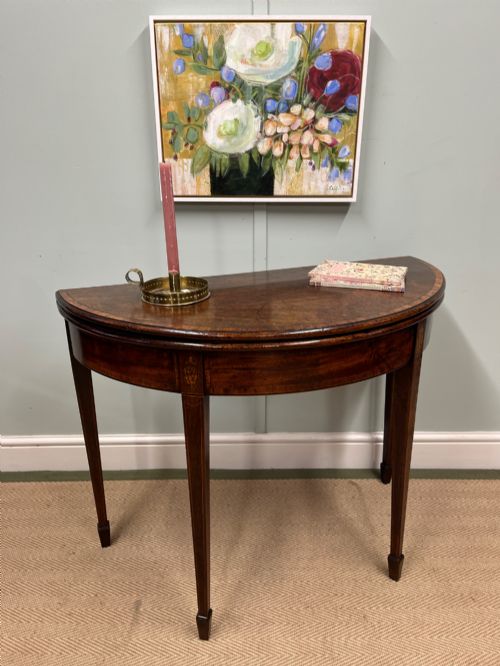


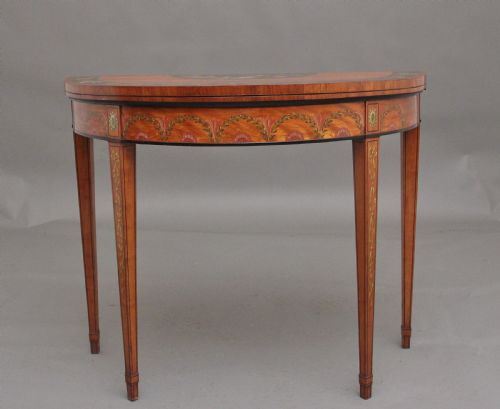


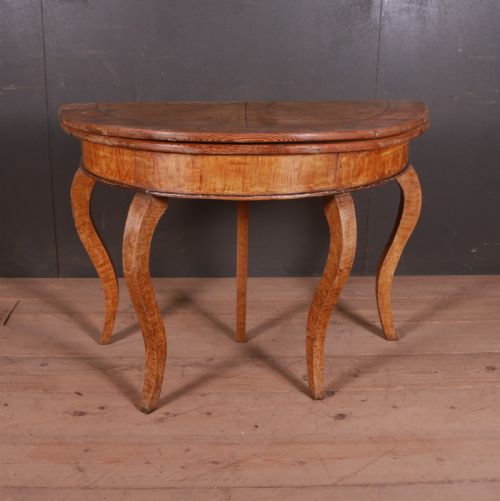
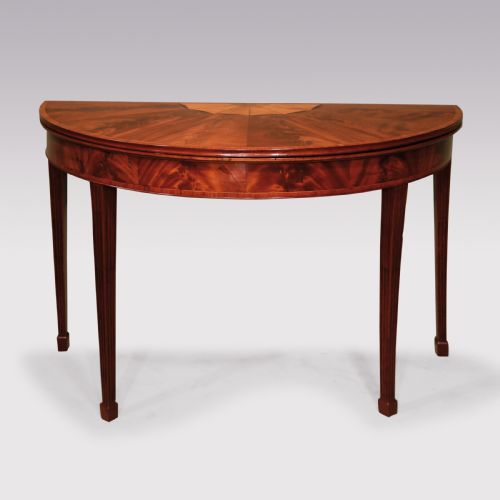


Semi Circular Card Table
A semi circular card table brings graceful curves and folding tops to a room, offering a versatile surface that transforms from console to gaming table.
Semi Circular Card Table
When searching for a semi circular card table, buyers encounter half-moon and demi-lune forms designed to sit flat against a wall when closed and unfold for play or tea. These pieces emerge chiefly from Georgian, George III, and nineteenth-century periods, alongside Edwardian revivals and occasional continental examples.
The version most commonly met on this page is the mahogany or satinwood fold-over card table, often featuring boxwood inlay or marquetry. Makers of these periods favoured versatile timber structures that functioned as console or tea tables when not in use for games.
Materials and construction
Construction relies heavily on mahogany, flame mahogany veneer, and satinwood, supported by intricate boxwood and wood inlay. Craftsmen applied fine veneers over solid secondary timbers to achieve smooth curved surfaces for the folding tops.
Detailing often incorporates brass hardware and painted satinwood motifs, alongside marquetry panels that define the characteristic half-moon shapes of the period.
Materials recorded across the available selection include mahogany, satinwood, walnut, boxwood inlay, and brass hardware.
Judging quality in these tables
Quality rests in the precision of the timber matching across the fold-over top and the crispness of the boxwood inlay or marquetry. Superior examples display seamless grain continuity when opened and retain solid structural alignment in the pivoting legs.
Finer pieces demonstrate restrained proportion and careful handling of secondary woods, whereas simpler items rely on basic veneer work without the refined marquetry or painted details seen in top-tier workshop output.
The Semi Circular Card Table Glossary
- Demi-lune
- Half-moon shape characteristic of tables designed to stand flat against a wall. This profile defines the primary silhouette of the pieces found here.
- Fold-over top
- A hinged table surface that doubles in area when opened for cards or tea. It rests upon a pivoting leg or swinging frame for support.
- Marquetry
- Decorative inlay patterns formed by fitted pieces of veneer applied to a timber surface. Craftsmen used various woods to create floral or geometric motifs.
- Console table
- A wall table fixed or placed against a vertical surface, often sharing a profile with the tables listed here before they are unfolded.
- Boxwood inlay
- Narrow strips or contrasting geometric lines of pale boxwood set into darker primary timbers to create decorative borders.
Semi Circular Card Table: Frequently Asked Questions
How were these tables used?
These pieces served primarily as console or pier tables against a wall during the day. When evening arrived, the top folded open to provide a stable surface for card games or social tea.
Their dual function made them practical additions to period drawing rooms and parlours where floor space remained at a premium.
How do I date a card table?
Dating relies on observing the prevailing style, timber choices, and inlay techniques associated with periods like George III or Sheraton. Eighteenth-century versions typically employ solid mahogany or flame veneers with restrained boxwood lines.
Later Edwardian and nineteenth-century interpretations often incorporate lighter satinwood grounds, painted details, or revival styling that distinguishes them from earlier Georgian work.
Where should I place one?
A semi circular card table suits a hallway, landing, or living room wall where a narrow profile is required. Placing it in a position that allows the top to unfold easily gives the room a functional antique focal point.
Keeping the piece away from direct heat sources protects the timber veneers and hinged joints over time.