

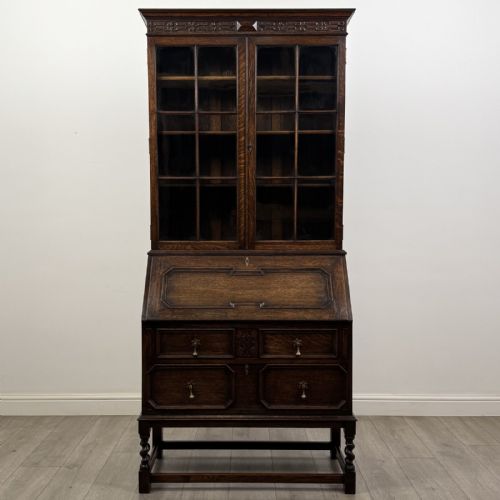
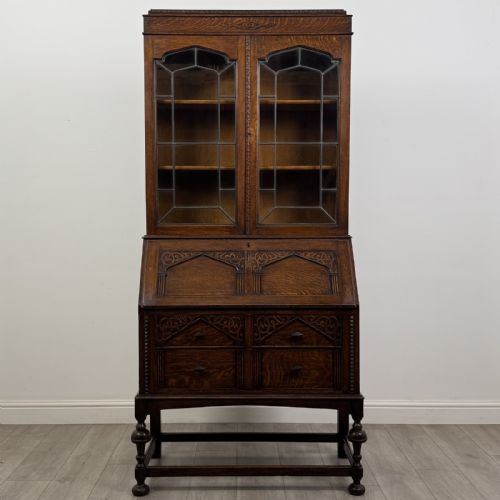
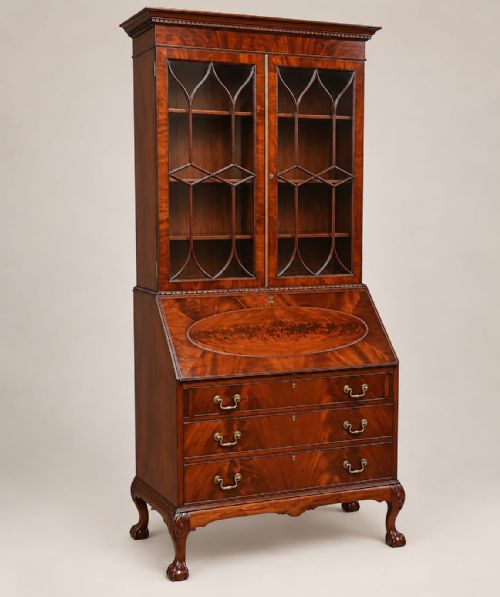
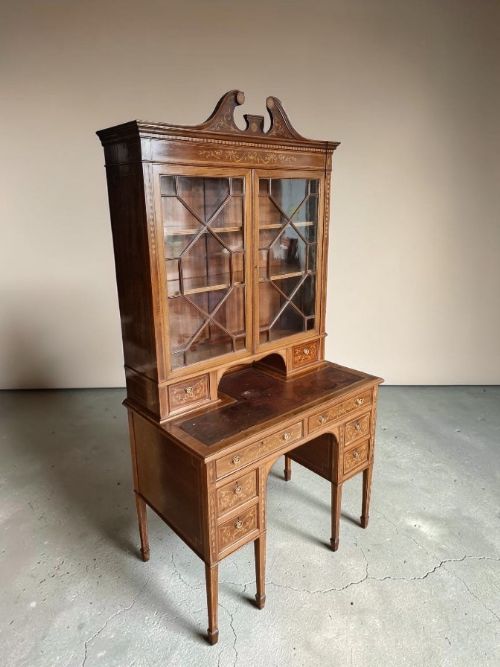


Secretary Bookcase Revival
A secretary bookcase revival combines a fitted writing desk with enclosed shelving, offering practical storage and workspace in a single period piece.
Secretary Bookcase Revival
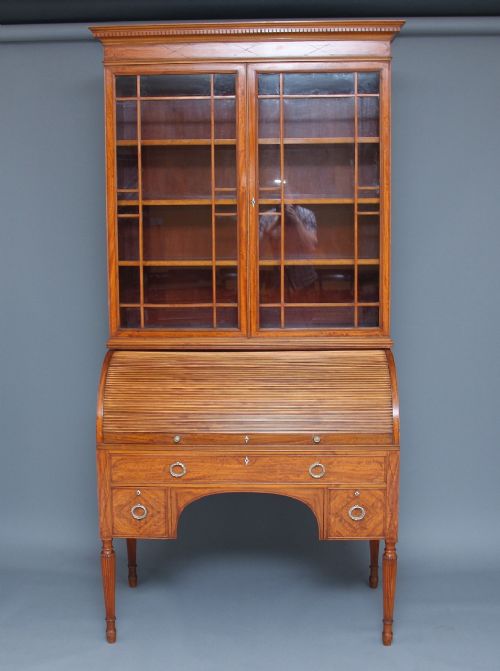
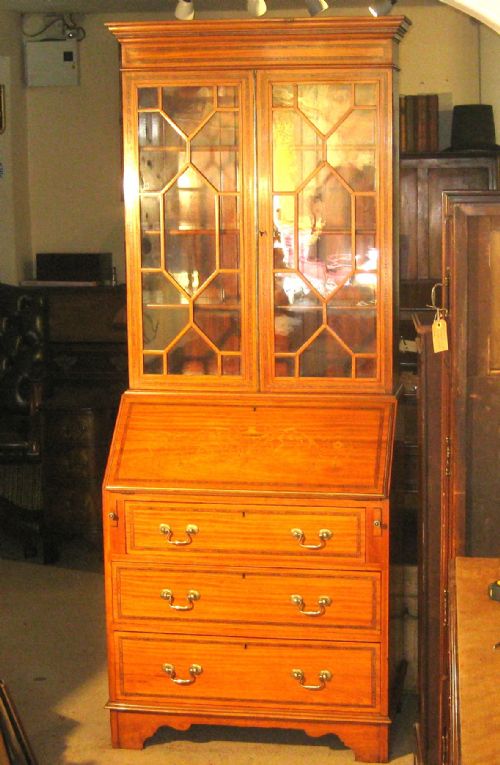
A secretary bookcase revival brings together a drop-front desk or cylinder writing surface with upper display shelving, manifesting in styles ranging from Jacobean to Edwardian Sheraton revival. These hybrid items serve both a working function and a display purpose within a room.
The examples found here span from the 18th century up to the 1920s, with strong representation from the Edwardian period and the early 19th century. Forms include bureau bookcases, secretaire bookcases, and cylinder bookcases executed in mahogany, satinwood, and oak.
Materials and construction methods
Timbers such as mahogany, satinwood, and solid or dark oak form the primary carcases, often enhanced with marquetry or intricate veneer work. Cabinetmakers utilised brass for hardware, leather for writing inserts, and lead or clear glass for upper door panels.
Secretary Bookcase Revival Retail Price Guide 2026
Typical asking prices for secretary bookcase revival among the pieces listed under this phrase on Sellingantiques today, from the lower quarter to the upper quarter. They describe what is for sale here now, not the wider market.
Listings feature oak, mahogany, and satinwood alongside leaded and clear glass panels across multiple revival periods.
Distinctions in craftsmanship and materials
Quality rests on the selection of timber and the precision of the inlay, where finely figured satinwood or rich mahogany elevates a piece above standard dark oak constructions. The execution of fitted interior drawers and pigeonholes within the writing compartment further demonstrates the maker's skill.
Design cohesion also dictates merit, as seen in balanced proportions across breakfront layouts and the careful integration of glazing bars in the upper cabinet doors. Maker attribution, such as work originating from established firms, adds a documented layer of pedigree.
Edwards & Roberts·Lamb & Co
The Secretary Bookcase Revival Glossary
- Secretaire
- A writing cabinet featuring a drop-front flap or a cylinder desk that conceals a fitted interior of small drawers and pigeonholes. This component transforms the lower section from a simple cupboard into a functional desk.
- Marquetry
- The art of applying pieces of veneer to a structure to form decorative patterns and pictures. Craftsmen use varied woods to create contrasting tonal designs on surfaces like satinwood.
- Breakfront
- A piece of furniture whose central section projects forward from the flanking outer sections. This architectural arrangement creates depth and visual interest in large bookcases.
- Barley Twist
- A turned wooden furniture leg or support carved in a helical screw shape. This decorative turning is frequently found on Jacobean revival oak furniture from the early 20th century.
Secretary Bookcase Revival: Frequently Asked Questions
What is a secretary bookcase?
A secretary bookcase is a dual-purpose item featuring an upper cabinet for books with glass or solid doors, paired with a lower section that incorporates a writing desk.
The writing surface typically folds down or pulls out, revealing a compartment of small drawers and pigeonholes for correspondence.
How do I date a revival piece?
Dating relies on identifying the revival style, such as Sheraton or Jacobean, alongside the secondary woods and construction methods used in the carcase.
Pieces originating from the Edwardian era often display lighter timbers and refined inlay work, whereas 1920s examples frequently utilise heavier dark oak.
Where should I place it?
These tall combination pieces require adequate wall space and sufficient floor clearance for the drop-down writing flap to open fully.
Living rooms, studies, and home libraries provide suitable environments where the upper glass doors can protect books while the desk remains accessible.
What is the difference between a bureau and a secretaire?
A bureau traditionally describes a desk with an angled sloping flap that covers the writing interior, while a secretaire often utilises a drawer front that pulls down horizontally.
Both forms are frequently integrated beneath bookcase superstructures in these revival designs.