




Scarborough Seascape Painting
A scarborough seascape painting captures the rugged Yorkshire coastline and bustling harbour life through nineteenth and early twentieth-century brushwork.
Scarborough Seascape Painting
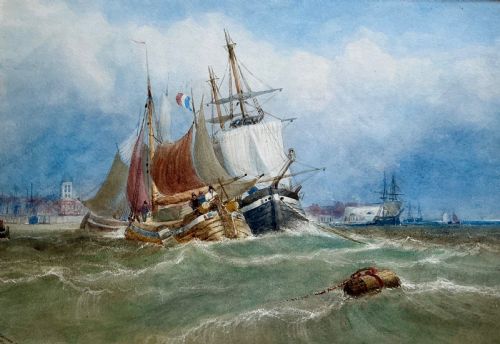
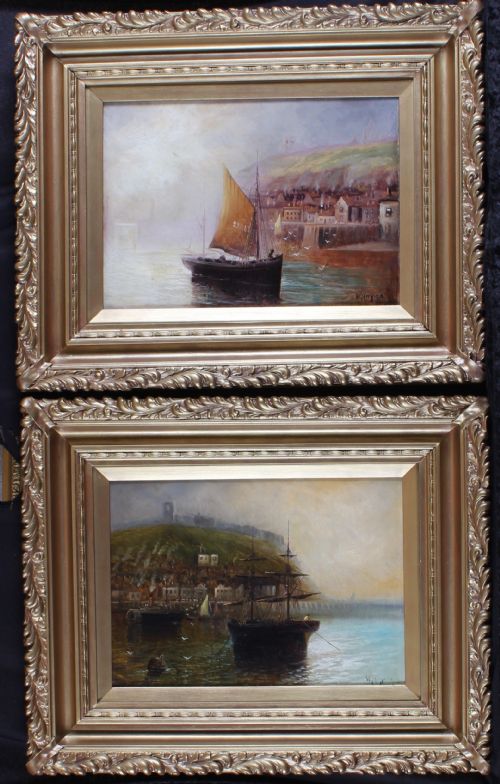
A scarborough seascape painting portrays the iconic Yorkshire coastline, featuring local landmarks such as Scarborough Castle, the harbour, and the sweeping north and south bays. These works frequently document maritime activity, including masted ships, fishing boats, and coastal steamers navigating choppy northern waters.
Buyers will most commonly encounter nineteenth-century and early twentieth-century examples on this page. Victorian marine art and Edwardian maritime pieces dominate the selection, ranging from intimate watercolours on paper to large oil paintings on canvas.
The regional focus centres firmly on Yorkshire views, capturing specific local geography like Cayton Bay, the Black Rocks, and White Nab. The depictions balance topographical record with atmospheric interpretations of sea mists and coastal light.
Materials and technique
Artists worked primarily with watercolour pigment on paper or oil paint applied to canvas, wood panels, or board. Watercolours capture the translucent qualities of sea spray and coastal weather, while oils allow for heavier impasto to render rough waves and masted ships.
Framing often involves period wood structures finished with gilt or giltwood moulding. These surrounds complement the tonal palette of the paintings, enclosing maritime scenes executed within traditional British school methods.
Listings feature works spanning the nineteenth century through the Edwardian period, executed in watercolour and oil on canvas or wood.
Factors of quality
Quality rests upon the artist's ability to render maritime atmosphere and topographical accuracy simultaneously. Stronger examples demonstrate confident brushwork in the depiction of shifting sea conditions, rigging, and coastal light.
Condition and medium preservation separate finer pieces from standard examples. Works retaining vibrant watercolour pigments or stable oil surfaces without excessive retouching command greater attention from collectors.
Henry Barlow Carter·Ernest Dade·Joseph Newington Carter·Harry Wanless·Frederick William Booty·John James Wilson·Walter Meegan·Frank William Scarbrough·James Webb·A E Story·George Hull·Francis Nicholson·Robert Ernest Roe·Robert Pearson·Paul Marny
The Scarborough Seascape Painting Glossary
- Seascape
- A work of art depicting the sea, coast, or maritime activity. These pieces focus on coastal geography and marine vessels.
- Watercolour
- A paint consisting of colour suspended in a water-soluble binder. It is traditionally applied to paper to achieve translucent effects.
- Giltwood
- Wood carved and covered with a thin layer of gold leaf or metal powder. This finish appears frequently on period frames.
- Impasto
- The process of applying paint thickly on a canvas so that it stands out from the surface. This technique creates texture in depictions of rough seas.
Scarborough Seascape Painting: Frequently Asked Questions
What subjects appear in these paintings?
These works depict local Yorkshire landmarks, including Scarborough Castle, the harbour, and surrounding bays. Coastal shipping and fishing vessels feature prominently across the maritime views.
Artists frequently recorded specific weather conditions, ranging from calm sea mists to rough waters off the North Cliff and White Nab.
How do watercolours and oils differ here?
Watercolour examples utilise pigment on paper to capture the luminous atmospheric effects of coastal light and sea spray. They often present a lighter, more delicate palette.
Oil paintings on canvas or panel provide heavier texture and depth, suiting stormy marine scenes and detailed studies of masted ships.
How should I hang a coastal painting?
Display these works away from direct sunlight to protect vulnerable watercolour pigments and oil varnishes from fading. Maintaining stable indoor humidity prevents timber panels and paper supports from warping.
Pairing the piece with its period giltwood frame enhances the visual weight and historical context of the artwork on the wall.
How do I identify the period?
Victorian and Edwardian pieces exhibit distinct stylistic markers associated with British school maritime art of the nineteenth and early twentieth centuries. Costume details on figures, vessel types, and framing styles offer reliable chronological clues.
Signatures, dates, and artist inscriptions on the front or reverse of the canvas often confirm the exact decade of creation.