




Satsuma Ware Vessel
Satsuma ware vessels bring intricate hand-painted detail and rich gilding into a room, offering collectors a tangible piece of Meiji craftsmanship.
Satsuma Ware Vessel
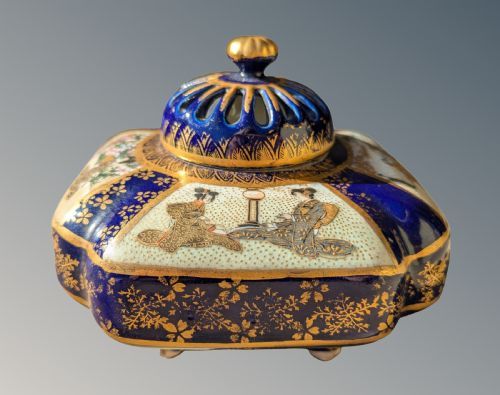
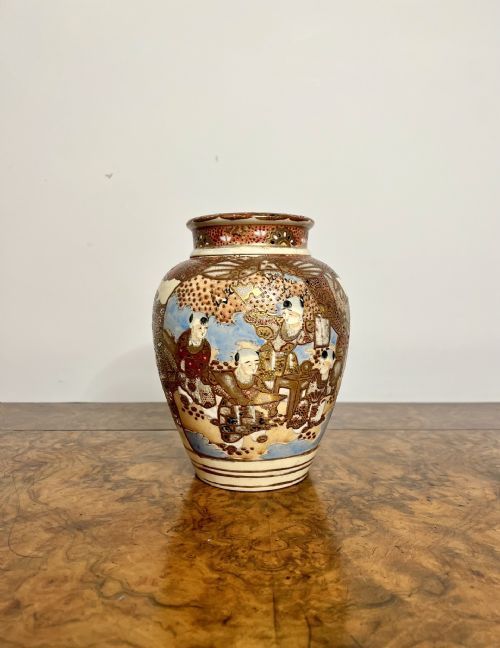
A satsuma ware vessel is typically an earthenware or porcelain object decorated with detailed enamel and gold leaf, most frequently seen here in forms such as vases, incense burners, tea caddies, and decorative bowls. These items originate predominantly from the Meiji period and the transition into the Taisho period, reflecting the traditional aesthetic output of Japanese studios.
The objects span various sizes from miniature vases to monumental bowls and lidded jars, often featuring intricate figural scenes, Arhats, dragons, or samurai battles. Buyers will encounter both smaller cabinet pieces and larger display vessels bearing the signatures of notable Kyoto studios and makers.
How they were made
Makers utilised earthenware or porcelain as the ceramic base, shaping them into vases, koro burners, and jars before applying a finely crackled glaze. This absorbent surface provided the foundation for detailed hand painting using coloured enamels.
Satsuma Ware Vessel Retail Price Guide 2026
Typical asking prices for satsuma ware vessel among the pieces listed under this phrase on Sellingantiques today, from the lower quarter to the upper quarter. They describe what is for sale here now, not the wider market.
Some miniature vessels pack one thousand individual painted figures onto a surface smaller than a teacup.
What varies in quality
The fineness of the brushwork and the complexity of the figural scenes dictate the standard of a piece, with master studios executing exceptionally dense compositions of Arhats or battle scenes. The precision of the gilt work and the subtlety of the enamel palette distinguish standard production from superior artistic output.
Studio signatures and crests, such as the Shimazu mon, add historical documentation and indicate pieces produced by renowned workshops. The overall balance of the form, the condition of the delicate crackle glaze, and the weight of the ceramic body further separate ordinary vessels from exceptional examples.
Kinkozan·Hotoda·Chosei·Kizan·Kotobuki do·Tokyo Taizan·Shozan
The Satsuma Ware Vessel Glossary
- Koro
- An incense burner featuring a body and a fitted lid, often supported on legs and utilised in traditional Japanese settings.
- Shimazu mon
- The family crest of the Shimazu clan, frequently stamped or painted as a mon on the base or body of satsuma pieces originating from their domain.
- Rakan
- Depictions of holy figures or enlightened disciples of Buddha, commonly appearing in detailed groupings on Meiji period ceramics.
- Meiji period
- The era of Japanese history spanning from 1868 to 1912, characterised by intense artistic production and opening trade with the West.
- Gilt
- A thin layer of gold applied to the surface of the ceramic to accentuate borders, robes, and decorative elements.
Satsuma Ware Vessel: Frequently Asked Questions
What is a satsuma koro?
A koro is an incense burner designed with a removable lid, allowing scented smoke to escape through pierced openings. These vessels often stand on small feet and feature elaborate handles.
In period settings, they functioned both as decorative objects of status and as practical burners for fragrant woods or resins.
How do I identify a Meiji period piece?
Meiji period pieces are dated between 1868 and 1912, a timeframe frequently indicated in studio signatures and historical attribution. They are characterised by dense enamel painting and extensive use of gold leaf.
Many of these items bear specific artist signatures or studio marks from production centres in Kyoto and Tokyo.
Where should I display a large satsuma vase?
Large vases and jars require a stable surface away from heavy foot traffic to protect their delicate enamel and gilt surfaces from accidental knocks. Placing them on a sturdy wooden table or cabinet allows the detailed figural scenes to be viewed clearly.
Keeping them out of direct sunlight helps preserve the vibrancy of the coloured enamels over time.
What do the figural scenes represent?
The painted figures often depict traditional Japanese narratives, historical battles, courtly processions, or religious subjects such as Rakan and samurai. These complex compositions reflect the storytelling traditions favoured by Meiji period artists.
Examining the robes and facial expressions reveals the narrative depth intended by the studio painter.