



Satinwood Office Desk
These satinwood office desk pieces bring light timber grain and formal inlay into workspaces, offering substantial writing surfaces shaped by Victorian and Edwardian makers.
Satinwood Office Desk
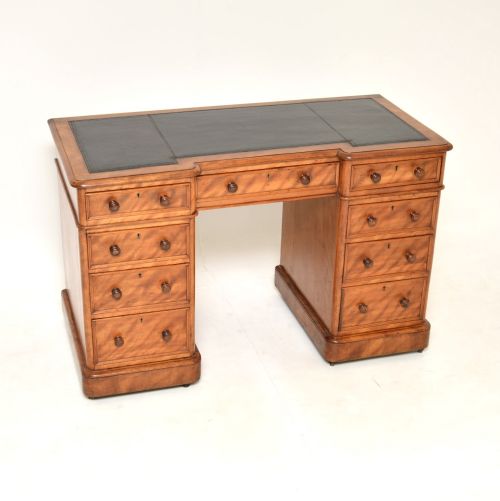
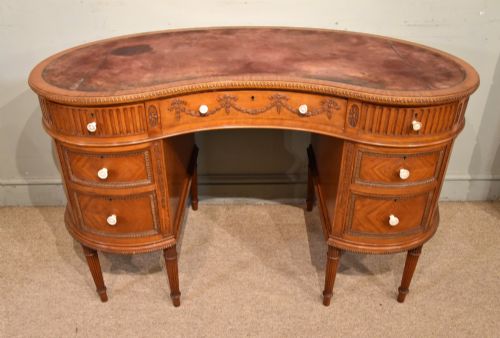
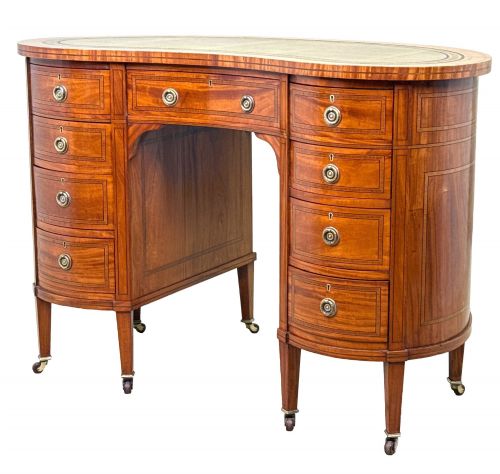
A satinwood office desk brings together pedestal forms, writing tables, and specialised shapes such as the kidney desk and the Carlton House desk. These pieces emerge predominantly from Victorian and Edwardian workshops across the nineteenth and early twentieth centuries, reflecting formal study and office requirements.
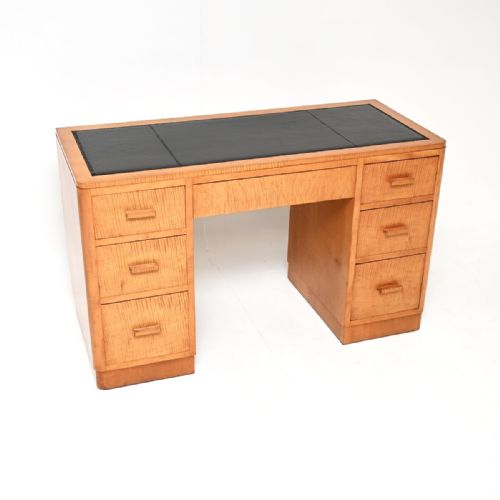
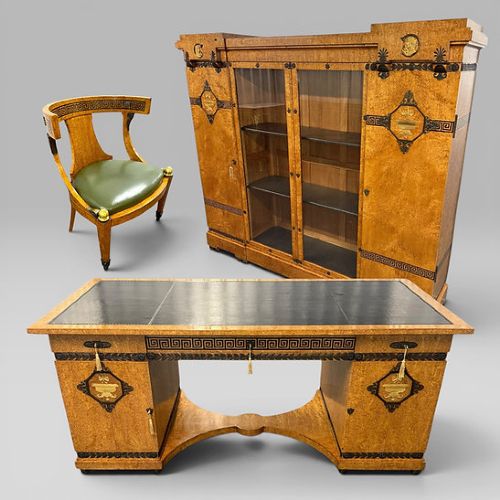
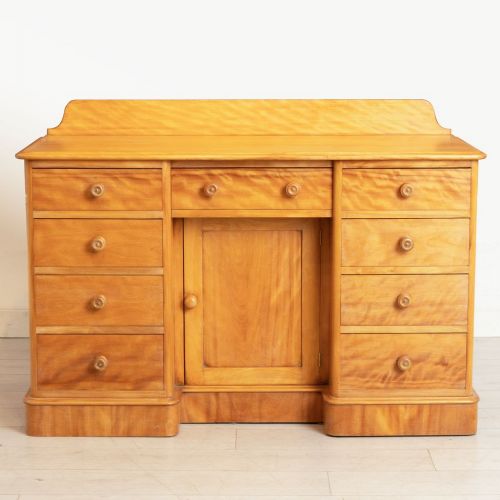
Pedestal desks and kneehole variants dominate the selection, offering multi-drawer storage beneath spacious writing surfaces. Alongside these are matching desk chairs and complete office sets that pair timber construction with upholstered elements.
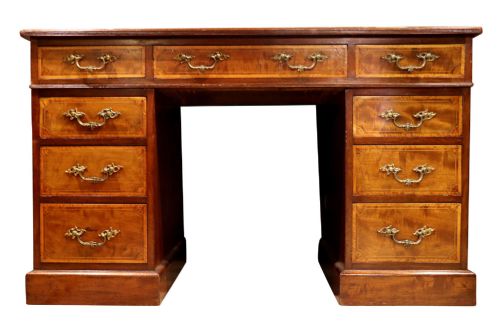
The aesthetic leans heavily toward Sheraton Revival and Neoclassical styles, utilising light satinwood veneers, satin birch, and mahogany carcass work. Makers applied marquetry inlay to enrich these writing surfaces, creating sophisticated furniture designed for prominent studies.
Gradations of quality
Quality rests in the precision of the marquetry inlay, the selection of figured satinwood veneers, and the retention of original brass hardware. Superior examples display crisp botanical or geometric patterns that align seamlessly across drawers and writing surfaces.
The integrity of the structural joinery and the survival of original leather writing inserts distinguish finer pieces from altered or later-assembled counterparts. Well-executed pedestal construction with smooth-running drawers indicates skilled workshop production.
Swivelling ships chairs designed for maritime comfort occasionally find their way into dry land offices, upholstered and ready for action.
Edwards & Roberts·Maple & Co·Mercier Frères·James Shoolbred
The Satinwood Office Desk Glossary
- Satinwood
- A lustrous, hard timber native to Ceylon and India, prized for its golden sheen and smooth grain. It was frequently used as a fine veneer on high-status Victorian and Edwardian desk surfaces.
- Carlton House desk
- A form of writing desk featuring a stepped superstructure of small drawers and pigeonholes curving around the rear of the writing surface. This layout originated in the late eighteenth century and saw revival popularity during the Victorian period.
- Pedestal desk
- A heavy freestanding desk supported by two banks of drawers beneath the main writing top. These pieces typically feature a central kneehole and abundant storage capacity.
- Marquetry
- The art of applying pieces of veneer to a structure to form decorative patterns and pictures. Makers utilised contrasting woods like mahogany and satinwood to achieve intricate floral and geometric designs.
- Satin birch
- A light-colored timber variant often utilised in nineteenth-century pedestal and kneehole desks. It provides a pale, durable alternative to satinwood while maintaining a luminous surface quality.
Satinwood Office Desk: Frequently Asked Questions
What is a satinwood office desk?
A satinwood office desk is a nineteenth or early twentieth-century writing piece surfaced with light golden timber veneer. These items range from large pedestal forms to refined writing tables.
They combine practical drawer storage with decorative inlay, serving as functional furniture for formal studies and executive offices.
How do I care for leather desk tops?
Leather writing surfaces require gentle cleaning with a damp cloth and occasional treatment with appropriate leather dressings to prevent cracking. Avoid harsh chemical cleaners that can strip the gilt tooling.
Keeping the leather conditioned preserves the colour and maintains the smooth texture necessary for daily writing.
Are these desks suitable for daily work?
Most pedestal and writing desks provide ample surface area and sturdy construction suited for modern laptop use and paperwork. Their multiple drawers offer practical organisation for office supplies.
Matching swivel chairs and armchairs designed alongside these desks complete a functional workspace setup.
How do I distinguish Edwardian from Victorian desks?
Victorian desks, produced between eighteen thirty and nineteen hundred, often feature heavier proportions, dense mahogany framing, and robust brass hardware. Edwardian pieces from the early twentieth century typically present lighter construction and delicate Sheraton Revival satinwood inlay.
Examining the internal drawer construction and secondary woods helps clarify the period of manufacture.