


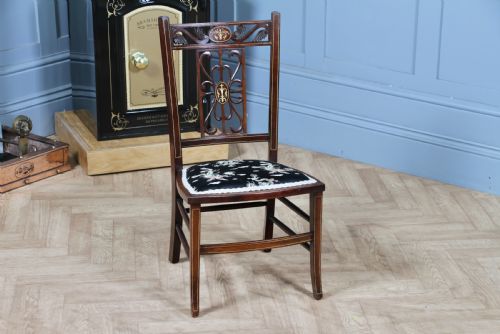

Satinwood Inlaid Salon Chairs
Satinwood inlaid salon chairs are refined nineteenth- and early-twentieth-century seating designed to bring lightness and floral detail into formal rooms.
Satinwood Inlaid Salon Chairs
When you search for satinwood inlaid salon chairs, you encounter seating built primarily during the Victorian and Edwardian eras, with a strong representation of Sheraton Revival design. These pieces include sets of four dining or salon chairs, occasional chairs, armchairs, corner chairs, and matched pairs suited to drawing rooms.
The prevailing form on this page pairs a dark mahogany frame with contrasting satinwood inlay and marquetry, often featuring stringing and floral motifs. You also find larger groupings, including salon suites comprising a settee alongside matching armchairs and side chairs.
Originating as fashionable additions to formal reception spaces, these chairs prioritise decorative elegance and lighter proportions over heavy rustic utility. They frequently retain traditional upholstery ranging from plain fabric to silk and velvet.
How they were made
Cabinetmakers constructed the frames using solid mahogany, shaping the timber for side chairs, armchairs, and settee frames. This dark wood provided a stable, robust foundation that contrasted sharply with lighter decorative elements.
Satinwood inlay and marquetry formed the visual signature of these pieces, requiring precise hand-cutting of contrasting veneers. Artisans embedded these lighter timbers and delicate stringing directly into the mahogany surfaces to create floral and geometric patterns.
Satinwood Inlaid Salon Chairs Retail Price Guide 2026
Typical asking prices for satinwood inlaid salon chairs among the pieces listed under this phrase on Sellingantiques today, from the lower quarter to the upper quarter. They describe what is for sale here now, not the wider market.
Edwardian makers thoughtfully added corner chairs to the salon, proving that even eighteenth-century polite society enjoyed a cosy corner.
What varies in quality
The finesse of the marquetry and inlay work dictates much of the visual distinction between individual chairs. Crisp, tightly fitted veneers with complex floral details demonstrate a higher level of artisan skill than simpler, broader bands of contrasting wood.
Frame construction and structural integrity also separate standard seating from finer examples. Solid joinery in the legs and arm supports, combined with high-grade silk or velvet upholstery, marks out the superior pieces in any collection.
The Satinwood Inlaid Salon Chairs Glossary
- Satinwood
- A lustrous, hard timber with a natural golden-yellow sheen used extensively for contrasting veneers and inlay work.
- Marquetry
- The art of applying decorative pieces of veneer to a structure to form intricate pictorial or floral patterns.
- Stringing
- Fine, thin lines of contrasting wood inlay used to edge panels, legs, and rails on cabinet furniture.
- Sheraton Revival
- A late nineteenth-century design movement inspired by the neoclassical furniture of George Sheraton, noted for refined proportions and delicate inlay.
Satinwood Inlaid Salon Chairs: Frequently Asked Questions
How do I date these chairs?
Dating relies on stylistic markers and timber characteristics recorded across Victorian and Edwardian examples. Pieces showing heavy Sheraton Revival influence typically date from around 1890 to 1900.
Examining the construction methods and the specific type of upholstery webbing also helps determine whether a chair originates from the late Victorian period or the early Edwardian era.
Are these chairs suitable for daily use?
These decorative seats were originally designed for formal reception rooms rather than heavy, everyday lounging. Their slender frames and delicate inlay require a gentle approach in modern domestic settings.
Placing them in low-traffic areas or utilising them as occasional seating preserves their structural joinery and prevents unnecessary wear on the satinwood veneer.
What is the difference between a salon chair and a side chair?
Salon chairs generally feature lighter proportions and more decorative embellishment, intended specifically to furnish formal drawing rooms and sitting spaces. They often incorporate more elaborate marquetry or carved details.
Side chairs represent a broader category of armless seating that can function around a dining table or alongside a desk, though Edwardian salon versions focus heavily on aesthetic appeal.
How should I clean the satinwood inlay?
Maintenance requires dry dusting with a soft, lint-free cloth to remove surface particles without disturbing the delicate veneer. Avoid using chemical sprays or excess moisture that could penetrate the wood joints.
Applying a traditional beeswax polish periodically helps nourish the mahogany and satinwood surfaces while maintaining a gentle, natural lustre.