

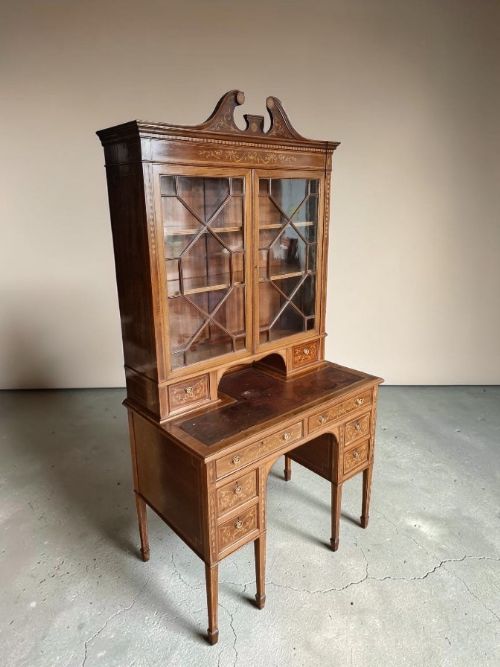
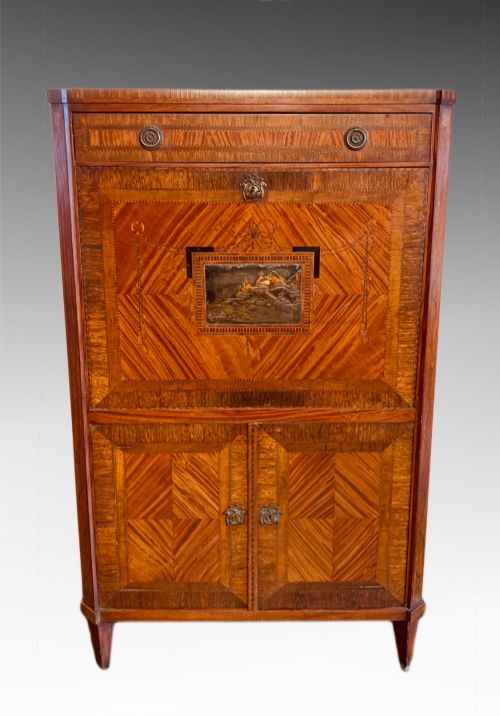
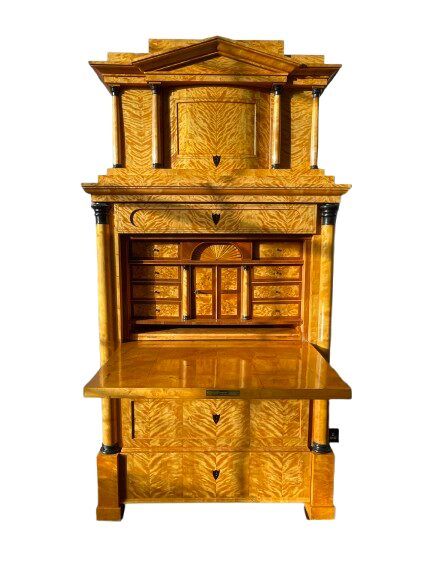
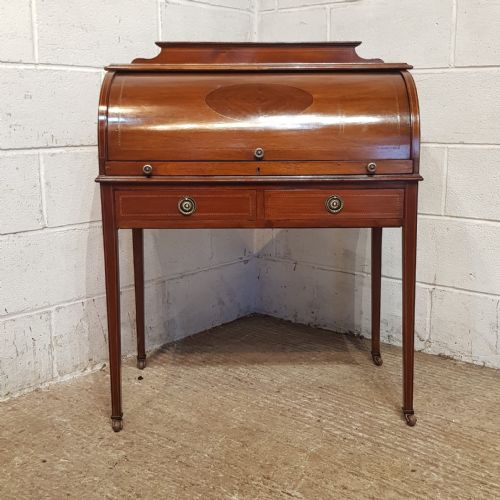


Satinwood Escritoire
A satinwood escritoire offers a refined writing surface combined with enclosed storage, bringing figured timber and delicate inlay into a study.
Satinwood Escritoire
When you search for a satinwood escritoire, you encounter sophisticated writing furniture designed for domestic use across several centuries. The pieces on this page span the Georgian period, the nineteenth century, the Edwardian era, and up to nineteen-ten.
The forms vary from fall-front escritoires and display desks to barrel-fronted desks, ladies writing tables with mirrored superstructures, campaign style fold-out tables, Carlton house desks, and cylinder desks. These items combine writing surfaces with compartments, drawers, and sometimes superstructures.
You are most likely to meet Edwardian and nineteenth-century examples on this page, often featuring Sheraton revival or Biedermeier styling. They serve as functional writing desks while acting as decorative focal points in a room due to their light-toned timber.
How they were made
Cabinet makers utilised satinwood as the primary visible timber, frequently paired with mahogany, walnut, birch veneer, and ebonised wood for contrast. Inlaid wood details define much of the decoration across these pieces, creating geometric or floral motifs.
Functional elements incorporated brass for handles, hinges, and mounts, alongside leather for writing surfaces and glass within display components or superstructures. Hand-painting also appears on specific Edwardian ladies writing tables, adding pictorial elements to the timber.
Satinwood Escritoire Retail Price Guide 2026
Typical asking prices for satinwood escritoire among the pieces listed under this phrase on Sellingantiques today, from the lower quarter to the upper quarter. They describe what is for sale here now, not the wider market.
Listings span the Georgian period, nineteenth century, nineteen-hundred, Edwardian era, and nineteen-ten, utilising satinwood, mahogany, walnut, brass, leather, glass, birch veneer, and ebonised wood.
What varies in quality
The distinction between standard and superior pieces rests on the complexity of the internal configuration and the precision of the timber matching. Elaborate mechanisms, such as those found in cylinder desks and Carlton house desks, demand sophisticated carpentry that elevates the piece.
The finesse of the inlaid wood and the quality of the secondary timbers, such as mahogany or birch veneer beneath the satinwood, dictate the overall standard. Hand-painted decoration and integrated mirrored superstructures also separate simpler desks from more ambitious creations.
The Satinwood Escritoire Glossary
- Escritoire
- A writing cabinet featuring a fall-front or sloped writing surface that conceals internal compartments. It combines storage with a pull-down desk.
- Carlton house desk
- A Davenport-style or horseshoe-shaped writing desk with a stepped superstructure of small drawers and compartments curving around the back and sides.
- Biedermeier
- A Central European style from the nineteenth century prioritising utilitarian comfort and clean lines over excessive ornamentation, often showcasing fine wood grain.
- Sheraton Revival
- A late nineteenth and early twentieth-century design movement drawing inspiration from eighteenth-century neoclassical furniture, characterised by light timbers and delicate inlay.
- Superstructure
- An upper structure of drawers, shelves, or a mirror added to the top surface of a desk, increasing both storage capacity and visual height.
Satinwood Escritoire: Frequently Asked Questions
What is a satinwood escritoire?
A satinwood escritoire is a writing cabinet finished in pale, lustrous satinwood timber, designed to provide a dedicated writing space alongside enclosed storage for letters and papers.
These pieces typically feature a drop-down front or internal compartments that keep writing materials hidden when not in use.
How were these desks used?
Owners utilised these desks for correspondence, managing household accounts, and writing letters in private rooms or receiving parlours.
The enclosed drawers and pigeonholes kept stationery and personal documents organised and secure throughout the day.
How do I date an Edwardian piece?
Edwardian pieces often display Sheraton revival influences, lighter construction, and sometimes hand-painted floral motifs or mirrored superstructures typical of the period around nineteen-hundred.
Examining the secondary woods and construction methods inside the drawers helps confirm the early twentieth-century origin.
Where should I place an escritoire?
An escritoire suits studies, living rooms, or bedrooms where its decorative inlay and figured timber can be appreciated without cluttering the floor space.
Because many examples feature finished backs or refined proportions, they function well positioned against a wall or angled in a corner.