


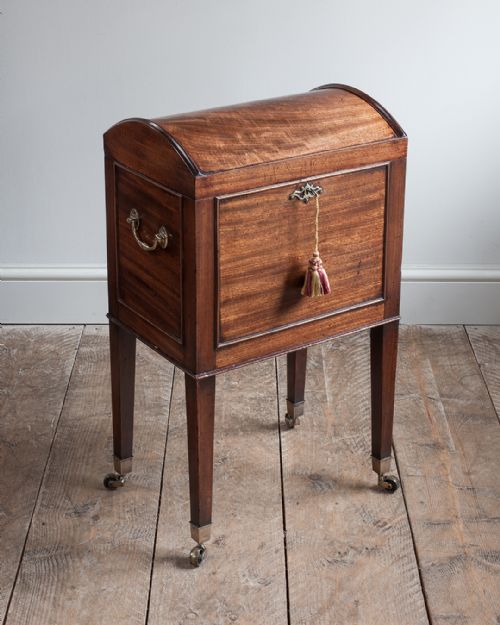


Sarcophagus Wine Caddy
A sarcophagus wine caddy is a grand classical storage vessel designed to keep bottles cool at the dining table.

Sarcophagus Wine Caddy
A sarcophagus wine caddy takes its name from ancient stone tombs, adopting a heavy, tapered rectangular box form that sits low on the floor or upon carved feet. These pieces belong primarily to the Georgian, Regency, and William IV periods, serving as functional dining room furniture for storing and chilling wine bottles.
The version most commonly met on this page is constructed from rich mahogany, often detailed with crisp mouldings, brass carrying handles, and occasionally inlaid satinwood or lighter veneers. They function as cellarettes or wine coolers, housing internal compartments lined for temperature retention.
Makers shaped these containers during the late eighteenth and nineteenth centuries to match the architectural grandeur of formal dining spaces. Their substantial forms reflect a period when entertaining guests involved elaborate displays of fine wine and polished timber.
How they were made
Cabinet makers built these vessels using solid mahogany and carefully chosen wood veneers over sturdy timber carcases, applying skill to achieve smooth curved surfaces. Brass hardware, including lion paw feet, ring handles, and escutcheons, was cast and fitted by hand to punctuate the dark wood.
Internal compartments often featured lead linings to hold ice and water safely without rotting the surrounding timber. Marquetry details such as satinwood inlay relied on precise cutting to insert contrasting light woods into the primary mahogany ground.
Some containers include hidden drainage plugs near the base, allowing melted ice to escape after a long evening of dining.
What varies in quality
The distinction between standard workshop output and top-tier cabinet making lies in the choice of timber figures and the crispness of the carved details. Grain selection on the primary mahogany and the precision of inlaid satinwood banding separate utilitarian boxes from high-status commissions.
Subtleties in proportion and the integration of robust cast metal hardware define the upper echelon of these pieces. Original internal lead linings and intact paw feet elevate the structural integrity and historical completeness of a caddy.
Gillows·Freemans of Norwich
The Sarcophagus Wine Caddy Glossary
- Cellarette
- A lockable container used for storing wine bottles near the dining table. They evolved from simple wooden boxes into elaborate architectural pieces during the Georgian era.
- Sarcophagus form
- A burial-inspired shape featuring a tapered body and a high pitched lid, translated by furniture makers into a grand container for the dining room.
- Veneer
- A thin layer of figured wood applied over a secondary timber base to create decorative grain patterns. Cabinet makers utilised this technique to display rich surface textures.
- Inlay
- The technique of embedding contrasting strips of light timber, such as satinwood, into the main wood surface. This created geometric borders and decorative panels.
Sarcophagus Wine Caddy: Frequently Asked Questions
What is a sarcophagus wine caddy used for?
These vessels were designed to hold and chill wine bottles in the dining room during formal meals. They kept the household stock secure and ready for service.
Inside the box, compartmentalised spaces often contained lead linings designed to hold melting ice. This kept bottles at the correct temperature before they reached the table.
How do I identify a Regency period caddy?
Regency examples typically display bold architectural lines inspired by classical antiquity, often featuring carved paw feet and heavy brass ring handles. The timber is predominantly dark mahogany with restrained use of brass inlay.
Proportions tend to be stout and weighty, reflecting the neoclassical taste of the early nineteenth century. Mouldings are clean and sharp rather than heavily ornate.
Where were these placed in a room?
They sat directly on the floor, usually positioned beneath a sideboard or in the corner of a grand dining room. Their low, heavy stance kept them stable despite their contents.
Because they were heavy when filled with glass and liquid, they remained in one place rather than being carried around the room by guests.
Are the interiors original?
Many interiors retain their original lead linings, though some have been altered or stripped over centuries of use. The presence of divided compartments indicates how bottles were separated.
Surviving metal liners often show patination from ice and water contact. Collectors value pieces that keep their internal dividers and original lining materials intact.