



Sapphire Gold Pearl Necklace
A sapphire gold pearl necklace brings together lustrous pearls, deep blue sapphires and rich gold in designs spanning from the Victorian era to the mid-twentieth century.
Sapphire Gold Pearl Necklace
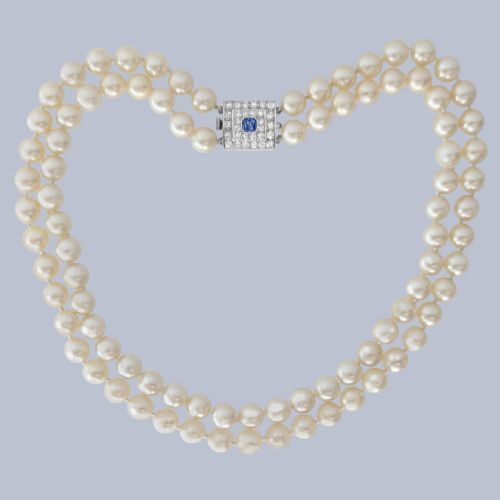
A sapphire gold pearl necklace encompasses a range of historic forms, most frequently appearing as multi-strand pearl necklaces secured with decorative clasps or as delicate drop pendants. These pieces demonstrate the evolving tastes of jewellery design across the Victorian, Edwardian, Art Deco and mid-century periods.
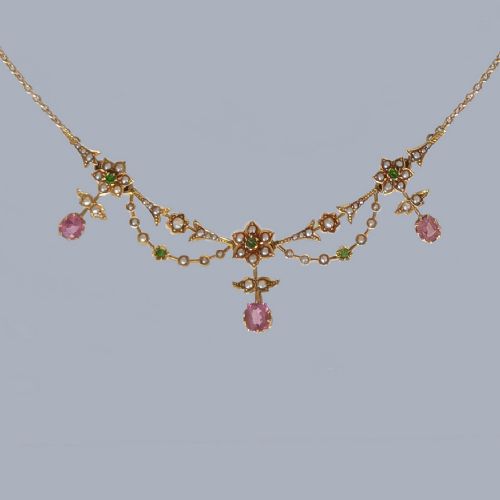
The most common configurations on this page pair double or triple strands of pearls with 9ct or 18ct gold clasps set with sapphires and diamonds. Pendant variants also feature prominently, often suspending seed pearls and sapphires from intricate gold frames characteristic of Edwardian work.
Makers and designers from these past eras utilised varied construction methods, ranging from floral wreath clasps to geometric Art Deco fastenings. Each iteration reflects the distinct aesthetic priorities of its decade of origin.
Materials and construction
The physical composition relies upon natural or cultured pearls, varied grades of gold including 9ct, 15ct and 18ct, and genuine sapphires. Many pieces integrate secondary gems such as diamonds, garnets, peridots or tourmalines to accentuate the primary stones.
Construction techniques involve delicate seed pearl stringing, claw settings for cabochon and faceted sapphires, and intricate openwork casting for gold pendant frames. Clasps often double as focal points, engineered to secure multiple strands while displaying clustered gems.
Sapphire Gold Pearl Necklace Retail Price Guide 2026
Typical asking prices for sapphire gold pearl necklace among the pieces listed under this phrase on Sellingantiques today, from the lower quarter to the upper quarter. They describe what is for sale here now, not the wider market.
Design styles represented span Victorian celestial, Edwardian drop pendants, Art Deco geometric clasps and 1960s multi-strand forms.
Variations in quality
Quality differences emerge in the uniformity and lustre of the pearls, alongside the depth of colour and clarity in the sapphires. Finer examples display carefully matched pearls with high lustre and vibrant, evenly saturated corundum.
The intricacy of the goldwork and the structural integrity of the settings further distinguish the work. Superior pieces exhibit refined metal craftsmanship in components like floral clasps and openwork pendant drops.
The Sapphire Gold Pearl Necklace Glossary
- Seed pearl
- Very small natural or cultured pearls, often half-drilled and glued or threaded onto fine wire or silk, commonly used in clusters and intricate Edwardian designs.
- Cabochon
- A gem polished to a smooth, rounded convex surface rather than faceted, frequently seen in antique sapphires to emphasise a soft depth of colour.
- Clasp
- A fastening device securing a necklace, which in finer antique pieces often transforms into a decorative centrepiece set with sapphires and diamonds.
- Drop pendant
- A suspended ornament hanging from a chain or collar, characteristic of Edwardian and Victorian jewellery styles featuring central sapphires and pearls.
Sapphire Gold Pearl Necklace: Frequently Asked Questions
What defines an Edwardian pendant necklace?
Edwardian pendant necklaces typically employ 15ct yellow gold or platinum-topped gold to create light, airy filigree frameworks. They incorporate seed pearls and pink or white sapphires in symmetrical floral, wreath or drop motifs.
These pieces reflect the delicate, garland-style aesthetic popular in the years leading up to the First World War.
Are these necklaces restrung?
Many historic pearl necklaces require periodic maintenance, and entries frequently note when a piece has been recently restrung. Restringing ensures the silk or synthetic thread remains strong and secure between each pearl.
This process preserves the drape of the necklace and protects the integrity of the pearls over time.
How do 9ct and 18ct gold pieces differ?
Gold purity alters both the physical colour and the weight of the setting, with 18ct gold containing a higher proportion of pure gold than 9ct. This higher karat typically yields a richer yellow hue in vintage and antique mounts.
Both purities were used across different eras, with 9ct appearing frequently in mid-century designs and 15ct or 18ct favoured in earlier Victorian and Edwardian pieces.