
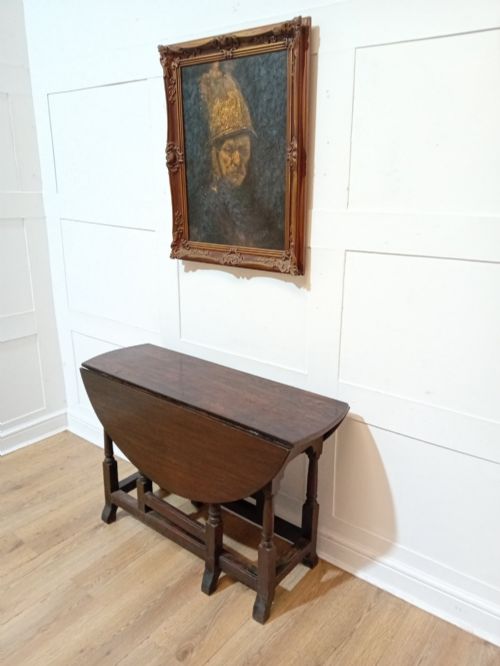
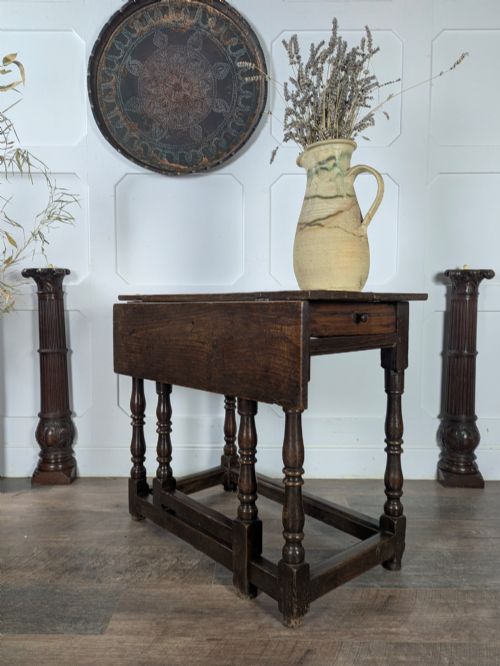
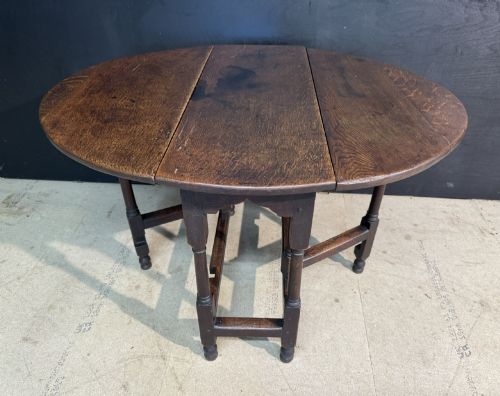
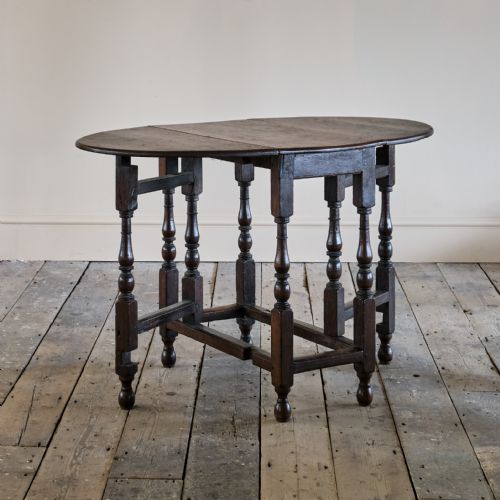

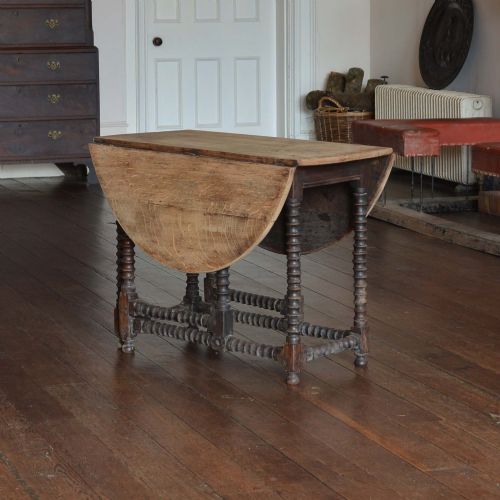


Rustic Oak Gate Leg Table
A rustic oak gate leg table is a folding timber classic that extends for dining and folds away to clear a room.
Rustic Oak Gate Leg Table
A rustic oak gate leg table combines timber framing with hinged flaps that drop down when not in use. You are looking at a practical piece of furniture designed to save space while providing a stable surface for dining or daily use.
The versions you are most likely to meet on this page span several centuries, from the seventeenth century through the eighteenth and nineteenth centuries, alongside later revivals and country interpretations. They appear in forms ranging from compact occasional tables to large dining tables.
Makers fashioned these dining tables, gateleg tables, occasional tables, coffee tables, and tables to suit diverse domestic spaces. The selection includes solid oak construction as well as pieces showing French provincial or English country character.
How they were made
Carpenters built these tables primarily using solid oak and timber inlay, supported by iron hardware for the essential folding mechanisms. The construction relies on sturdy framing where swinging legs support the drop leaves.
Turned supports such as baluster posts and bobbin turnings give the structural uprights their characteristic profile. Fruitwood occasionally appears alongside the dominant oak to form the core of the piece.
Listings feature pieces spanning the seventeenth century through to 1930, utilising oak, fruitwood, and iron.
What varies in quality
The quality of a gate leg table rests on the integrity of its timber and the strength of its moving joints. Heavier solid oak construction and thoughtful turning on the legs elevate a piece above simpler utilitarian examples.
Proportion and the handling of the drop leaves dictate how gracefully the table sits when fully open or closed. Early examples display hand-worked surfaces that contrast with the tighter regularity found in later revivals.
The Rustic Oak Gate Leg Table Glossary
- Gateleg table
- A table with hinged leaves supported by swing-out legs that resemble a swinging gate. This design allows the surface area to expand or contract easily.
- Drop leaf
- A hinged section of a table top that can be raised and supported or lowered when not in use. It provides flexibility for changing room layouts.
- Baluster post
- A vertical support column shaped with a swelling contour, commonly found on seventeenth-century furniture legs. It adds architectural weight to the base.
- Bobbin turning
- A type of furniture leg decoration formed by a lathe to resemble a string of beads or bobbins. This technique creates a rhythmic, tactile profile.
- Solid oak
- Timber taken straight from the log rather than applied as a veneer over a secondary wood. It forms the durable body of traditional country furniture.
Rustic Oak Gate Leg Table: Frequently Asked Questions
How do I use a gate leg table in a small room?
Keep both leaves dropped against the central frame to use the table as a narrow console or occasional surface against a wall.
Swing out the supporting legs and lift the leaves whenever you need a full dining or working surface.
Are these tables sturdy enough for daily dining?
Traditional oak gate leg tables were built for heavy everyday use in domestic kitchens and dining rooms.
The swing-out legs provide solid support under the drop leaves when properly adjusted and leveled.
How do I tell an earlier table from a later revival?
Examine the timber surfaces for hand-tooled marks, peg construction, and the specific style of the turning on the legs.
Seventeenth and eighteenth-century examples display different wear patterns and joinery compared to nineteenth-century pieces or 1930s interpretations.
What is the difference between an occasional table and a dining table?
Occasional tables are built on a smaller scale for placement beside seating or in corners of a room.
Dining tables stand at standard table height with a larger top surface designed to seat multiple people.
How should I care for an oak surface?
Dust the timber regularly with a dry cloth and avoid placing the table near direct heat sources that could dry out the wood.
Apply natural beeswax occasionally to nourish the oak and maintain its protective finish.