





Rural Village Watercolour
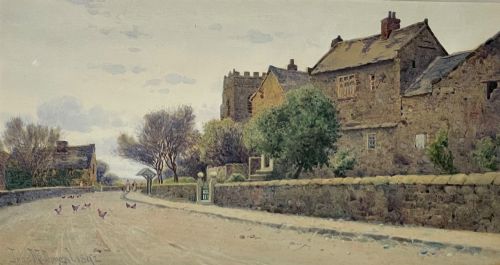
Rural village watercolour paintings capture country life across the Victorian, Edwardian and later periods on paper.
Rural Village Watercolour
A rural village watercolour depicts country settlements, cottage scenes and agricultural landscapes through the medium of pigment on paper. When searching for a rural village watercolour, collectors encounter works ranging from 19th-century Victorian pastoral scenes to later 20th-century interpretations.
The pieces on this page span the Victorian era, the 19th century, and subsequent decades up to 1940. Subjects stretch from named locations in Wirral, Wensleydale, Norfolk and Warwickshire to continental French village scenes.
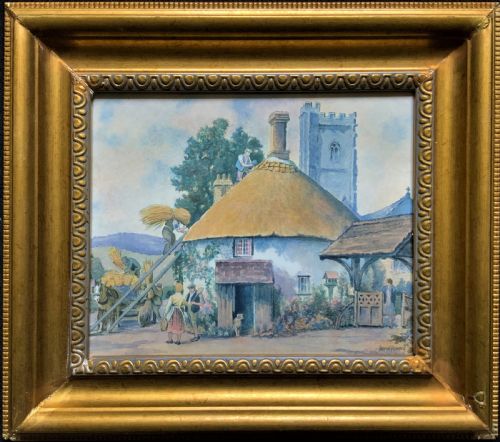
Compositions frequently incorporate figures, working landscapes and village architecture under varying atmospheric conditions. They offer a direct window into historical rural life, recorded by artists working on location or in studios from preliminary sketches.
How they were made
These works rely on watercolour pigment applied to paper supports, often framed behind glass within wooden or gilt wood frames. Artists utilised transparent washes to build light and tone, reserving the white of the paper for highlights.
Techniques range from precise architectural delineation to looser brushwork associated with British Impressionism and the Camden Group. Support materials typically consist of heavyweight watercolour paper or card.
Rural Village Watercolour Retail Price Guide 2026
Typical asking prices for rural village watercolour among the pieces listed under this phrase on Sellingantiques today, from the lower quarter to the upper quarter. They describe what is for sale here now, not the wider market.
Keep an eye out for a young foal caught in the act of stealing fruit straight from a basket.
What varies in quality
Quality rests upon the artist's draftsmanship, handling of light, and atmospheric depth within the composition. Stronger works demonstrate confident brushwork and a sophisticated control of pigment washes over mere topographical recording.
Condition plays a part, particularly the preservation of pigment vibrancy against fading from light exposure, and the integrity of the paper support. The framing materials, from simple wood to ornate gilt mouldings, also contribute to the overall presentation.
John McDougal·Fred Lawson·Helena Maguire·John Edward Bale·Robert Hollands Walker·Maurice Asselin·Alfred Rimmer·David Heward·Joseph Hughes Clayton·Thomas Pyne
The Rural Village Watercolour Glossary
- Watercolour pigment
- Finely ground colour particles mixed with a binder soluble in water, applied in washes to paper. It allows for luminous effects through transparency.
- Gilt wood
- Timber frames finished with a thin layer of gold leaf or metallic gilt paint. They provide traditional framing for 19th- and early 20th-century works on paper.
- Victorian Pastoral
- An artistic style focusing on idealized or romanticized rural and agricultural subjects popular during the 19th century. These scenes emphasise quiet country life and agrarian harmony.
- British Impressionism
- A movement reflecting French impressionist techniques adapted by British artists focusing on light, everyday subjects, and loose brushwork. Works in this style prioritize momentary visual impressions over rigid academic finish.
Rural Village Watercolour: Frequently Asked Questions
How do I date a rural village watercolour?
Dating relies on stylistic clues, artist active dates, and framing materials where original. Victorian and early 20th-century works often carry signatures, exhibition labels, or inscriptions on the reverse.
Paper types and watercolour palettes also shift across periods, moving from tighter 19th-century topographical detail towards looser post-impressionist handling by the 1920s and 1940s.
Where should I hang a watercolour painting?
Watercolours require careful placement away from direct sunlight to prevent pigment fading and paper degradation. UV-protective glass offers additional safeguarding in brighter rooms.
Stable humidity and temperature levels protect both the paper support and the wooden or gilt framing from warping or foxing over time.
What subjects appear in these village watercolours?
Common motifs include country cottages, village streets, agricultural workers, and rural landscapes across Britain and France. Specific regional views from Norfolk, Yorkshire, and Warwickshire frequently feature in the compositions.
Artists also recorded daily activities such as washing days, livestock tending, and evening scenes at dusk.
How do I distinguish genre art from pastoral scenes?
Genre art focuses primarily on human figures and narrative daily activities within a specific setting. Pastoral scenes place greater emphasis on the idealized landscape and natural environment surrounding rural life.
Both categories overlap frequently in village watercolours depicting working communities.