
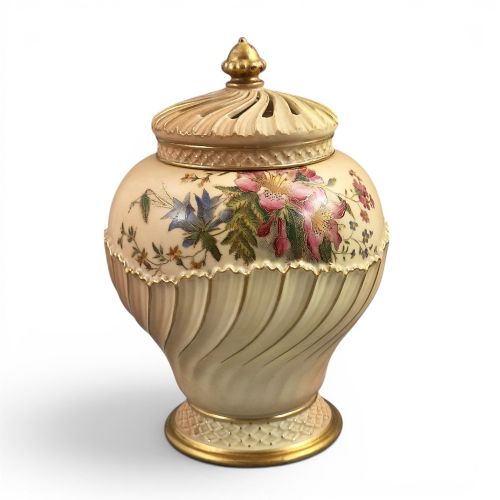


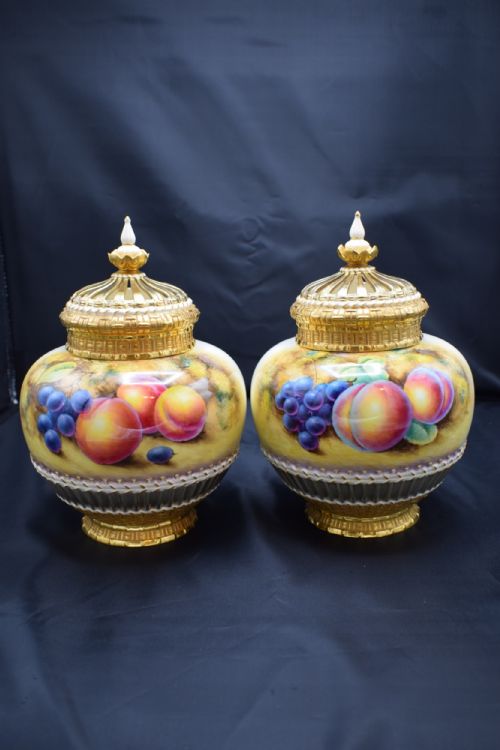


Royal Worcester Covered Urn
These royal worcester covered urn pieces are refined ceramic vessels for display and pot pourri, sought after for their painted decoration and porcelain quality.
Royal Worcester Covered Urn
A royal worcester covered urn encompasses decorative jars, pot pourri vases, and vessels with matching lids produced across the nineteenth and twentieth centuries. The pieces on this page span the Edwardian era, the Victorian period, and mid twentieth century decades up to nineteen sixty.
Buyers will frequently meet blush ivory ground pieces and painted fruit or animal scenes. Forms include ovoid jars, pedestal vases, and bow vases fitted with crown tops or standard covers.
Origins trace directly to English porcelain production. Traditional English styles dominate alongside Victorian and Edwardian decorative conventions.
Materials and Techniques
Production relies upon porcelain and bone china as the primary ceramic bodies. Potters shape these materials into varied vase forms before applying glazes and enamel colours.
Decoration involves hand painting by factory artists, paired with gilding, gold leaf, and gilt highlights. Enamels bring rich tones to depictions of birds, fruit, and floral subjects.
Cock pheasants, flying swans, and highland cattle frequently peer out from the painted porcelain sides.
Evaluating Quality
Quality rests upon the skill of the painting and the complexity of the form. Named artist work carries distinct visual distinction compared to standard factory output.
The precision of the gilding and the preservation of the enamel colours shape the visual presence of each urn or jar. Details such as crown covers and pierced lids demand careful execution in porcelain.
Royal Worcester·Hadley’s & Sons Worcester
The Royal Worcester Covered Urn Glossary
- Blush ivory
- A soft, matte cream coloured porcelain ground developed by the factory to resemble real ivory. It serves as a subtle backdrop for floral and animal painting.
- Pot pourri
- A vessel featuring a pierced or perforated cover designed to diffuse scent from dried botanicals. These jars often take ovoid or pedestal forms.
- Gilding
- The application of gold leaf or gilt onto the ceramic surface. It highlights handles, rims, and ornamental borders.
- Crown top
- A lid shaped like an open crown, frequently paired with pot pourri jars. This form allows fragrance to escape while concealing the contents.
Royal Worcester Covered Urn: Frequently Asked Questions
What are royal worcester covered urn pieces used for?
These vessels were created primarily for interior display and for holding scented pot pourri within domestic rooms. The pierced covers allowed fragrance to permeate while keeping the botanicals contained.
Today they function as decorative objects that showcase traditional English ceramic artistry and hand painted natural subjects.
How do I date an Edwardian piece?
Dating relies upon factory marks stamped underneath the porcelain alongside stylistic markers such as blush ivory grounds and Edwardian shapes. Reference materials help match specific date ciphers to the year of manufacture.
Pieces from this era often combine soft cream tones with gilt detailing and naturalistic painting by recorded factory artists.
Who painted these porcelain urns?
The factory employed specialist artists who focused on specific subjects such as birds, highland cattle, and painted fruit. Signatures or distinct painting styles identify the hand behind the work.
Names associated with these pieces include members of the Stinton family, Harry Davis, and Kitty Blake.
Are these pieces made of bone china?
The inventory includes both standard porcelain and bone china bodies. Potters selected these ceramic materials for their fine texture and ability to hold detailed enamel painting.
Gilding and gold leaf are applied over the fired body to complete the decorative scheme.