
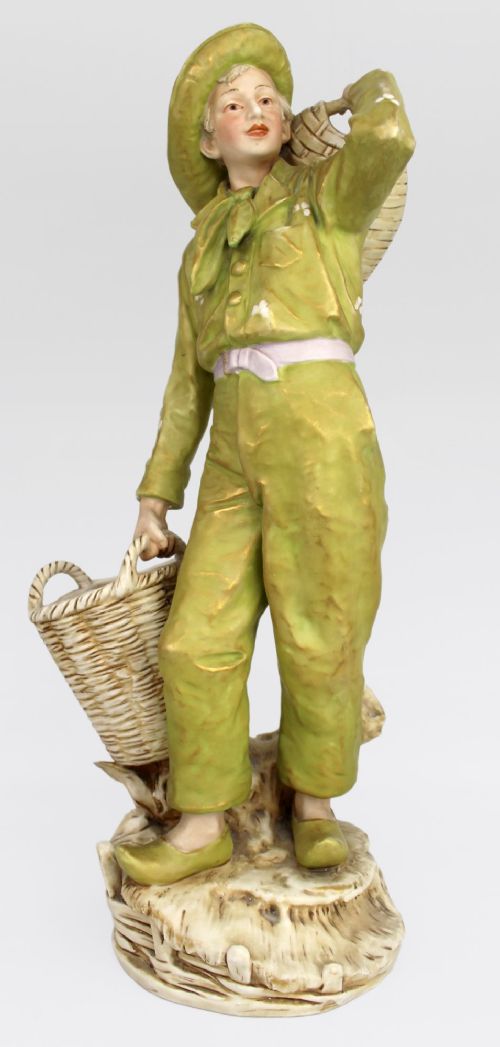


Royal Dux Porcelain
Royal Dux porcelain pieces bring sculptural elegance from the late nineteenth and early twentieth centuries into modern interiors through detailed figures and decorative vessels.
Royal Dux Porcelain
Royal Dux porcelain spans striking figural groups, decorative vases, and elaborate centrepieces produced predominantly during the late nineteenth century and the Edwardian period. Buyers searching for royal dux porcelain encounter elaborate studies of human figures, animals, and mythological subjects rendered in distinct historical styles.
The inventory leans heavily towards figurative works, from water carriers and maidens leaning on shells to Art Nouveau bathers and Art Deco flapper girls. Animal models, including dogs, birds, and polar bears, also appear frequently alongside substantial pairs of decorative vessels.
Most examples originate from the Bohemian manufactory during its most expressive design phases around 1900, capturing the fluid curves of Art Nouveau and the geometric lines of later decades.
How they were made
Makers utilised ceramic body compounds shaped into detailed forms, combining smooth porcelain with areas of biscuit porcelain to create textural contrast across the surface of each sculpture. This unglazed finish allowed modellers to render skin tones and drapery with high fidelity.
Glaze and paint were applied alongside enamel and gilt highlights, with gold leaf accentuating the borders of garments and the rims of vessels. Artisans also employed specialised firing techniques to set the rich colour palettes seen in Victorian Orientalist and Turn-Teplitz designs.
Listings feature porcelain, biscuit porcelain, enamel, and gold leaf applied across nineteenth century and Edwardian periods.
What varies in quality
Quality rests in the crispness of the modelling and the depth of the applied hand-painted details, where finer examples display subtle tonal shading on faces and drapery. The precision of the applied gilding and enamel work also separates standard production items from more ambitious sculptural groups.
Scale and ambition dictate distinction, as monumental figures and multi-piece centrepieces demonstrate greater technical mastery in firing without distortion than smaller, simpler figurines.
H. Schubert·Alois Hampel
The Royal Dux Porcelain Glossary
- Biscuit porcelain
- Unfired or unglazed ceramic material that has been fired once, offering a matte, marble-like texture favoured for detailed figural work.
- Turn-Teplitz
- The Bohemian pottery region associated with the production centre where these figures were originally manufactured.
- Vide poche
- A small decorative dish or bowl designed for emptying pockets, often integrated into figural porcelain designs featuring shells or maidens.
- Art Nouveau
- A design movement characterised by flowing, organic lines, plant motifs, and graceful female forms.
- Gilt
- A thin layer of gold applied to the porcelain surface to highlight specific decorative elements and trim.
Royal Dux Porcelain: Frequently Asked Questions
What periods do these pieces date from?
Most items originate from the late nineteenth century through to the Edwardian era and the 1920s. The designs frequently reflect the aesthetic movements of their specific decade of production.
Art Nouveau and Victorian styles dominate the earlier outputs, while cleaner geometric lines appear in pieces from the Art Deco period.
How were these decorative items used?
Large centrepieces and figural vessels served as functional ornaments or table decorations in period dining rooms and parlours. Vases and vide poche bowls held flowers or small personal items.
Figurines and animal sculptures functioned purely as display pieces to showcase taste and artistic refinement.
How do I identify Art Nouveau examples?
Art Nouveau pieces feature characteristic flowing lines, asymmetric compositions, and natural motifs such as water nymphs, shells, and maidens. The postures of the human figures emphasise organic movement and draped garments.
Stylised floral elements and soft pastel colour palettes often accompany these sculptural forms.
How should I display porcelain figures?
These sculptures require stable surfaces away from high-traffic areas due to their detailed porcelain extremities and delicate painted or gilded finishes. Adequate spacing allows the complex forms of centrepieces and multi-figure groups to be viewed from multiple angles.
Proper lighting helps accentuate the textural contrast between glazed surfaces and matte biscuit porcelain.