


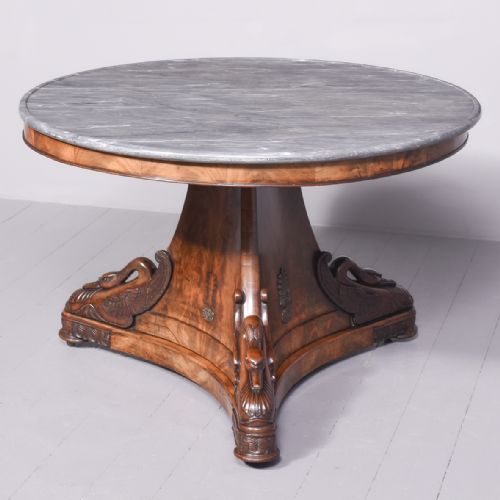


Round Marble Entry Table
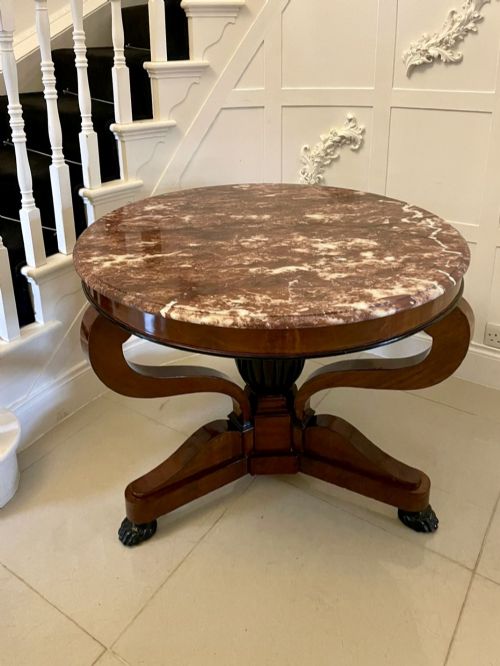
A round marble entry table brings solid stone and rich timber together in the hallway, offering a sturdy surface for daily comings and goings.
Round Marble Entry Table
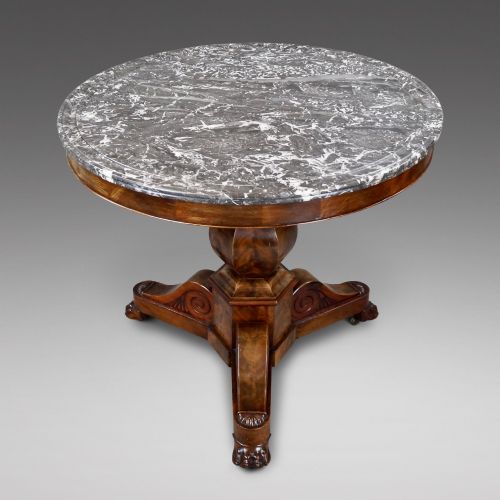
A round marble entry table combines the cool, heavy presence of stone with timber frames designed to hold weight in a hallway or centre space. These pieces arrive mainly from nineteenth-century workshops, drawing on French Empire, Restauration, and Victorian tastes.
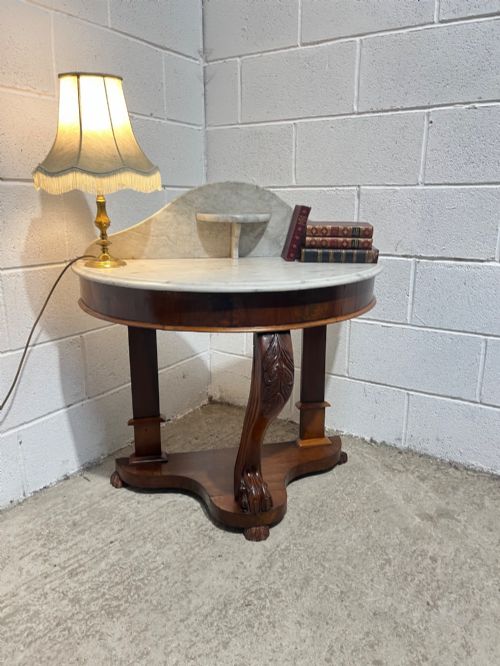
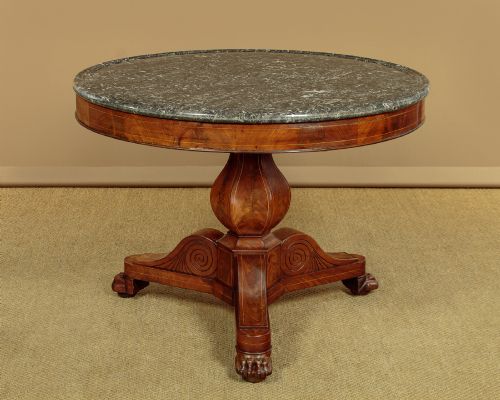
The form splits largely between centre tables and console tables, with the gueridon showing up frequently among the current selection. Most examples pair a smooth marble top with dark woods like mahogany or flame mahogany.
Makers from the eighteen-sixties alongside earlier nineteenth-century artisans shaped these round marble entry table designs to anchor grand rooms and narrow passages alike. Their circular tops present natural veining supported by mahogany pedestals or multi-legged frames.
How they were made
Craftsmen shaped these pieces using solid mahogany and flame mahogany veneers laid over secondary timbers, building sturdy frames to bear heavy stone slabs. Timber sections received careful turning and polishing to bring out the natural grain patterns.
Stone cutters sliced and polished marble to form smooth, flat circular tops that fit precisely onto the wooden bases. Metal elements such as brass and ormolu mounts were cast and applied to corners and pedestals for decorative accent.
Joinery relied on traditional methods of framing and pegging to keep the heavy stone balanced safely above the floor. Inlayers added contrasting wood details, while bronze ornaments were secured to enhance the Empire and Victorian styling.
Listings feature pieces spanning the nineteenth century up to nineteen forty, utilising marble, mahogany, flame mahogany, walnut, brass, ormolu, and inlay.
What varies in quality
The depth and figure of the timber veneer set one piece apart from another, with flame mahogany showing lively grain contrast while plain woods appear simpler. Richness in the wood preparation creates a warmer visual depth across the base.
The selection and finish of the marble top dictate the overall refinement of the table, particularly the clarity of its natural veining and the smoothness of its edge moulding. Heavier, well-fitted stone rests more securely in its frame.
Ornaments in brass, bronze, and ormolu introduce another layer of distinction, where crisp casting and firm attachment elevate the decorative success of the design. Simpler pieces rely entirely on the purity of the wood turnings and stone circle.
The Round Marble Entry Table Glossary
- Gueridon
- A small round table, typically supported by a central pillar or three legs, originating in seventeenth-century France and remaining popular through the nineteenth century.
- Ormolu
- Gilt bronze mounted onto furniture as a decorative trim, created by applying a gold amalgam to cast bronze and heating it.
- Flame mahogany
- A veneer cut from the fork of a mahogany tree where the branches join the trunk, producing a rippling, flame-like pattern.
- Console table
- A table designed to stand against a wall, frequently supported by brackets or legs at the front while relying on the wall for balance.
- French Empire
- A neoclassical design style spanning the early nineteenth century, characterised by heavy classical motifs, dark woods, and bronze mounts.
Round Marble Entry Table: Frequently Asked Questions
Where should I place a round marble entry table?
These tables sit well in a spacious hallway or entrance hall where people can walk around the circular top easily. They provide a sturdy surface for post, keys, or a decorative bowl upon entry.
Because the top is heavy stone, the table requires a stable floor surface and enough surrounding clearance to let the wood and marble catch the light.
How do I clean the marble top?
Wipe the stone surface using a soft cloth dampened with warm water and mild, neutral soap. Avoid acidic cleaners, vinegar, or citrus solutions that can etch the polished finish.
Dry the marble thoroughly afterwards to prevent water spots from forming on the stone surface.
How do I identify a nineteenth-century piece?
Look for construction details such as hand-cut joints, dense mahogany timbers, and the characteristic weight of period marble. Styles like French Empire and Victorian point directly to nineteenth-century workshop practices.
Examine the underside of the top and the joinery where the pedestal meets the base for signs of age and traditional assembly.