



Rosewood Storage Casket
These rosewood storage casket pieces are heavy timber boxes built to hold letters, jewels and tea, offering dense grain and deep colour that age well in any room.
Rosewood Storage Casket
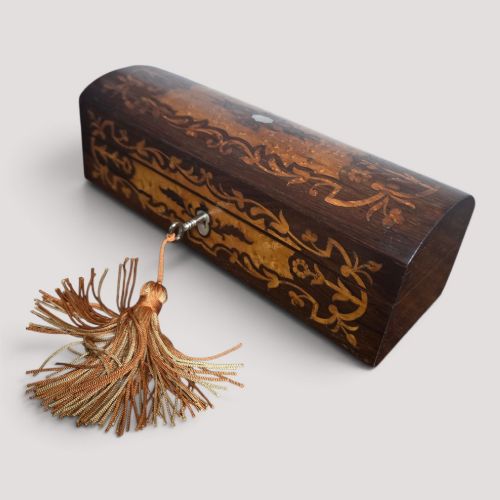
A rosewood storage casket encompasses small wooden containers made to hold personal valuables, writing materials and leaf tea. They arrive in forms ranging from simple lidded trunks to partitioned sewing boxes and sarcophagus-shaped jewellery chests.
The pieces on this page span the Regency, Victorian and early twentieth-century periods, with English workshops producing the vast majority alongside Chinese export examples. Buyers most frequently meet Victorian work boxes and Regency tea caddies finished in dark tropical timber.
Victorian examples often feature fitted interiors lined in silk or paper, designed to organise small trinkets and sewing tools. Regency and William IV pieces tend towards bolder architectural silhouettes such as the sarcophagus form.
How they were made
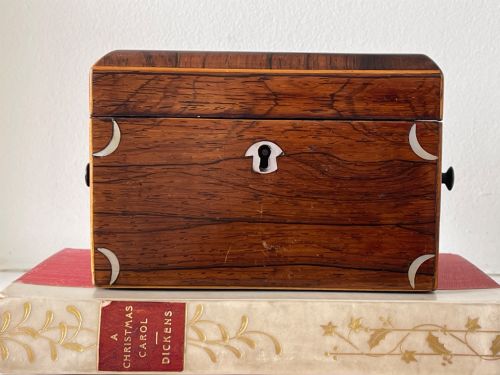
Carpenters built these caskets using solid rosewood or pine carcasses veneered with figured rosewood boards to display rich grain patterns. They reinforced corners and fitted lids with brass hinges and locks to secure the contents.
Craftspersons inlaid contrasting materials into the timber surface, utilising mother-of-pearl, brass stringing and boxwood lines. Tunbridge Ware pieces incorporate tiny mosaic tesserae assembled from natural woods to form pictorial scenes on the lid.
Rosewood Storage Casket Retail Price Guide 2026
Typical asking prices for rosewood storage casket among the pieces listed under this phrase on Sellingantiques today, from the lower quarter to the upper quarter. They describe what is for sale here now, not the wider market.
Listings feature pieces spanning the Regency, Victorian, William IV and early twentieth-century periods.
What varies in quality
The crispness of the inlay and the precision of the mitred joints separate ordinary containers from finer work. Superior examples display tightly fitted mother-of-pearl plaques and clean brass stringing that sits flush with the polished timber.
Internal fitted trays and compartments reveal the original maker's investment of time. Boxes retaining their original silk linings and operable brass locks command stronger interest than those stripped of their internal architecture.
The Rosewood Storage Casket Glossary
- Rosewood
- A dense, dark timber prized for its heavy weight and contrasting dark grain figures. It takes a high polish and forms the primary carcass material for these boxes.
- Tunbridge Ware
- A type of decorative woodwork originating from Kent, featuring mosaic patterns built from thousands of tiny tinted wood blocks. These form geometric or pictorial designs on the box lids.
- Sarcophagus
- An architectural box shape featuring a sloping, pedestal-like lid derived from classical monumental tombs. This form appears frequently on Regency and William IV tea caddies and jewellery chests.
- Mother-of-pearl
- The iridescent inner layer of mollusc shells, sliced into thin plaques and embedded into the timber surface. It creates shimmering geometric or floral motifs.
- Stringing
- Thin inlaid lines of contrasting wood or metal set into grooves on the box surface. It outlines the edges and panels to define the geometric composition.
Rosewood Storage Casket: Frequently Asked Questions
What did people store inside a rosewood storage casket?
These boxes held valuable personal items including jewellery, letters, sewing implements and loose tea leaves. Many contained fitted compartments to keep each category of object separate.
Tea caddies often featured internal foil-lined canisters with lids to preserve the aroma of the dry leaves. Sewing boxes included small trays with bone or ivory winders for thread.
How do I date a rosewood box?
Dating relies on stylistic clues such as the silhouette, the type of inlay and the interior fittings. Regency pieces often show brass inlay and sarcophagus shapes, while Victorian examples lean towards mother-of-pearl and fitted silk trays.
Construction methods also provide context, as machine-sawn veneers and brass screw heads point towards later nineteenth-century production. Earlier pieces rely on hand-cut dovetails and traditional adhesives.
Are the interiors usually original?
Many surviving boxes retain their original paper or wooden partitions, though fabric linings frequently required replacement over the decades. Some listings note newly lined interiors where the fragile original silk perished.
Buyers should examine whether the internal trays lift out cleanly and if the remaining compartments match the exterior period style. Original locks and mirrors inside the lid add considerable interest.
How should I care for rosewood furniture?
Rosewood benefits from placement away from direct sunlight and strong heat sources to prevent the timber from drying and splitting. Maintaining a stable indoor humidity protects both the wood and the delicate veneer.
Cleaning requires only a soft, dry cloth to remove dust. Periodic applications of appropriate wax feed the polished surface without building up excessive residue.