





Rosewood Nested Tables
Rosewood nested tables are sets of graduated occasional tables designed to stack together, offering adaptable surface space that tucks away neatly when not in use.
Rosewood Nested Tables
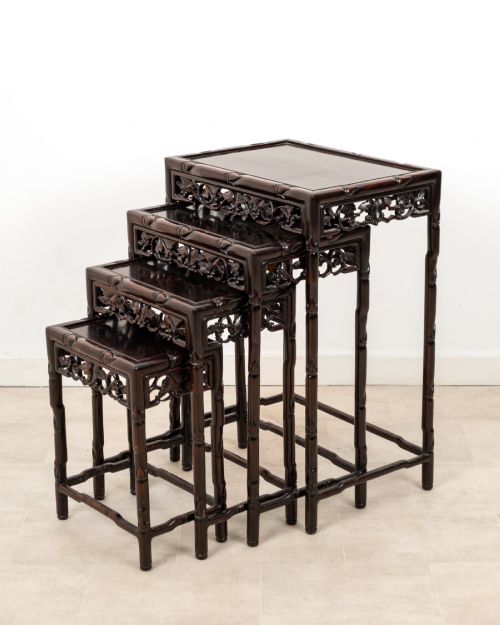
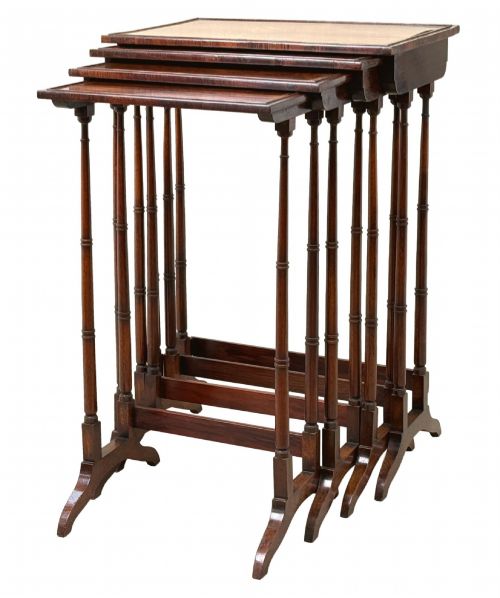
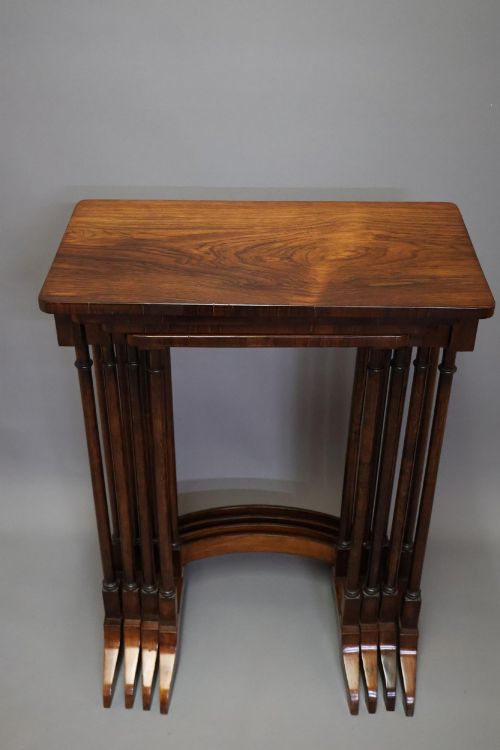
When searching for rosewood nested tables, a buyer encounters sets of occasional tables, frequently structured as a quartetto of four pieces or as sets of three, which slide beneath one another in graduating sizes. The form appears across distinct design traditions, spanning British Regency pieces and nineteenth-century Chinese export furniture.
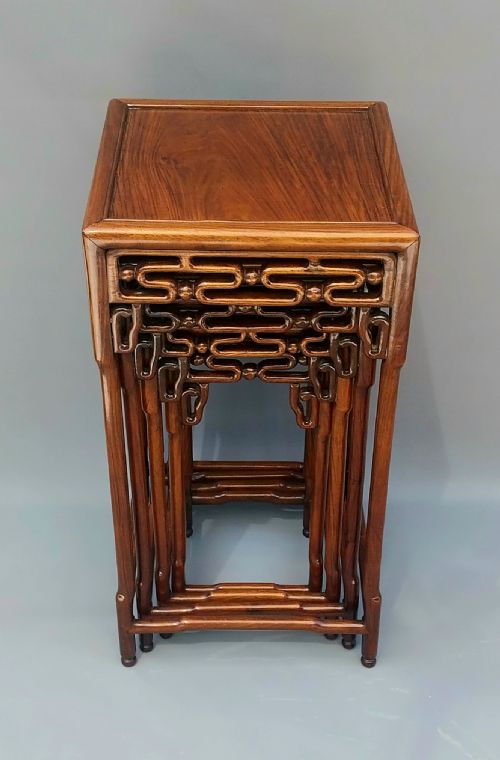
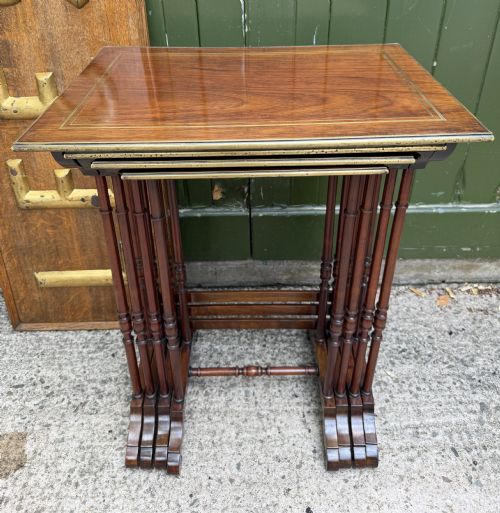
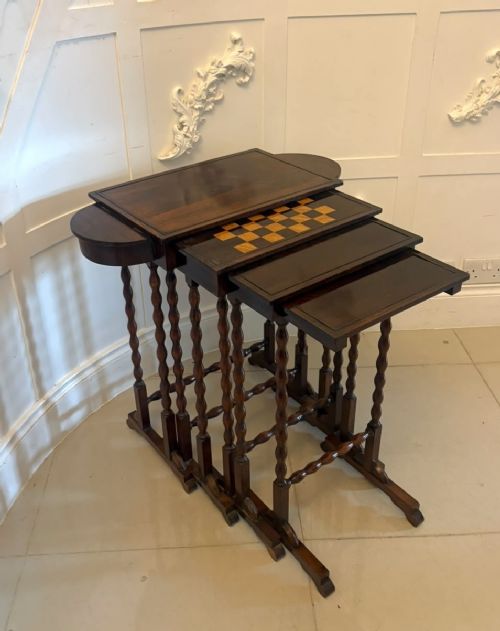
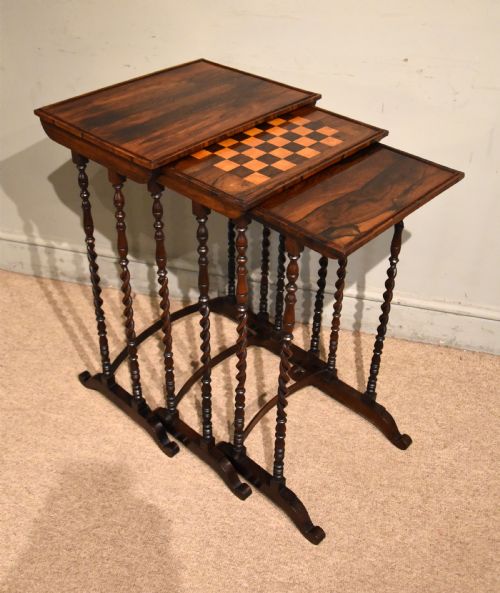
British Regency examples typically present slender turned supports and precise proportions designed for drawing rooms, sometimes incorporating brass inlay or integrated chess boards. Conversely, Chinese export and Qing Dynasty examples rely on dense tropical hardwoods, often featuring carved aprons and structured frames.
Later iterations extend into the early twentieth century, taking the form of Art Nouveau French designs and Art Deco variations in Indian rosewood. The selection ranges from minimal occasional stands to highly decorative carved sets intended for display as much as utility.
How they were made
Cabinetmakers utilised dense timbers such as rosewood, hongmu, and assorted hardwoods, frequently pairing them with contrasting wood veneers, boxwood stringing, or brass inlays to accentuate the framing. The physical weight of these tropical timbers allowed makers to construct exceptionally slender legs without sacrificing structural integrity.
Construction relies on precise joinery to ensure each table within the nest clears the frame of the next without binding. Carved details on Chinese export pieces required hand-chisselling into seasoned hardwood, while European workshops focused on smooth polished veneer surfaces and fitted joints.
Certain Regency nested tables hide entire chess boards within the sliding mechanism for impromptu parlor games.
What varies in quality
The distinction between standard production and the highest grade lies in the selection of the timber and the precision of the graduating fit. Superior sets maintain crisp alignment when stacked, with uniform clearance and minimal play between the individual frames.
In Regency work, quality shows in the subtlety of the brass inlay and the grain matching across the table tops. In Chinese export pieces, the depth and crispness of the hand-carved motifs separate workshop execution from mass production.
Émile Gallé·Gillows·W&C Wilkinson London
The Rosewood Nested Tables Glossary
- Quartetto
- A matched set of four occasional tables designed to nest together. The term appears frequently in Regency furniture records.
- Hongmu
- A traditional Chinese term for dense red-black hardwoods. These timbers are heavy and durable, commonly utilised in export furniture.
- Veneer
- A thin layer of superior wood applied to a secondary timber base. This technique permits intricate grain patterns on table surfaces.
- Graduated
- Describing a set of tables where each piece decreases in dimension sequentially. This scaling allows the smaller tables to slide cleanly beneath the next size up.
Rosewood Nested Tables: Frequently Asked Questions
What is a quartetto table?
A quartetto table refers specifically to a set of four nesting tables. The configuration originated in Regency England as a space-saving innovation for entertaining.
These sets function as a single compact unit that deploys into four distinct surfaces when guests require them.
How do I care for rosewood?
Rosewood requires stable humidity and protection from direct sunlight to prevent the timber from drying or splitting. Regular dusting with a dry cloth preserves the polished surface.
Avoid placing damp items directly on the veneer to prevent water rings and finish degradation.
Were these tables used daily?
Historical examples served as portable tea tables, writing supports, or card tables in nineteenth-century drawing rooms. Their mobility allowed servants to move them about the house easily.
They accommodated the Victorian and Regency demand for flexible, multi-purpose furniture in formal interiors.
How do I distinguish Regency from Chinese export sets?
Regency tables typically feature mahogany or pine carcasses faced with rosewood veneer, often highlighted by brass stringing and slender turned legs. Chinese export sets utilise solid dense hardwoods like hongmu and display traditional carved relief work.
The structural joinery and decorative motifs provide immediate clues to the geographical origin of the workshop.