



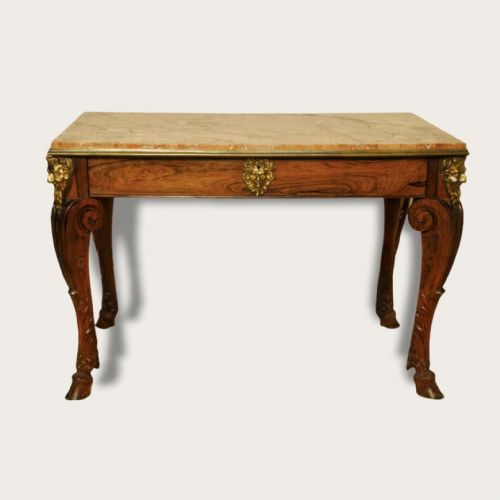


Rosewood Marble Console Table
A rosewood marble console table brings deep timber and cool stone together in a form built to anchor a formal hall or parlour.
Rosewood Marble Console Table
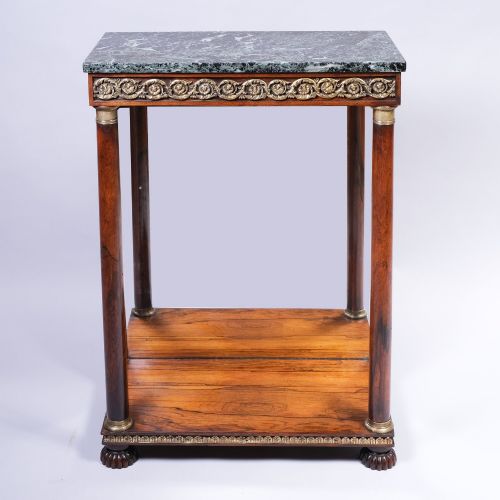
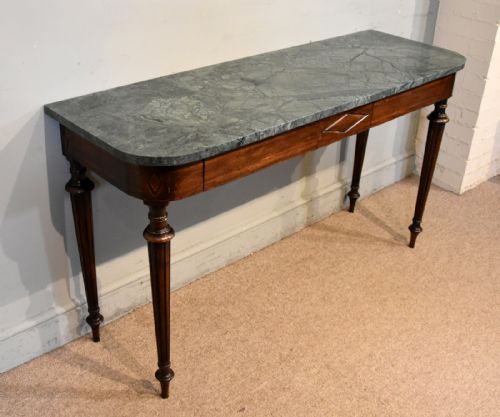
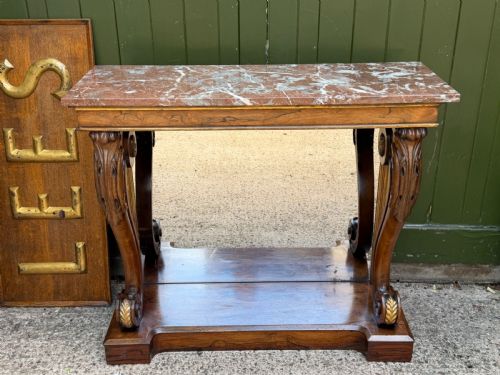
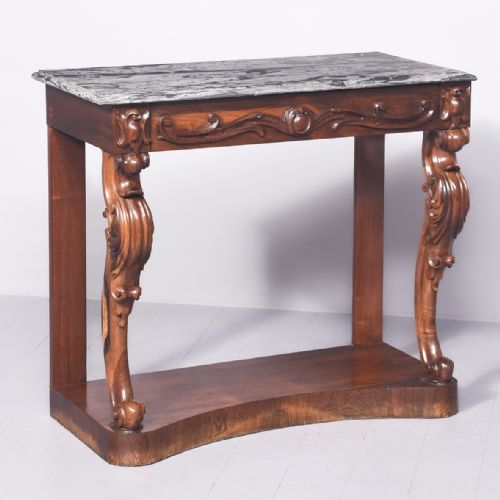
A rosewood marble console table combines a dense exotic timber frame with a fitted stone top, designed originally to stand flush against a wall in a reception room or hallway. The evidence shows these pieces surface frequently from the nineteenth century, spanning Regency, William IV, and Victorian periods alongside distinct Qing Dynasty interpretations in carved hardwood.
Most examples you encounter here belong to the broader Regency and nineteenth-century traditions, often featuring mirror backs, parcel-gilt details, or brass mounts. Alongside standard console tables, the record includes related forms such as pier tables, chiffoniers, and centre tables that share the same material vocabulary of figured wood and inset marble.
Makers drew on diverse design languages, ranging from British Regency classicism and French Empire influence to Anglo-Indian craftsmanship and Chinese Qing Dynasty carving. These regional variations mean a buyer might choose between a strict architectural pier table with Ormolu mounts and an intricately carved hardwood centre table with a rouge marble panel.
Materials and construction
Cabinetmakers built the foundational frames using dense hardwoods, applying figured rosewood veneers or solid timber alongside secondary structural woods. Parcel-gilt highlights and brass or ormolu mounts were added to catch the light, while mother-of-pearl occasionally appears as an inlaid accent.
The heavy stone tops, ranging from grey to white or rouge marble, required robust sub-frames and stretcher bases to support the dead weight. Many nineteenth-century versions incorporated inset mirror glass into the back panels beneath the marble slab, amplifying natural light within the room.
Listings feature nineteenth-century pieces alongside Regency and Qing Dynasty examples, combining rosewood, hardwood, marble, brass, and ormolu.
Judging quality in these tables
Quality rests principally on the selection of the rosewood veneer and the figuring within the marble top, where harmonious grain and stone patterning elevate the piece. Superior examples display crisp, hand-carved details in the wood and refined chasing on any brass, ormolu, or parcel-gilt enrichments.
Structural integrity sets apart fine execution, particularly how the base supports the heavy stone slab without sagging or shifting. Original components matter greatly, as replacement marble tops or altered timber frames diminish the coherence of the piece.
The Rosewood Marble Console Table Glossary
- Console table
- A table designed to stand against a wall, traditionally fixed with brackets or resting on front legs. These forms often feature flat backs to sit flush against interior plasterwork.
- Pier table
- A specific type of side table made to fit the pier space between two windows. They frequently incorporate mirror-backed lower sections to reflect light back into the room.
- Ormolu
- Gilded bronze mounted onto furniture as a decorative trim. The technique involves applying a mercury and gold amalgam to cast bronze before firing.
- Parcel-gilt
- Woodwork partially decorated with gold leaf applied to specific carved details or mouldings. This technique creates contrast against the dark background of rosewood.
- Chiffonier
- A low cabinet or sideboard fitted with shelves and doors, frequently appearing with a marble top in nineteenth-century contexts. It served both storage and display functions in the home.
Rosewood Marble Console Table: Frequently Asked Questions
Where should I place a console table?
These tables suit hallways, entrance passages, and reception rooms where floor space is shallow. Because they stand against a wall, they provide a display surface without obstructing main thoroughfares.
Pairing a console with a matching wall mirror or placing it beneath a picture window allows the fitted marble top and rosewood frame to anchor the room's composition.
How do I care for the marble top?
Marble requires gentle cleaning with warm water and a soft cloth, avoiding acidic substances that can etch the polished surface. Regular dusting keeps the stone and the surrounding timber frame in good condition.
Avoid placing damp items directly onto the unsealed stone or untreated rosewood veneer to prevent permanent rings and moisture marks.
Are these tables heavy to move?
The combination of dense tropical hardwood and a solid stone slab makes these pieces substantial in weight. Most require two people to lift and reposition safely without straining the joints.
The heavy marble top is frequently detachable from the wooden base, which simplifies transport and placement within a room.
How do I identify a Regency period piece?
Regency pieces often display classical architectural motifs, such as reeded legs, brass inlay, and restrained scrollwork. The use of figured rosewood combined with parcel-gilt accents is characteristic of this design era.
Examining the construction methods, secondary timbers beneath the frame, and the fixing of the marble slab helps confirm the nineteenth-century origin.