
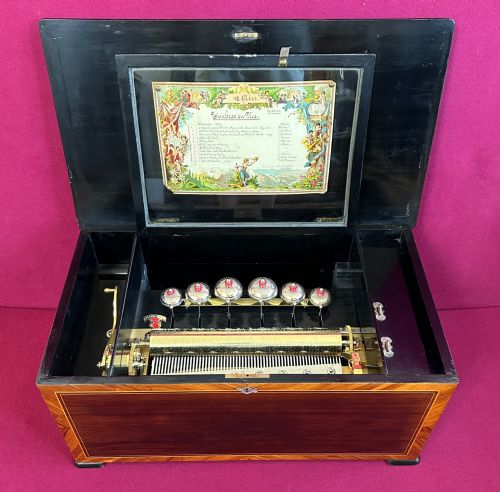



Rosewood Cylinder Music Box
These rosewood cylinder music boxes are mechanical marvels housed in rich timber cases, bringing nineteenth-century parlour melodies back to life.

Rosewood Cylinder Music Box
A rosewood cylinder music box combines precision pin-studded metal cylinders with tuned steel teeth to play mechanical tunes automatically. The examples seen here belong primarily to the Victorian period, spanning the mid to late nineteenth century.
Most pieces feature polished rosewood exteriors, often enhanced with marquetry inlay or contrasting boxwood lines. Buyers encounter various scales, ranging from simple eight-air arrangements to larger models featuring visible bells and complex movements.
Originating largely from Swiss workshops, these instruments served as prime domestic entertainment before the invention of recorded sound. The surviving examples on this page reflect the height of this intricate acoustic craft.
Materials and construction methods
Cases are constructed using dense rosewood and occasionally walnut or ebonised wood, providing the acoustic resonance required for the internal comb. These timber housings are frequently embellished with marquetry inlay and boxwood stringing.
Inside, the mechanical heart relies on heavy brass cylinder barrels set with tiny metal pins that strike tuned steel teeth. Additional elements like glass covers and exposed brass bells appear in more elaborate configurations.
Some nineteenth-century listeners preferred their mechanical tunes accompanied by the gentle chime of visible brass bells.
Distinguishing quality and execution
The crispness of the marquetry inlay and the depth of the rosewood grain contribute significantly to the visual merit of the housing. Superior examples maintain the original integrity of both their casework and their delicate steel combs.
Nicole Freres·LeCoultre
The Rosewood Cylinder Music Box Glossary
- Cylinder
- The rotating brass barrel set with precision pins that pluck the tuned teeth of the comb. It dictates the specific sequence of notes played.
- Comb
- The flat plate of tuned steel teeth struck by the pins on the rotating cylinder. Each tooth is hand-tuned to a specific musical pitch.
- Air
- A distinct musical tune or melody recorded onto the cylinder. Boxes are often described by how many airs they can play.
- Marquetry inlay
- Decorative patterns formed by fitting contrasting pieces of veneer into the rosewood surface. It defines the aesthetic exterior of finer boxes.
- Boxwood stringing
- Thin lines of pale boxwood inlaid into the darker rosewood case to create geometric borders. This detail highlights the cabinetwork.
Rosewood Cylinder Music Box: Frequently Asked Questions
How do cylinder music boxes work?
A wound spring turns a brass cylinder covered in tiny metal pins. These pins pluck individual teeth on a steel comb to produce programmed melodies.
More advanced models incorporate multiple airs and striking bells operated by secondary levers within the movement.
What is an air?
An air represents a single complete musical tune encoded onto the rotating brass cylinder. Pins are arranged in distinct tracks to trigger the necessary notes in sequence.
Boxes typically offer a fixed selection of tunes, ranging from simple eight-air formats to extensive twelve-air repertoires.
How should I care for a music box?
Keep the instrument in a stable environment away from direct sunlight and damp conditions to protect the delicate rosewood veneer and internal steel components. Avoid over-winding the spring mechanism.
Occasional dusting of the glass and exterior wood preserves the finish, while internal mechanical servicing should be left to specialists.
How do I identify a Victorian piece?
Victorian examples rely on distinct casework styles, typically featuring dark rosewood veneers, brass fittings, and intricate marquetry typical of nineteenth-century cabinetmaking. Many house Swiss movements imported during this era.
Examining the internal components and construction methods helps confirm the mid-to-late nineteenth-century timeline.