


Rococo Walnut Secretary Desk
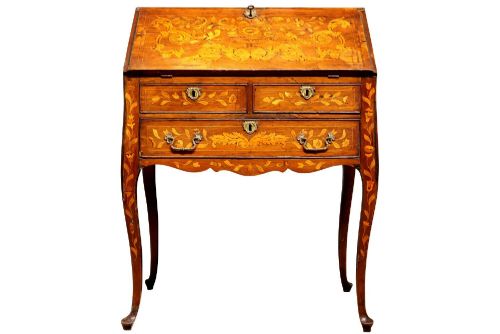
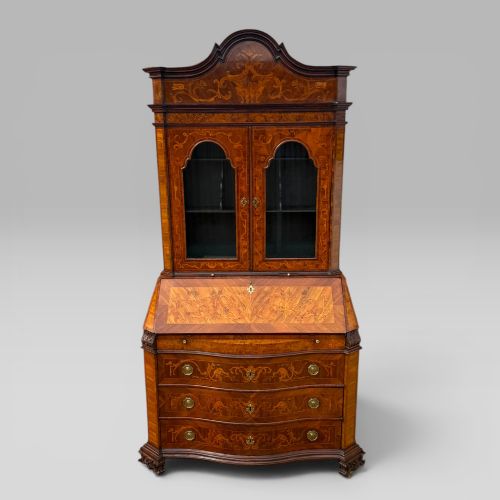
These rococo walnut secretary desk examples are grand continental writing cabinets built to conceal correspondence behind fitted falls and double-dome superstructures.
Rococo Walnut Secretary Desk
A rococo walnut secretary desk combines a lower bureau writing slope with upper bookcase cabinets, forming a monumental piece of furniture. You will frequently encounter Dutch and Italian regional variations across the eighteenth century, alongside later nineteenth-century revival interpretations.
The primary forms range from double-dome bureau bookcases to bureau cabinets and smaller bonheur de jour writing tables. Burr walnut and rich fruitwood veneers dominate the structural silhouettes, often paired with intricate floral marquetry.
Continental workshops from Venice, Germany and the Netherlands produced these secretary desks with distinct regional carved details and architectural proportions. Eighteenth-century origins provide the foundational style, while nineteenth-century revival pieces continue the tradition.
Materials and construction
Cabinetmakers utilised solid walnut and burr walnut as foundational timbers, applying delicate tulipwood and fruitwood veneers across the main surfaces. Floral marquetry panels were meticulously sawn and fitted by hand to create elaborate decorative motifs on the fall fronts and doors.
Cast brass handles, escutcheons and hinges punctuate the dark timber surfaces, providing functional articulation for drawers and cabinet doors. Glass panelling in the upper bookcase sections allows for the display of contents while protecting books and papers.
The documented periods span from the mid-eighteenth century through to late nineteenth-century revival movements.
Assessing quality and execution
The density and figuring of the burr walnut veneer dictate the visual impact of the cabinet facade. Master craftsmen selected timber cuts with deep, rolling grain patterns that catch the light across the bureau front.
The precision of the floral marquetry inlay separates standard production from exceptional cabinet work. Integrated shading on individual leaf and petal veneers demonstrates advanced technical skill in provincial and metropolitan workshops alike.
The Rococo Walnut Secretary Desk Glossary
- Bureau bookcase
- A writing cabinet featuring a lower sloping desk section beneath an enclosed upper shelving unit. This combined form was designed to store correspondence and display bound volumes.
- Marquetry
- The art of forming decorative patterns by fitting together thin slices of various coloured woods and veneers. Craftsmen arranged floral and geometric motifs across the primary carcase.
- Burr walnut
- Timber taken from a tree growth where the grain has grown in a deformed, swirling manner. This prized wood yields highly decorative veneer panels with complex figuring.
- Double dome
- An upper cabinet roof line shaped into two adjacent curved, vaulted arches. This architectural profile is typical of high-status eighteenth-century case furniture.
- Bonheur de jour
- A small, light lady writing desk featuring a small cabinet or set of drawers on top of the writing surface. These pieces emerged during the mid-nineteenth century revival periods.
Rococo Walnut Secretary Desk: Frequently Asked Questions
How do I date a secretary desk?
Dating relies on examining the construction methods, timber selection and decorative motifs present in the carcase and veneers. Eighteenth-century examples display hand-cut dovetails and regional continental styling.
Nineteenth-century revival pieces often incorporate machine-sawn elements and slightly heavier proportions while copying earlier baroque and rococo designs.
Where were these desks made?
The surviving pieces originate primarily from continental European workshops in the Netherlands, Italy and Germany. Dutch and Venetian makers were particularly prolific in producing highly decorated marquetry examples.
Regional differences in the curve of the cabriole legs and the arrangement of internal drawers help identify the specific country of origin.
What is burr walnut?
Burr walnut is a specialised timber derived from the knotted growth of a walnut tree, highly valued for its swirling and turbulent grain patterns. Cabinetmakers sliced this wood into thin veneers to cover large expanses of the desk facade.
Because no two sections of burr timber share the same pattern, each cabinet possesses a completely unique surface appearance.
How should I clean walnut veneer?
Maintain walnut furniture by dusting regularly with a soft, dry cloth to prevent abrasive particle build-up. Avoid using harsh chemical polishes or modern silicone sprays that can damage old french polish surfaces.
Keep the timber away from direct sunlight and strong heat sources to prevent the delicate marquetry veneers from drying and lifting.