
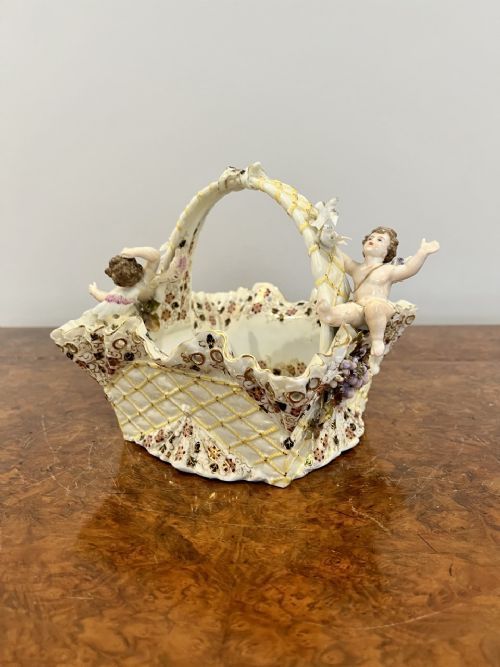


Rococo Style Porcelain Basket
A rococo style porcelain basket brings elaborate, asymmetric scrollwork and delicate floral motifs straight to the dining table or sideboard.
Rococo Style Porcelain Basket
When you search for a rococo style porcelain basket, you encounter ornate centrepieces, decorative bowls, and figural dishes designed to dominate a formal table setting. The examples on this page span the Georgian period through the Edwardian era, featuring prominent German works alongside English productions.
Most items you meet here adopt the Rococo Revival or Victorian Rococo Revival aesthetic, heavily influenced by continental factories like Meissen, Sitzendorf, and Schierholz. Forms range from covered chestnut baskets and sweetmeat figures to large flower centrepieces supported by cherubs.
How these porcelain baskets were made
Potters utilised fine ceramic paste, including soft-paste porcelain, shaping the bodies by hand or pressing them into moulds before applying intricate surface details. Artisans individually formed hundreds of tiny petals and leaves to create the dense, three-dimensional floral garlands characteristic of the style.
Glazing and firing preceded the meticulous application of enamel colours and gold leaf highlights, often referred to as gilding or gilded enamel. Painters brushed rich polychrome palettes onto the figures and basket weaves before a final low-temperature kiln firing fixed the decoration.
Gardener figures and plump cherubs persistently populate these baskets, apparently unbothered by the heavy floral loads they carry.
What varies in quality across these pieces
Quality rests heavily on the crispness of the moulding and the delicacy of the applied floral work, where finer pieces retain sharp leaf veins and paper-thin petals. Heavier, clumsier modelling indicates mass production or later revival interpretations lacking the verve of the original aesthetic.
The sophistication of the hand-painted enamel work and the generosity of the gold leaf application separate standard factory output from masterworks. Superior pieces display nuanced shading on figures and floral clusters, whereas lesser examples rely on flat, uniform washes of colour.
Derby Porcelain·Volkstedt Porcelain·C.G. Schierholz and Sohn·Sitzendorf·Meissen
The Rococo Style Porcelain Basket Glossary
- Soft-paste porcelain
- A glassy ceramic material fired at lower temperatures than hard-paste porcelain, possessing a warm, slightly creamy body favoured by eighteenth-century English factories like Derby.
- Sweetmeat
- A small confection or sweet served during dessert courses, accommodated by specialised low dishes or figures holding shallow bowls.
- Comport
- An ornamental pedestal dish or bowl raised above the table surface, frequently used for fruit or decorative arrangements.
- Gilding
- The application of gold leaf or powdered gold onto ceramic surfaces to highlight raised scrolls and rims.
- Putto
- A plump, unwinged male infant figure, often appearing as a cherub in German centrepieces and figural groups.
Rococo Style Porcelain Basket: Frequently Asked Questions
What were porcelain baskets used for originally?
These elaborate vessels served as centrepieces on formal dining tables, holding dried fruits, sweetmeats, or sweet confections during dessert courses.
Wealthy households also utilised them simply as decorative ornaments on sideboards and mantelpieces to display wealth and artistic taste.
How do I distinguish German and English pieces?
German factories like Sitzendorf, Schierholz, and Volkstedt typically produced heavily populated figural centrepieces featuring cherubs and applied flowers during the nineteenth century.
English makers such as Derby focused on functional covered vessels like chestnut baskets utilising soft-paste porcelain bodies.
What is Rococo Revival style?
Rococo Revival is a nineteenth-century design movement that re-engaged with the asymmetric curves, C-scrolls, and naturalistic motifs of the mid-eighteenth century.
Victorian iterations often amplified the ornamentation, incorporating bolder gilding and more elaborate figural bases.
How should I clean a porcelain basket?
Dust these delicate items gently with a soft, dry brush to prevent snagging bristles on the fragile applied flowers and pierced lattice work.
Avoid submerging pieces with old gilding or enamel paint in water, as moisture can degrade historical surface finishes.