
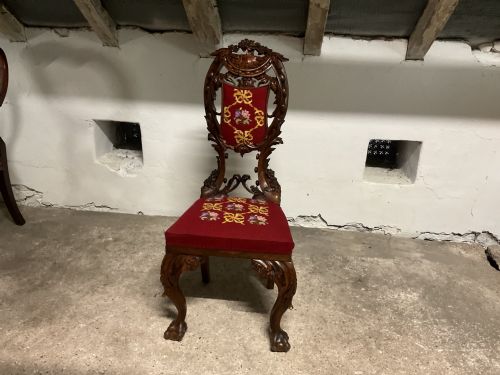


Rococo Revival Hall Chairs
These rococo revival hall chairs bring dramatic nineteenth-century curves and elaborate carving straight into a modern hallway.
Rococo Revival Hall Chairs
Rococo revival hall chairs comprise nineteenth-century seating designed with flowing organic shapes, scrolled outlines, and prominent cartouches. The selection gathered here spans the Victorian era, bringing together versatile side chairs and grander entrance seating.
Most examples originate from the nineteenth century, including specific dates across the eighteen-fifties, sixties, seventies, and nineties. Makers deployed styles ranging from French Chateau influences to classic Victorian interpretations.
Buyers encounter forms that bridge functional entrance seating and decorative occasional placement. Many pieces feature pierced splats or heraldic crests carved directly into the timber frame.
Materials and construction
Cabinetmakers constructed these frames using dense hardwoods like mahogany, walnut, and rosewood, alongside occasional ebonised finishes and painted surfaces. Selected pieces incorporate brass elements to accent the carved woodwork.
Upholstered variants integrate traditional textiles and velvet across high backs and seats. Skilled artisans shaped the solid timber to achieve the characteristic asymmetrical scrolls and deep relief carvings central to the style.
Materials appearing across current inventory include mahogany, walnut, rosewood, brass, fabric, and velvet.
Assessing quality and craftsmanship
The distinction between standard seating and finer examples rests entirely on the depth and crispness of the timber carving. Superior pieces display intricate pierced splats and heraldic crests rendered with sharp relief rather than shallow machine profiling.
Material selection further defines the upper tier, where richly figured rosewood or dense mahogany frames retain their structural integrity alongside well-preserved textiles and velvet upholstery.
The Rococo Revival Hall Chairs Glossary
- Pierced splat
- The central vertical upright of a chair back that has been cut through to create an openwork decorative pattern. This technique lightens the visual weight of heavy timber frames.
- Heraldic crest
- A carved emblem or coat of arms displayed prominently on the upper chair back. Such details often denote specific lineage or commissioned civic seating.
- Side chair
- An un-armed seat designed for occasional use around a room or against a hallway wall. These form a large portion of nineteenth-century decorative seating.
- Cartouche
- An ornamental frame resembling a scroll or unwrapped parchment, frequently utilised as a focal point in nineteenth-century carving. It often houses crests or floral motifs.
Rococo Revival Hall Chairs: Frequently Asked Questions
Where should I place these chairs?
These pieces suit entrance halls, landings, and large corridors where their carved backs create an immediate visual impact. They also function well as occasional seating in reception rooms.
Because nineteenth-century hall chairs are relatively narrow, they fit neatly against walls without obstructing thoroughfares while offering a firm, upright seat.
How do I care for the timber frames?
Maintain the polished mahogany, walnut, and rosewood surfaces using gentle dusting with a soft, dry cloth. Avoid placing timber furniture near direct heat sources or strong sunlight.
Occasional application of appropriate wax polish helps preserve the sheen on antique wood without building up a heavy residue over the carved details.
Are these chairs comfortable for daily use?
Nineteenth-century hall seating prioritised upright posture and decorative presence over deep lounging comfort. Wooden panel backs and firm seats encourage an erect sitting position.
Upholstered variants featuring fabric or velvet offer slightly more cushioning, though these chairs remain best suited for brief seating rather than prolonged relaxation.
How can I date these pieces accurately?
Dating relies on examining the timber species, joinery techniques, and the specific manifestation of nineteenth-century revival styles. Pieces bearing documented production dates from the eighteen-fifties to the nineties show shifts in timber preference.
Stylistic markers such as ebonised finishes or French Chateau influences help narrow down the period of manufacture alongside the structural construction of the seat frame.