





Rococo Revival Games Table
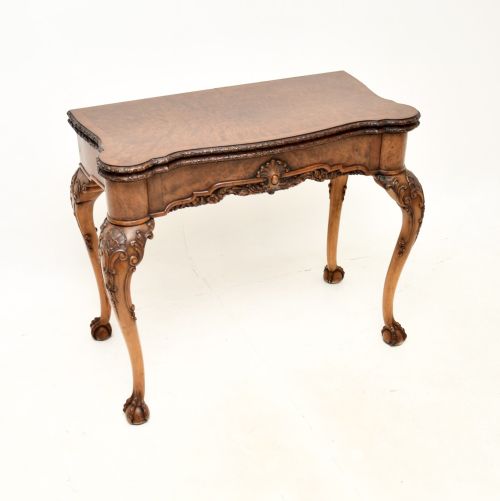
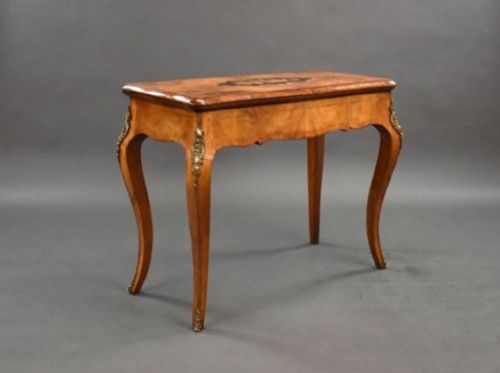
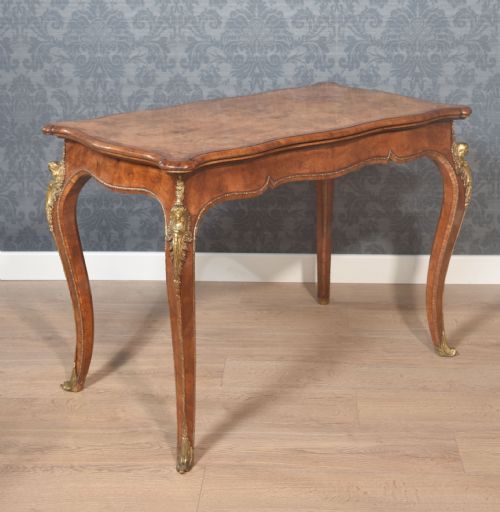
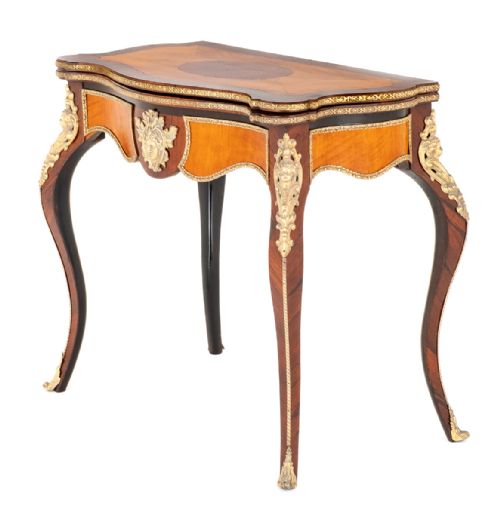
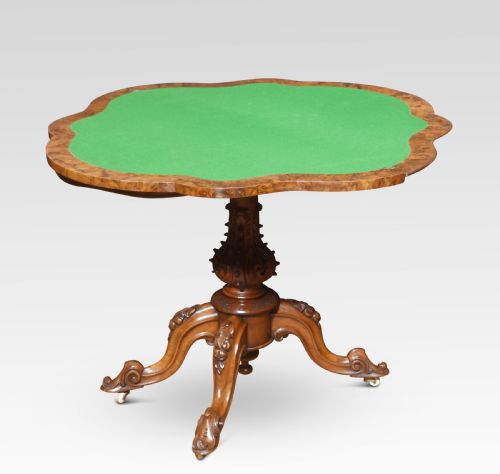
These rococo revival games table pieces are exuberant conversation pieces designed for parlour entertainment, offering rich veneers and serpentine forms.
Rococo Revival Games Table
A rococo revival games table combines the lively, asymmetric curves of eighteenth-century French design with nineteenth-century cabinet-making, creating practical furniture for card playing and social gatherings. These pieces usually feature fold-over tops that reveal lined playing surfaces when opened.
The versions most commonly met on this page belong to the Victorian era, spanning dates from eighteen-fifty to nineteen-twenty. They frequently appear in walnut, burr walnut, and rosewood, often shaped with serpentine edges and supported by carved cabriole legs.
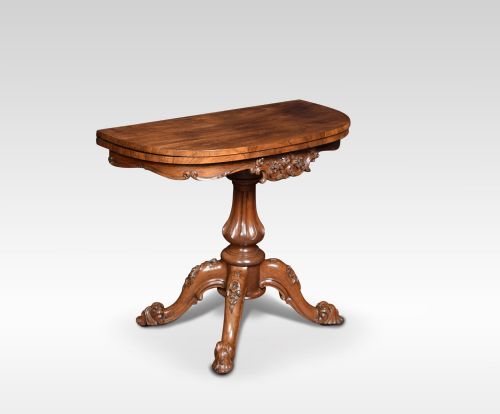
Makers and workshops of the period also produced tea tables and tea and card tables alongside dedicated games tables. The forms range from butterfly-shaped surfaces to demi-lune designs and pieces embellished with marquetry inlay.
Materials and construction
Cabinet-makers relied on figured timbers such as burr walnut, rosewood, and kingwood, laying choice veneers over solid foundational woods to create striking patterned surfaces. Marquetry inlay and brass or ormolu mounts frequently decorated the friezes and borders.
The structural carcass typically involved mahogany or walnut, shaped into serpentine outlines and butterfly contours. Folding mechanisms allowed the top to pivot and open flat, supported by clever pivoting frames or hinged legs.
Some butterfly-shaped card tables unfold with wings so enthusiastic they practically demand a hand of whist.
Distinctions in quality
The fineness of the burr walnut veneer and the precision of the marquetry inlay set superior examples apart from standard production. Artisans who selected exceptionally figured grain patterns and executed crisp carving on the cabriole legs produced tables of notable distinction.
The integrity of the pivoting mechanism and the neatness of the fold-over hinge work indicate the standard of workshop execution. Maker attribution, such as pieces bearing stamps by Edwards & Roberts or Maple & Co. of London, reflects workshop reputation.
Edwards & Roberts·Maple & Co.
The Rococo Revival Games Table Glossary
- Burr walnut
- A prized timber harvested from the gnarled growths of the walnut tree, showing swirling, highly decorative grain patterns.
- Marquetry inlay
- Decorative patterns formed by fitting small pieces of contrasting veneer into a prepared wooden surface.
- Ormolu
- Gilded bronze mounts and decorative ornaments applied to furniture framing and legs.
- Serpentine
- A curved line or edge that undulates with a convex centre flanked by concave curves.
- Demi-lune
- A half-moon shape characteristic of certain tea and card table tops.
Rococo Revival Games Table: Frequently Asked Questions
How do I open a games table?
Most tables feature a fold-over top that lifts and rotates on a central pivot to reveal a concealed compartment or a baize-lined playing surface. The supporting leg or frame swings out simultaneously to bear the weight of the open leaf.
Take care to lift the top cleanly before rotating, as older hinges and pivots can bind if forced at an incorrect angle.
Were these tables used for dining?
These tables were primarily designed for parlour games, card playing, and social tea service rather than formal family dining. The folding leaves provided a compact footprint when closed against a drawing room wall.
When opened for cards, the surface offered a stable space for counters and hands, while tea tables accommodated porcelain service.
How do I tell a tea table from a games table?
Tea tables and games tables share similar fold-over top constructions, but games tables frequently conceal specific compartments for cards and gaming pieces beneath the folded leaf. Tea tables often present simpler polished wooden surfaces tailored for serving vessels.
Inspect the interior compartments and lining materials to determine the intended function of the piece.
How do I date a Victorian walnut table?
Dating relies on examining the timber choice, construction techniques, and stylistic markers recorded across the nineteenth century. Pieces incorporating heavy burr walnut veneers and elaborate marquetry often point towards the middle and later decades of the era.
Maker stamps and specific revival styling clues further narrow the decade of manufacture.