



River Thames Watercolour
River thames watercolour paintings capture the enduring charm of capital and countryside scenes along the water through delicate pigments on paper.
River Thames Watercolour
A river thames watercolour brings together historic views of London landmarks, bridges, and quiet rural reaches upstream in a traditional medium. Buyers searching for a river thames watercolour will most frequently encounter works dating from the nineteenth and early twentieth centuries, spanning Victorian and Edwardian periods.
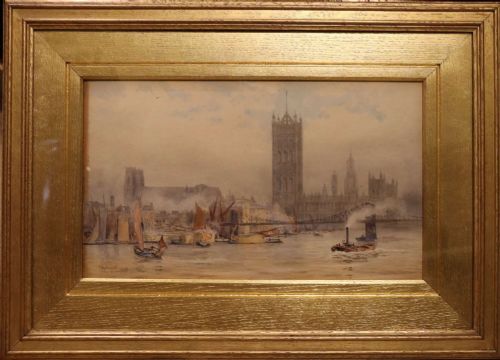
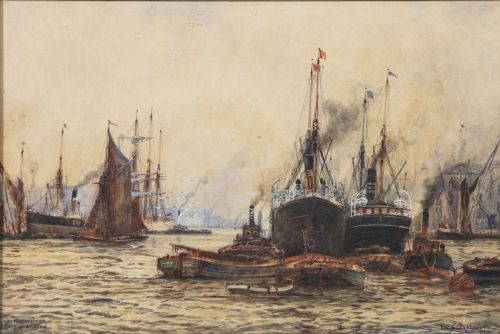
The subjects range widely from bustling maritime traffic in the Port of London and the Houses of Parliament to serene village backwaters near Windsor, Marlow, and Richmond. These paintings offer a direct window into the changing architecture and social life of the riverbanks over successive generations.
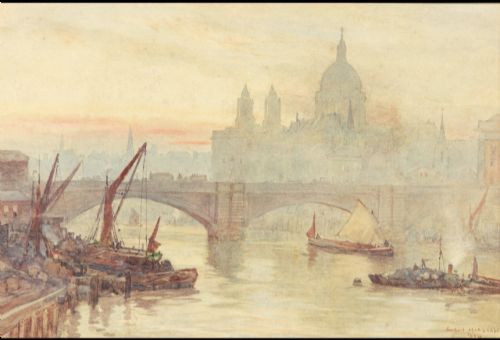
Most surviving examples are framed works on paper, often preserved behind glass with wooden mouldings that reflect the framing conventions of their era. Whether showing the monumental dome of St Paul's Cathedral or children fishing at dusk, each sheet records a specific topography observed by artists working plein air or within studio settings.
Materials and execution
The foundation of every piece is watercolour pigment applied to paper, occasionally supplemented with touches of ink or bodycolour to define crisp architectural details and shimmering light on the water. Artists relied on transparent washes to build up atmospheric effects of mist, smoke, and evening light across the London sky.
Supports typically consist of heavyweight rag or wove paper housed within traditional glass and wood frames to protect the delicate water-soluble pigments from moisture and dust. These physical components combine to preserve the immediacy of the original brushwork across more than a century.
Listings feature works executed on paper using watercolour pigment, spanning the Victorian and Edwardian eras alongside mid-century British views.
Judging quality and presence
Quality rests primarily on the sureness of the brushwork and the artist's command of light and atmospheric perspective across the river landscape. Stronger works demonstrate confident handling of reflections on the water and a balanced composition that anchors bustling urban architecture or quiet rural banks.
Condition also plays a vital role, as works retaining their original vibrancy and free from heavy fading or foxing command greater appreciation. The sensitivity with which the artist captures the distinctive atmospheric haze of the London reaches distinguishes a master hand from more routine topographical recording.
Frank William Scarbrough·Henry John Kinnaird·Robert Winchester Fraser·Frederick George Coleridge·Walter Duncan·William Alister Macdonald
The River Thames Watercolour Glossary
- Watercolour pigment
- Finely ground colour particles suspended in a water-soluble binder, forming the primary medium for these river scenes.
- Topographical
- Representing specific real-world locations with a focus on accurate architectural and geographical detail.
- Eyot
- A small island situated in a river, frequently featured in rural stretches of the Thames landscape.
- Bodycolour
- Watercolour paint mixed with a white pigment to render it opaque, used for highlights and dense cloud formations.
- Foxing
- Small brownish spots caused by chemical reactions in older paper over time, often found in nineteenth-century sheets.
River Thames Watercolour: Frequently Asked Questions
How should I hang my watercolour?
Keep watercolours away from direct sunlight to prevent the delicate pigments from fading over time. Position them on interior walls where room temperature and humidity remain relatively stable.
Ensure the frame is properly sealed behind glass to protect the paper from dust and atmospheric pollution. Professional conservation framing with UV-filtering glass offers the best long-term preservation.
Are these paintings signed by the artist?
Many works bear the artist's signature or initials, often inscribed discreetly in the lower corner within the painted composition. Signatures provide a direct link to the hand of the creator and help establish provenance.
Unsigned watercolours frequently rely on stylistic attribution, period framing labels, or inscriptions on the reverse of the paper to identify the maker and subject location.
What subjects are most common?
Urban views featuring London bridges, the Houses of Parliament, and St Paul's Cathedral form a large group among these river scenes. These compositions capture the bustling commercial traffic and atmospheric smoke of the capital.
Upstream views focusing on locks, bridges, and rural villages around Richmond, Windsor, and Marlow offer a contrasting pastoral charm. Both urban and rural subjects reflect the enduring nineteenth and early twentieth-century fascination with the Thames.
How do I date a nineteenth-century painting?
Dating relies on a combination of visible architectural landmarks, artist working dates, and physical characteristics of the paper and framing. Changes in London's skyline, such as the construction dates of specific bridges, provide reliable chronological markers.
Examine any inscriptions on the reverse of the mount or stretcher bars, which frequently record the exact year, exhibition history, or title of the work.